
Voices from the Canopy: Indigenous Women of Papua Demand Sovereignty Amidst Land Crisis
By Editorial Staff
For the Indigenous women of Papua, the forest is not a commodity, a resource map, or a site for industrial extraction. It is the cradle of life—a repository of medicinal plants, ancestral knowledge, cultural identity, and the very foundation upon which the future of their children is built. However, as the march of industrial development encroaches deeper into the Papuan wilderness, these women are sounding a global alarm: when the forest falls, the entire infrastructure of their existence collapses with it.
This sentiment served as the emotional and moral heartbeat of the PAPEDA Summit 2026, held in Sorong, Southwest Papua. The forum, which gathered a diverse coalition of government officials, Indigenous leaders, civil society organizations, academics, and youth activists, sought to chart a path for sustainable development in the Tanah Papua region. Yet, beneath the formal rhetoric of sustainability, the summit revealed a deep-seated chasm between policy promises and the lived realities of the Indigenous people.
The Crisis of Ownership: The Moi Struggle
At the center of the debate was the testimony of Barbalina Osok, Chairperson of Kwongke Kaban Salukh Moi of Southwest Papua. Her story is emblematic of the systematic disenfranchisement faced by the Moi people. Since the early 1990s, the Moi ancestral lands have been subjected to aggressive logging concessions, many of which have since been converted into sprawling palm oil plantations.
For over three decades, the forest—a source of sustenance passed down through generations—has been drained of its vitality. Osok noted that the benefits of these industrial operations rarely reach the traditional landowners. Worse, the shadow of these concessions looms large, with some permits slated to remain active until 2032 or 2033.
"The issue is not merely one of investment or economic arithmetic," Osok stated during a panel. "It is about the fundamental lack of agency. We are not consulted on how our own soil, our own water, and our own heritage are exploited."
The Feminine Perspective on Land Tenure
Marlince Siep, a prominent Indigenous activist, provided a poignant perspective on how land loss disproportionately impacts the domestic and social spheres of Papuan life. In many Papuan societies, women are the primary stewards of food security and the keepers of traditional knowledge, bridging the gap between ancestral wisdom and the next generation.
"Land is Mother," Siep declared, her voice echoing in the conference hall. "To the government and the stakeholders, I ask: allow the remaining healthy forests to exist so they can be inherited by the next generation of Indigenous Papuan women."
Siep’s call to action was a critique of top-down developmentalism. She argued that the current model of "progress" is designed in Jakarta with little regard for the specific ecological and cultural nuances of Papua. She urged policymakers to center the voices of Indigenous communities, arguing that any development strategy that ignores the custodians of the land is inherently destined to fail.
Chronology of the Conflict
The tension between industrial expansion and Indigenous rights in Papua did not emerge overnight. It is a decades-long struggle characterized by three distinct phases:
- The Era of Extraction (1990s–2010s): During this period, the Indonesian government accelerated the granting of logging and plantation concessions across Papua, often bypassing the Free, Prior, and Informed Consent (FPIC) of local clans.
- The Regulatory Limbo (2010s–2020s): As awareness of Indigenous rights grew, a complex legal struggle ensued. While regulations regarding "Social Forestry" were introduced, the implementation remained sluggish. Millions of hectares were earmarked for conservation or social forestry, but the bureaucracy of mapping and legal verification kept most Indigenous communities in a state of limbo.
- The Modern Impasse (2026–Present): The PAPEDA Summit represents the current boiling point. While the government boasts of reaching 8.41 million hectares of social forestry out of a 12.7-million-hectare target, the reality on the ground is that only 12 Indigenous Law Communities (MHA) in Papua have achieved full legal recognition. Dozens of other claims remain trapped in a cycle of endless verification.
Official Responses and Administrative Hurdles
The government’s position remains caught between the drive for economic growth and the necessity of fulfilling constitutional mandates regarding Indigenous rights. Elisa Kambu, the Governor of Southwest Papua, expressed a commitment to resolving these conflicts.

"The provincial government is committed to facilitating the mapping of traditional territories," Kambu stated. He emphasized that accelerating the recognition of Indigenous forests is the only way to provide these communities with the legal standing required to fend off predatory corporate interests.
However, official data suggests that the pace of this recognition is insufficient. While the government points to the 8.41 million hectares of "social forestry" as a success, critics argue that these figures often mask the exclusion of Indigenous people from their own ancestral territories. The "social forestry" label is sometimes applied to lands that are already being managed by the state, rather than returning stolen lands to their rightful Indigenous custodians.
Implications: A Fragile Future
The implications of this struggle extend far beyond the borders of Papua. The Papuan rainforest is one of the world’s most critical carbon sinks. Its destruction is not just a human rights issue; it is a global environmental catastrophe.
Furthermore, the failure to secure land tenure creates a volatile social environment. This was made starkly clear on the final day of the PAPEDA Summit. The proceedings were interrupted by spontaneous protests outside the venue, as local residents and activists staged a demonstration against National Strategic Projects (PSN). The protesters held signs and chanted, demanding that the government prioritize the rights of the people over the requirements of capital. The summit, intended to be a platform for dialogue, ended in a premature dispersal—a visual metaphor for the ongoing friction between state agendas and community survival.
For the Indigenous communities of Papua, recognition of their territory is not an administrative box to be ticked. It is a matter of existential security. It dictates whether they can continue to harvest medicinal roots, whether they can sustain their unique cultural rituals, and whether their daughters will have a place to call home.
Towards a New Paradigm
The conclusion of the summit left observers with a sobering lesson: trust is earned through action, not words. The rhetoric of "sustainable development" is hollow if it is not backed by the formal, irreversible return of land rights to Indigenous clans.
The path forward requires a radical shift in how the Indonesian state perceives the Papuan landscape. Instead of viewing it as a frontier for extraction, the state must view it as a complex, living landscape managed by the world’s most effective conservationists—the Indigenous people themselves.
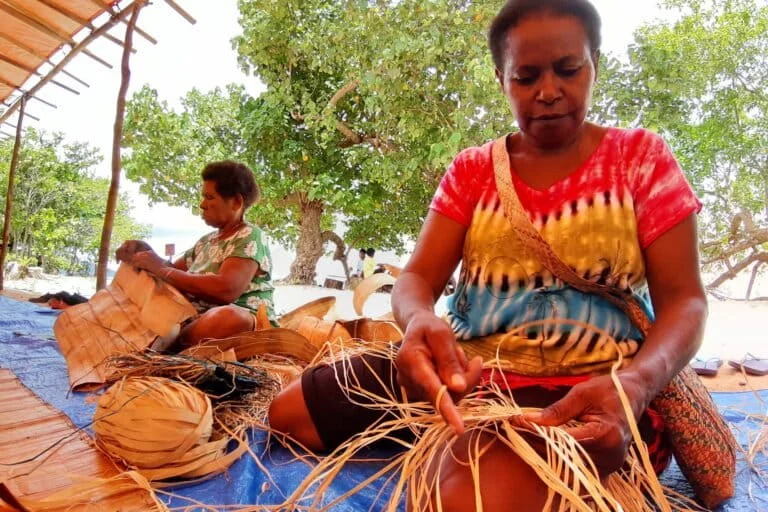
As the sun set over Sorong, the image of women from the Moi tribe skillfully weaving noken (traditional bags) from bark fiber served as a reminder of what is at stake. The noken is more than a craft; it is a symbol of endurance, a vessel that carries the history of a people who have survived despite being treated as obstacles to progress.
The success of future forums will not be measured by the number of participants or the eloquence of speeches. It will be measured in the hectares of forest returned to Indigenous control, the cessation of illegal concessions, and the restoration of a dignity that has been systematically eroded for over thirty years. Until then, the voices of Papuan women will continue to rise—not just from the halls of government, but from the very heart of the forests they are fighting to save.
Photography: The women of the Moi tribe, known for their craftsmanship, weave noken with the distinct Moi Kelim pattern made from bark fiber. Photo by Lusia Arumingtyas/Mongabay Indonesia.







