JAKARTA, INDONESIA — In the realm of literary arts and theatrical performance, few mediums possess the immediate emotional resonance of a drama. Whether experienced on a grand stage or through the screen of a television, a powerful theatrical performance requires more than just raw talent and charismatic acting; it demands a solid foundational blueprint—the text drama, or dramatic script.
Understanding the mechanics of a dramatic text is a fundamental milestone for students, aspiring playwrights, and theater enthusiasts alike. Far from being a simple collection of spoken lines, a dramatic text is a complex architectural framework designed to breathe life into human experiences, conflicts, and resolutions.
The Etymology and Evolution of Drama
To fully grasp the nature of a text drama, one must first trace the roots of the word "drama" itself. Originating from the ancient Greek term draomai, drama translates directly to "to do," "to act," "to commit," or "to take action." Consequently, drama fundamentally represents action, deeds, and physical manifestation translated into a narrative format.
According to standard lexicographical definitions, a drama is a storytelling medium that relies heavily on dialogue and character action to convey a narrative driven by conflict. When transformed into a text drama, it becomes the written script used by actors, directors, and production crews. This text provides the structural flow, character blueprints, stage directions, and thematic elements necessary to bring a staged performance to life.
Anatomy of a Performance: The Structure of a Dramatic Text
A well-constructed dramatic text is not written arbitrarily; it follows a strict architectural framework. Literary theorists generally divide the structure of a text drama into three primary components:
Prolog (Prologue): Serving as the gateway to the performance, the prologue is an introductory section delivered by a narrator or a specific character. It establishes the foundational context, sets the mood, and prepares the audience for the events that will unfold.
Dialog (Dialogue): The core of any dramatic text, dialogue represents the verbal exchanges between two or more characters. Through these conversations, the plot advances, characters reveal their inner motivations, and the underlying themes are articulated.
Epilog (Epilogue): Positioned at the conclusion of the performance, the epilogue acts as a closing statement. It frequently delivers a final summary, reinforces the central moral lesson, or provides closure to the fates of the characters.
Deconstructing the Elements: Intrinsic and Extrinsic Factors
Analyzing a dramatic text requires a two-pronged approach, examining both the internal mechanics of the story and the external influences that shaped its creation.
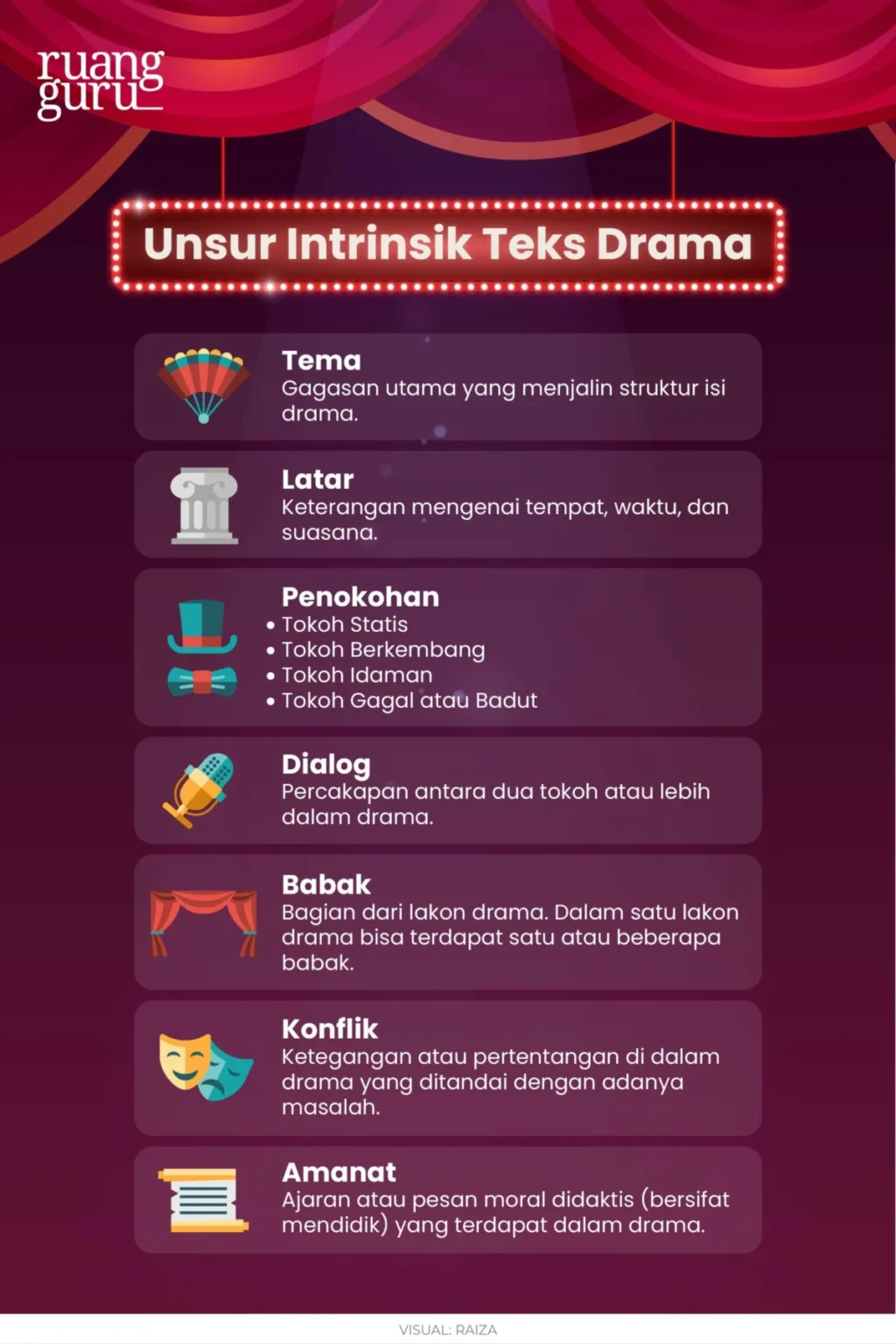
1. Intrinsic Elements (Internal Components)
Intrinsic elements are the foundational building blocks embedded directly within the text drama itself:
Theme: The overarching ideological core or main idea that steers the narrative (e.g., nationalism, humanism, unconditional love, or betrayal).
Setting (Latar): The contextual framework detailing the time, physical location, and atmospheric conditions of the scenes.
Characters (Tokoh): The individuals driving the narrative who embody specific traits and carry the responsibility of conveying the playwright’s message.
Characterization (Penokohan): The psychological and behavioral design of the characters, typically categorized into protagonists (heroes/main figures), antagonists (opposing forces), and tritagonists (supporting figures).
Conflict: The tension or struggle arising from opposing forces, which serves as the primary engine driving audience engagement and emotional investment.
Babak (Acts/Scenes): The macro-divisions of a theatrical play. Transitions between acts are visually signaled by falling curtains or dimmed stage lighting, allowing the production to shift locations or temporal periods seamlessly.
Amanat (Moral Message): The concluding lesson, ethical takeaway, or educational philosophy embedded within the resolution of the drama.
2. Extrinsic Elements (External Influences)
While not printed directly in the dialogue, extrinsic elements profoundly shape the nature of a dramatic text:
Author’s Biography: The personal history, educational background, and societal upbringing of the playwright.
Philosophical Outlook: The author’s personal worldview, core beliefs, and ethical stances that naturally bleed into the narrative themes.
Socio-Cultural Context: The prevailing societal norms, political climates, and cultural movements of the era in which the text was written, serving as direct inspiration for the author’s commentary.
Masterpieces of the Stage: Notable Indonesian and World Dramas
To understand the practical application of these dramatic elements, literary scholars often examine classic works from both Indonesian and international playwrights:
Landmark Indonesian Dramas
Kisah Perjuangan Suku Naga by W.S. Rendra: A poignant social critique addressing the friction between traditional cultural preservation and aggressive industrial modernization.
Aduh by Putu Wijaya: An absurdist masterpiece utilizing dark humor to skewer contemporary sociopolitical dynamics.
Kapai-Kapai by Arifin C. Noer: A deeply symbolic, surrealist exploration into the fundamental human quest for the meaning of life.
Marsinah: Nyanyian dari Bawah Tanah by Ratna Sarumpaet: A hard-hitting historical drama dramatizing the tragic martyrdom of a labor activist fighting for workers’ rights.
Tamu-Tamu Bukit Ketok by Usmar Ismail: A classic realist drama exposing the systemic inequalities faced by marginalized rural communities.
Global Theatrical Masterpieces
Caligula by Albert Camus: An absurdist examination of absolute tyranny and the psychological quest for radical freedom.
Hamlet by William Shakespeare: The quintessential tragedy dealing with existential doubt, betrayal, and the heavy burden of vengeance.
The Cherry Orchard by Anton Chekhov: A profound Russian realist text depicting social upheaval through the loss of a noble family’s ancestral estate.
Waiting for Godot by Samuel Beckett: A foundational Theatre of the Absurd text focusing on two vagrants engaged in endless dialogue while awaiting an elusive figure who never arrives.
Practical Application: Sample Dramatic Dialogue
To visualize how these elements coalesce into a functioning script, consider the following short dramatic excerpt focusing on interpersonal ambition and peer support:
Pursuing Dreams Characters: Adi and Anjas (childhood friends reunited after years apart)
Setting: A quiet park bench in the late afternoon.
Anjas: "Adi, where are you planning to pursue your higher education?" Adi: "I’m aiming for the Merchant Marine Polytechnic (PIP)." Anjas: "What major are you planning to take?" Adi: "Navigation. I want to become a ship captain, haha! But…" Anjas: "Is something wrong?" Adi: "I’ve always struggled quite a bit with physics." Anjas: "Don’t let that discourage you. If you apply yourself and study with greater dedication, you can overcome it. Keep pushing forward and never surrender your ambitions. Just remember to back up your hard work with steadfast prayer." Adi: "Thank you for the encouragement, Anjas. I will certainly redouble my study efforts." Anjas: "That’s the spirit!"
Through this simple exchange, the text successfully establishes character dynamics, introduces internal conflict (academic insecurity), and delivers a motivational resolution fitting the play’s thematic core.
Educational Implications and Modern Learning Tools
As educational standards in literature evolve, mastering the components of text drama equips students with critical analytical skills, empathy through character study, and enhanced public speaking capabilities. Educational institutions across Indonesia, following national curriculum guidelines (such as those outlined by Kemendikbud), continue to prioritize dramatic arts as a multidisciplinary tool for cognitive development.
For students seeking personalized academic support in mastering Indonesian literature and dramatic theory, specialized tutoring services—such as Ruangguru Privat—offer customized lesson planning. Additionally, modern adaptive learning ecosystems like ADAPTO provide dynamic, animated video lessons tailored to individual learning paces, ensuring that complex literary concepts remain accessible to the next generation of storytellers and scholars.



.jpg)
.jpg)