Tragedy in the Highlands: Toraja Travel Driver Killed and Burned After Armed Group Interception in Papua Pegunungan
JAKARTA — The routine journey of a civilian travel driver turned into a horrific nightmare in the rugged highlands of Papua Pegunungan. Aris Sanda, widely known to his family, friends, and passengers as Bapak Tasya—a native of Toraja making an honest living in Indonesia’s easternmost provinces—met a tragic end after his vehicle was ambushed by an armed separatist faction along the remote Wamena-Mbua route in Jayawijaya Regency.
What began as a standard transport run delivering passengers and essential logistics to the interior ended in bloodshed, hostage-taking, and arson. Aris’s remains were eventually discovered inside his charred vehicle near the picturesque yet isolated Lake Habema, sending shockwaves across the region and prompting renewed national discourse regarding the fragile security landscape for civilian workers in Papua.
Main Facts of the Incident
The core details of the incident paint a grim picture of escalating violence targeting civilian infrastructure and transport workers in Papua Pegunungan:
- The Victim: Aris Sanda (Bapak Tasya), a Toraja-born inter-city "lajuran" (public transport/travel) driver working in the rugged terrains of Jayawijaya and surrounding regencies.
- The Location: The ambush occurred near the Lake Habema intersection at Gunung Boy, Trikora District, Jayawijaya Regency, Papua Pegunungan. The final resting place of the victim and his vehicle was further up in the Lake Habema region.
- Timeline of Key Events: The interception took place on Tuesday, September 15, around 06:00 WIT. Following a brief period of captivity, his body and burned vehicle were located the following day, Wednesday, September 16, after extensive sweeps by security forces.
- Perpetrators: Security apparatus, including the Indonesian National Armed Forces (TNI), have attributed the attack to armed criminal groups (KKB) linked to the West Papua National Liberation Army (TPNPB-OPM), specifically factions associated with Kodap III Ndugama.
- Immediate Aftermath: The victim’s remains were recovered, subjected to forensic processing at Wamena Regional General Hospital (RSUD Wamena), and subsequently repatriated to Makassar for burial in his hometown in Toraja. Joint security forces have launched intensive investigations and manhunts.
Chronology of Events: From Routine Transit to Brutal Execution
The unfolding of the tragedy followed a chilling sequence of events, documented through military reports, eyewitness accounts from surviving passengers, and circulating digital media.
The Ambush at Gunung Boy
On Tuesday, September 15, 2026, at approximately 06:00 WIT, Aris Sanda was operating his travel vehicle. He was ferrying a vehicle full of passengers along the vital overland route connecting Wamena, the economic hub of the Baliem Valley, to Mbua in the neighboring interior regency.
As the vehicle approached the intersection near Lake Habema in Gunung Boy, Trikora District, their path was abruptly blocked by a heavily armed group. According to statements released by the Head of Information for Koops TNI Habema, Lieutenant Colonel Inf. M. Wirya Arthadiguna, the armed faction immediately ordered the vehicle to a halt.
Separation of the Driver
Upon stopping, the armed group subjected the vehicle and its occupants to intense scrutiny. While the general passengers were interrogated, they were ultimately spared physical harm and ordered to turn back toward Wamena on foot or via alternative means.
However, the situation took a sinister turn for the driver. Aris Sanda was singled out and forcibly separated from his passengers. He was dragged away from the main transport route deeper into the desolate, high-altitude terrain surrounding Lake Habema.
Hostage-Taking and Propaganda Video
In the hours following his abduction, intelligence and digital trails indicated that Aris was held hostage by the armed faction. Disturbing digital evidence soon surfaced online in the form of a mobile video recording.
The footage showed Aris standing in the middle of a highland road, visibly distressed and surrounded by armed insurgents. In the video, the civilian driver was coerced into holding the banned Bintang Kejora (Morning Star) flag—the emblem of the Papuan separatist movement—and forced to read or deliver coerced statements regarding the political status of Papua.
Law enforcement and counter-terrorism cyber units immediately flagged the video, incorporating it into their formal forensic investigations to map out the exact timeline of coercion, psychological torture, and ultimate execution.
Discovery of the Charred Vehicle and Remains
By Wednesday, September 16, the military command center launched an aggressive search and rescue operation involving joint personnel from Koops TNI Habema. The initial stages of the search faced severe natural hurdles; thick mountain fog, freezing temperatures, and rugged topography hampered the visibility of the search teams scouring the high-altitude expanse of Lake Habema.
Hours into the operation, perseverance paid off, though the discovery yielded grim results. Search teams stumbled upon the skeletal frame of a completely burned-out vehicle matching the description of Aris’s transport van. Upon closer inspection, the remains of Aris Sanda were discovered inside the wreckage, having suffered extensive trauma from both the fire and suspected prior violence.
Supporting Data and Forensic Investigation
Following the recovery of the victim’s remains, the state apparatus moved swiftly to secure the crime scene and gather empirical evidence to build an airtight legal case.
- Crime Scene Investigation (TЗP): Joint investigators from the Indonesian National Police (Polri) and military personnel conducted a thorough processing of the crime scene (Olah TKP) around the Lake Habema intersection and the vehicle burn site. Ballistic evidence, material fragments, and personal belongings of the victim were cataloged.
- Medical Examination: The charred remains were transported under heavy guard to Wamena Regional General Hospital (RSUD Wamena) for post-mortem examinations. Forensic experts worked to determine the exact cause of death—analyzing whether Aris succumbed to gunshot wounds prior to the vehicle being set ablaze or if he was burned alive.
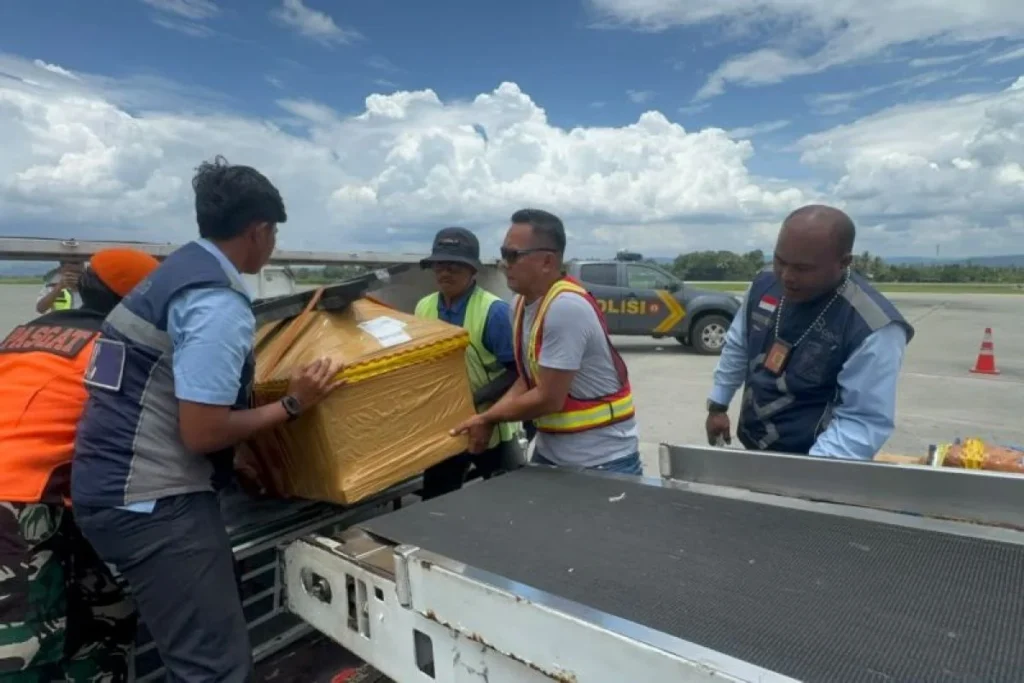
- Repatriation of the Body: Following preliminary medical clearances and identification protocols, arrangements were immediately expedited to fly Aris Sanda’s body out of Papua. On subsequent days, his coffin was flown to Makassar, South Sulawesi, before being transported overland to his native Toraja land for a sorrowful final homecoming and Christian burial surrounded by grieving relatives.
- The "Lajuran" Economy: Economic data from the region highlights the critical vulnerability of transport workers like Aris. Known locally as sopir lajuran, these drivers are the lifeblood of highland logistics. They brave dangerous mountain passes to ferry basic commodities, fuel, medical supplies, and civilian passengers between urban centers like Wamena and cut-off interior districts like Mbua, Nduga, and Ilaga.
Official Responses and Institutional Reactions
The brutal execution of an unarmed civilian driver drew swift, unified condemnation from state institutions, security chiefs, and legislative bodies, amplifying calls for a structural reassessment of security in conflict-prone zones.
Military and Police Position
The Indonesian National Armed Forces (TNI) and the National Police have firmly labeled the incident an act of terrorism committed by criminal separatist elements. Lieutenant Colonel M. Wirya Arthadiguna emphasized that targeting civilian transportation workers who provide essential services to local communities exposes the hypocrisy and brutality of armed rebel factions who claim to fight for the local populace while destroying its working class.
Security forces have intensified operational patrols along the Wamena-Mbua corridor, pursuing the specific members of the TPNPB-OPM Kodap III Ndugama believed to have orchestrated the ambush.
Legislative Outcry: House of Representatives (DPR RI)
Members of the national parliament expressed deep outrage over the incident. Commission I of the DPR RI issued a strong statement declaring that the continuous targeting of civilian drivers, teachers, medical workers, and infrastructure builders in Papua represents an intolerable violation of basic human rights and a direct threat to the safety of ordinary citizens.
Lawmakers demanded that the state recalibrate its security strategies to ensure that vital economic arteries in the interior are heavily guarded, preventing isolated mountain roads from becoming death traps for civilian workers.
Regional Governance and DPD RI Inquiries
The Regional Representative Council (DPD RI), through its special legislative committees (Pansus), reiterated urgent calls for the central government to evaluate the holistic framework of conflict resolution in Papua.
Senators argued that ongoing kinetic military operations must be paired with aggressive infrastructural safety guarantees, economic protection for migrant and local workers alike, and enhanced intelligence networks to intercept armed groups before they can establish roadblocks on public highways.
Broader Implications for Civilian Security in Papua
The murder of Aris Sanda is not an isolated incident, but rather part of a disturbing pattern of violence that has plagued transport corridors in the Papuan highlands for years.
- Paralysis of Regional Logistics: When drivers refuse to travel out of fear for their lives, the economic arteries connecting urban centers to interior valleys dry up. This leads to artificial scarcity, skyrocketing prices for basic goods, and severe hardship for local Papuan communities who rely entirely on these transport services for food and medicine.
- Psychological Terror and Social Divisions: The use of forced propaganda videos—such as forcing the victim to hold separatist flags moments before his execution—is a deliberate psychological tactic meant to sow fear, polarize ethnic relations between indigenous populations and migrant workers (such as the Torajanese, Bugis, and Javanese communities), and project unchecked territorial dominance by armed factions.
- The Dilemma of Peace and Enforcement: The tragedy underscores the perpetual dilemma faced by Indonesian policymakers: balancing heavy-duty security enforcement to root out armed insurgencies with the imperative of protecting innocent civilian lives who are inevitably caught in the crossfire of asymmetric warfare.
As investigations continue and military manhunts push deeper into the Ndugama highlands, the memory of Aris Sanda—a hardworking father and driver simply trying to earn an honest living—stands as a stark reminder of the heavy human toll exacted by unresolved conflicts in the remote peripheries of the Indonesian archipelago.