President Prabowo Subianto Formally Inaugurates 204 New Military Units During 81st TNI Anniversary
JAKARTA — In a landmark move aimed at restructuring and modernizing the nation’s defense architecture, President Prabowo Subianto officially inaugurated 204 new military units across the Indonesian National Armed Forces (TNI). The historic inauguration took place during the grand parade commemorating the 81st Anniversary of the TNI at the PRIMA parade ground at the TNI Headquarters in Cilangkap, East Jakarta, on Monday.
The sweeping expansion encompasses all three branches of the military—the Indonesian Army (TNI AD), the Indonesian Navy (TNI AL), and the Indonesian Air Force (TNI AU). Designed to address modern geopolitical dynamics and secure the vast archipelagic expanse of the Republic of Indonesia, this structural upgrade represents one of the most comprehensive military expansions in recent Indonesian history.
Main Facts of the Expansion
The grand inauguration ceremony marked a critical milestone in Indonesia’s defense strategy. By pressing a ceremonial siren and witnessing a booming 21-gun artillery salute fired by the Field Artillery (Armed), President Prabowo formally brought 204 new operational units into active service.
The expansion is strategically tailored to enhance regional command structures, territorial development, and rapid-response capabilities. The overarching breakdown of the 204 newly established units highlights a heavy emphasis on territorial management and mobility:
- Indonesian Army (TNI AD): Received the bulk of the new structures, highlighted by six brand-new Military Area Commands (Kodam), 30 Territorial Development Infantry Brigades, 150 Territorial Development Infantry Battalions, and three Combat Support Battalions (consisting of one cavalry battalion, one field artillery battalion, and one air defense artillery battalion).
- Indonesian Navy (TNI AL): Strengthened its amphibious and maritime projection power with the addition of one Marine Infantry Brigade and four Marine Infantry Battalions.
- Indonesian Air Force (TNI AU): Enhanced its aerial defense, paratrooper mobility, and surveillance networks through the establishment of the Kopasgat 2nd Parako Division, a Parako Brigade, three Parako Battalions, two Air Force Air Squadrons, two Air Force Radar Units, and one Air Force Education Squadron.
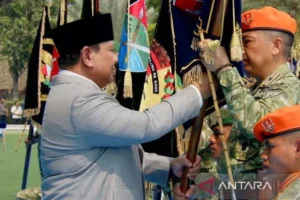
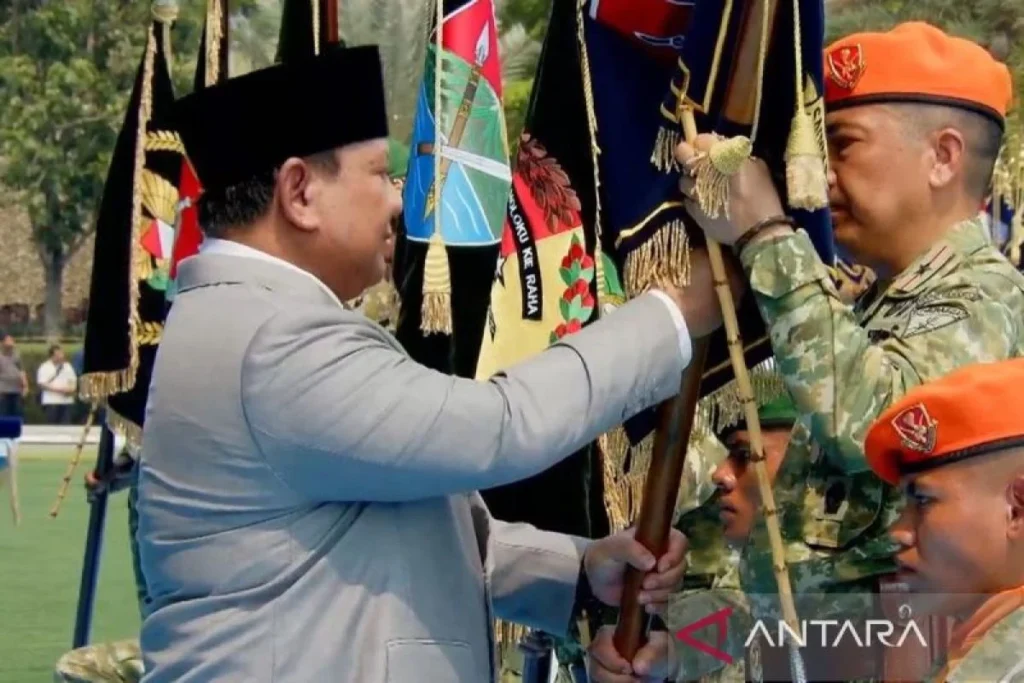
During the ceremony, President Prabowo also symbolically inaugurated the leaders of these newly formed units, handing over command batons and unit flags to the newly appointed regional commanders and handing unit emblems to seven selected organizational representatives.
Chronology of the 81st TNI Anniversary Ceremony
The morning proceedings began with meticulous precision, drawing thousands of spectators, dignitaries, and military personnel to the heart of the TNI Headquarters.
- Arrival and Inspection: President Prabowo Subianto arrived at the venue dressed in formal attire, accompanied by high-ranking state officials and military top brass. He immediately proceeded to inspect the troops, riding in an open-top tactical vehicle past thousands of assembled service members.
- Parade and Trooping the Color: A total of 3,378 personnel drawn from the three primary branches of the armed forces—alongside contingents of the Reserve Component (Komcad) and youth scouting organizations (Kowarcab/Pramuka)—participated in a flawless display of military discipline and pageantry.
- The Presidential Proclamation: At the podium, President Prabowo delivered his official address, culminating in the formal decree establishing the units. "With the utterance of ‘Bismillah-ir-Rahman-ir-Rahim,’ this morning, Monday, October 5, 2026, by the grace of Almighty God, I, Prabowo Subianto, President of the Republic of Indonesia, hereby inaugurate 204 new TNI units," declared the President to a thunderous applause.
- Symbolic Rites and Leadership Handover: Following the press of the siren button and the echoing cannon fire, President Prabowo formally swore in and invested the six new Kodam commanders. This ritualistic transfer of power emphasized the gravity of territorial defense leadership.
- Cultural Displays and Modern Capability Demonstrations: The formal protocol was followed by dynamic capability demonstrations, showcasing the integration of newly acquired defense hardware, tactical interoperability, and traditional arts, underlining the bond between the military and the civilian populace.
Comprehensive Supporting Data: Breakdown of the 204 Units
To fully appreciate the scope of the restructuring, a granular look at the distribution of the 204 units reveals the government’s strategic vision for national security. The modernization focuses heavily on expanding the footprint of the armed forces in underdeveloped or rapidly growing regions, ensuring that command and control lines are shortened and response times are slashed.
1. Indonesian Army (TNI AD) Restructuring
The Army remains the largest recipient of the structural expansion, reflecting its pivotal role in territorial integrity, border security, and internal stability.
- Regional Commands: Establishment of six new Military Area Commands (Kodam), significantly widening the operational reach of the Army across strategic provinces.
- Territorial Infantry Brigades: 30 new Territorial Development Infantry Brigades were formed. These brigades are uniquely tasked with fostering regional development, community engagement, and rapid deployment in times of crisis.
- Territorial Infantry Battalions: 150 new battalions have been peppered across various strategic districts to reinforce security down to the grassroots level.
- Combat Support Units: To give teeth to the territorial expansion, three specialized combat support battalions were introduced:
- One Cavalry Battalion (Armored/Tank support).
- One Field Artillery Battalion (Medan).
- One Air Defense Artillery Battalion (Arhanud).
2. Indonesian Navy (TNI AL) Expansions
As an archipelago nation, Indonesia’s maritime defense is paramount. The Navy’s landing arm—the Marine Corps—received targeted reinforcements.
- One Marine Infantry Brigade added to the operational order of battle.
- Four Marine Infantry Battalions commissioned to bolster amphibious landing and coastal defense capabilities.
3. Indonesian Air Force (TNI AU) Enhancements
Air dominance and rapid airborne insertion capabilities saw a major qualitative leap with the restructuring of the Air Force’s special forces (Pasgat) and surveillance apparatus.
- Kopasgat Expansion: The creation of the 2nd Parako Division (Commando/Parachute Forces) along with an overarching Parako Brigade and three dedicated Parako Battalions.
- Air Operations: Two new Air Squadrons equipped to handle transport, tactical support, or strategic missions.
- Early Warning and Surveillance: Two brand-new Air Force Radar Units to plug blind spots in Indonesia’s aerial radar coverage.
- Training Infrastructure: One specialized Air Force Education Squadron to train the next generation of aviators and tactical specialists.
Official Responses and Presidential Directives
Speaking before the amassed troops and the Indonesian public, President Prabowo used the 81st anniversary platform to reiterate his administration’s philosophy regarding civil-military relations and national duty.
"The honor of the nation and the welfare of the people rest squarely on the shoulders of the TNI," Prabowo stated firmly during his national address.
The President strongly emphasized that despite the modernization of hardware and the expansion of administrative structures, the armed forces must never lose touch with their historical roots. He underscored that the TNI is, first and foremost, an army born from the people, fighting for the people, and inextricably bound to the welfare of the general populace.
"The TNI must always remain a people’s army, staying close to the people, protecting the people, and serving as the ultimate shield for the sovereignty of the Republic of Indonesia," he added.
Military analysts and government officials present at the ceremony echoed these sentiments, noting that the expansion is not merely an exercise in bureaucratic enlargement, but a necessary adaptation to modern asymmetric threats, transnational crime, and natural disaster management.
Strategic Implications for National Defense
The activation of these 204 units carries profound strategic, operational, and sociopolitical implications for Indonesia:
1. Decentralized Defense and Deterrence
By establishing six new Kodam commands and dozens of territorial battalions, Indonesia is decentralizing its defense posture. In a nation spanning over 17,000 islands, centralized rapid-response forces are often too far away to react immediately to localized threats or natural calamities. The new units ensure that military command nodes are closer to potential flashpoints, thereby bolstering credible deterrence.
2. Dual-Purpose Function: Security and Development
The naming of "Territorial Development Infantry Brigades and Battalions" highlights Indonesia’s unique socio-military doctrine. These units are designed to cooperate with local governments, aid in infrastructure development in remote areas, and spearhead disaster relief operations. Given Indonesia’s susceptibility to earthquakes, volcanic eruptions, and extreme weather, having embedded military units trained in community recovery will drastically improve national resilience.
3. Modernization and Interoperability
The inclusion of specialized units—such as advanced radar squadrons, air defense artillery, and marine brigades—signals a shift toward a more balanced, multi-domain warfare capability. As regional tensions in the Indo-Pacific rise, Indonesia’s ability to project power, secure its air-sea corridors (ALKI), and coordinate joint operations between the Army, Navy, and Air Force becomes increasingly critical.
4. Economic and Logistical Challenges
While the strategic advantages are clear, military experts have pointed out the immense logistical and budgetary requirements needed to sustain 204 new units. Equipping these battalions with modern weaponry, communication gear, housing, and administrative infrastructure will require sustained fiscal commitment from the central government over successive fiscal years.
Conclusion
The 81st Anniversary of the TNI will be remembered in modern Indonesian history as the day the nation fundamentally restructured its defense architecture. Under the stewardship of President Prabowo Subianto, the activation of 204 new military units bridges the gap between traditional territorial defense and modern multi-domain operational readiness. As these units unfurl their flags and take up their posts from Sabang to Merauke, the Indonesian National Armed Forces embark on a new chapter defined by regional vigilance, people-centric service, and unyielding national sovereignty.