
The Sleeping Giants: Why Kikai and Toba Are Reminding Us That Silence Isn’t Extinction
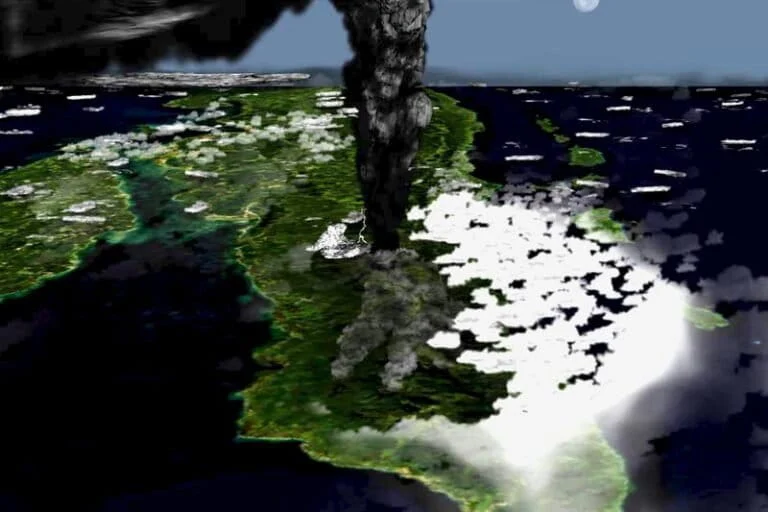
Deep beneath the sapphire waters of the Ryukyu Islands in Japan lies a silent titan. Kikai, a colossal underwater supervolcano, has long been regarded as a relic of a violent past—a memory of a cataclysmic eruption 7,300 years ago that reshaped the Japanese archipelago and sent megatsunamis crashing against its southern shores. Yet, a recent awakening on May 17, 2026, has shattered the illusion of its dormancy. By spewing gas and ash 400 meters into the atmosphere, Kikai has signaled to the scientific community that a supervolcano’s rest is not a permanent state, but rather a deceptive pause in a much longer, more dangerous cycle.
This revelation, bolstered by a groundbreaking study published in Communications Earth & Environment in March 2026, forces a global reassessment of how we monitor and perceive the world’s most dangerous volcanic systems, including the Yellowstone caldera in the United States and the legendary Toba in North Sumatra, Indonesia.
The Anatomy of an Awakening: The Kikai Discovery
The 7,300-year-old Kikai-Akahoya eruption was a geological event of near-apocalyptic scale. It obliterated the surrounding landscape, blanketed Japan in ash, and reached as far as the Korean Peninsula. In its wake, it left a massive caldera measuring 20 by 17 kilometers. For millennia, the volcanic dome at its center—submerged 600 meters deep—appeared to be a stagnant monolith.
However, the 2026 research team utilized a sophisticated technique known as deep-sea refraction seismic surveying to peer beneath the ocean floor. Unlike traditional land-based seismology or geochemistry, which often fail to detect deep-seated magma movement, this method measures the velocity of seismic waves as they travel through the crust. The results were startling: the reservoir responsible for the prehistoric cataclysm is far from empty.
The study introduced the "melt re-injection" model. This theory posits that new, molten magma is naturally infiltrating the existing reservoir at shallow depths. This process acts as a slow-motion fuel pump, recharging the chamber that once triggered the Kikai-Akahoya catastrophe. The recent minor eruption serves as a poignant reminder that even after thousands of years of silence, the "plumbing" of a supervolcano remains connected to the Earth’s mantle.
Chronology of a Cataclysm: From Kikai to Toba
To understand the scale of the threat, one must look at the historical timeline of these systems. While Kikai’s history is etched into the seafloor of the East China Sea, the record of Lake Toba in Indonesia provides an even more sobering lesson in planetary impact.
- 74,000 Years Ago: The Toba super-eruption occurs, ejecting an estimated 5,300 cubic kilometers of material. This event created a 3,000-square-kilometer caldera, now home to the serene waters of Lake Toba.
- 7,300 Years Ago: The Kikai-Akahoya eruption occurs, devastating Southern Japan and marking the last major activity of the Kikai system before the modern era.
- 1.6 Million Years Ago to Present: Toba has experienced at least four massive eruptions. Geological evidence suggests that after each collapse, the magma system underwent significant changes, migrating laterally and evolving in composition.
- March 2026: A study in Communications Earth & Environment formalizes the "melt re-injection" model, proving that Kikai is actively recharging.
- May 17, 2026: Kikai displays visible activity, venting ash and gas, confirming the predictions of the new model.
The Toba Connection: A Persistent Threat
The findings at Kikai have direct, urgent implications for the study of the Toba caldera. Toba is not merely a tourist destination; it is a live, complex volcanic system. Geologically, its reservoir sits at a depth of approximately 5 to 11 kilometers, roughly mirroring the depth of the chamber beneath the Kikai caldera.
Research into Toba’s thermal history indicates that its previous super-eruptions were the result of a gradual "thermal maturation" of the magma reservoir. With a steady magma supply rate estimated at 0.008 to 0.01 cubic kilometers per year, the system is consistently building pressure. Scientists estimate that the volume of magma currently capable of triggering an eruption exceeds 315 cubic kilometers.
Unlike typical stratovolcanoes that provide clear warnings, Toba’s history suggests that super-eruptions are notoriously difficult to predict. The standard precursor signals—such as significant seismic swarms, ground deformation, or drastic changes in gas composition—are not always present before a catastrophic event. This leads to the terrifying possibility that a supervolcano could reach a tipping point with minimal surface-level agitation.
Official Scientific Consensus and Methodological Shifts
The global scientific community, led by institutions focusing on volcanology and geophysics, is now calling for a shift in monitoring protocols. The consensus is that relying on surface-level data is insufficient for systems of this magnitude.
"We have been looking for the wrong signs," noted one lead researcher during a conference following the publication of the 2026 study. "If melt re-injection is a standard feature of caldera systems, we must prioritize deep-crustal seismic velocity monitoring over superficial indicators."
The international volcanological community is currently advocating for:
- Deployment of permanent ocean-bottom seismometers (OBS): To monitor the velocity of waves through magma chambers in real-time, particularly in high-risk zones like the Ryukyu arc.
- Long-term thermal tracking: Using satellite-based gravity measurements to detect mass changes beneath the caldera floor, which could indicate magma accumulation.
- Cross-system comparisons: Applying the data from Kikai to better understand the recharge rates of Yellowstone and Toba, creating a global repository of "melt-recharge" behaviors.
Implications: The Future of Volcanic Risk Assessment
The discovery that Kikai is "recharging" rather than "dying" transforms our understanding of volcanic life cycles. It suggests that the interval between super-eruptions is not a period of cooling, but a period of subterranean construction.
The Human and Climate Cost
The potential impact of another Toba-scale eruption is difficult to quantify but would be global in scope. The 74,000-year-old event is linked to a significant drop in global temperatures, with some studies suggesting a decline of three to five degrees Celsius for several years, leading to widespread crop failure and ecosystem collapse. While such events are rare, the economic and social vulnerability of modern civilization to such climate fluctuations is exponentially higher than it was during the Pleistocene.
Moving Toward Proactive Monitoring
The transition from reactive to proactive monitoring is the greatest challenge facing geologists today. If Toba, Yellowstone, and Kikai are indeed systems that can "recharge" quietly for millennia, the current reliance on short-term monitoring—often spanning only a few decades—is woefully inadequate.
Scientists are now pushing for multi-decadal observation programs. The goal is to establish a "baseline" for these supervolcanoes that includes the rate of melt re-injection. By knowing exactly how much magma enters the reservoir annually, researchers hope to calculate a "saturation point" that would allow for better risk forecasting.
Conclusion: A Call for Vigilance
The events at Kikai have provided a rare, high-stakes wake-up call. We now know that the world’s most dangerous volcanoes do not simply fade away; they simmer, they pulse, and they prepare. The silence of a caldera is not the silence of a grave, but the silence of a battery being charged.
As we look toward the future, the integration of deep-sea seismic technology and the adoption of the melt re-injection model will be vital. While we cannot stop these geological giants, our ability to understand them—and to recognize the subtle signs of their reawakening—may be the difference between a disaster and a managed crisis. The Earth remains a dynamic, living planet, and in the case of Kikai and Toba, it is clear that the most dangerous giants are the ones that have learned how to sleep with one eye open.







