
The Silent Guardians of Mount Slamet: Preserving the Mystical Ecosystem of Telaga Ranjeng
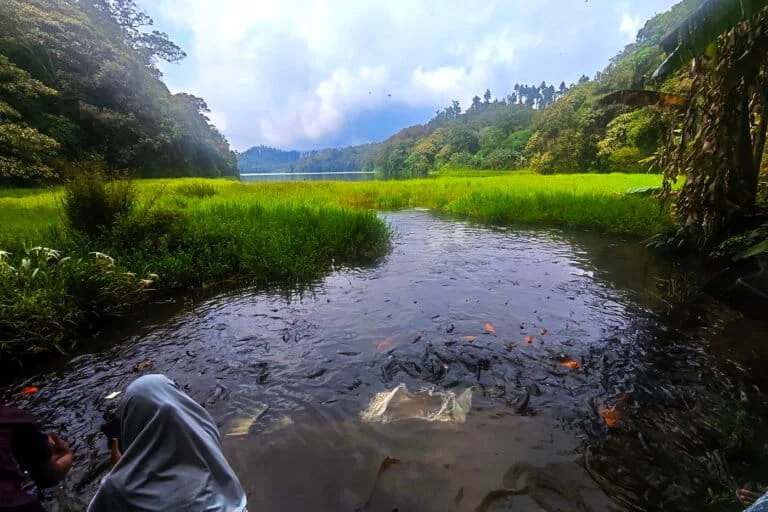
High on the western slopes of Mount Slamet, shrouded in the cool, swirling mists of Central Java, lies a sanctuary where nature and folklore exist in a delicate, symbiotic embrace. Telaga Ranjeng, a serene lake situated at an elevation of 1,600 meters above sea level in the village of Pandansari, Brebes, is more than just a scenic destination. It is a living testament to the power of indigenous conservation—a place where the rules of the modern world yield to the ancient, unspoken laws of the land.
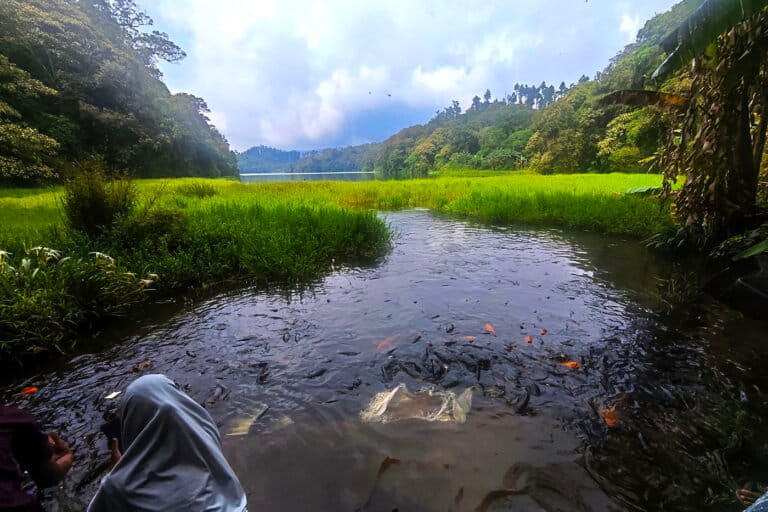
In this secluded enclave, thousands of golden carp and oversized catfish glide through the crystal-clear waters, completely unafraid of the humans watching them from the banks. This peaceful coexistence is not a coincidence; it is the result of centuries of ancestral taboos that forbid the harming of any living creature within the lake’s boundaries.
The Sanctity of the Waters: A Living Tradition
For the residents of Pandansari, the fish in Telaga Ranjeng are not merely aquatic life; they are regarded as sacred guardians of the water. This belief system, passed down through generations, holds that the lake is a protected realm. Any attempt to disturb, catch, or harm the fish is believed to invite misfortune upon the perpetrator and the community at large.
"Telaga Ranjeng is famous for its catfish, which are strictly off-limits," explains Afan Maulana, a visitor from the nearby regency of Banyumas. "You are allowed to observe them, to marvel at their size and their density, but you may never take them. It is a line that no one here dares to cross."
This cultural prohibition acts as a self-regulating mechanism. In a world where overfishing and habitat degradation are rampant, the community of Pandansari has maintained a pristine ecosystem through the simple, unwavering enforcement of local wisdom. Sirin, a local resident, emphasizes the village’s commitment: "The community here remains vigilant. We protect these fish as part of our duty to the land."
A Chronicle of Conservation: Resilience Through Time
The preservation of Telaga Ranjeng is not static; it is a dynamic process that has weathered the passage of time and environmental shifts. Jamal, a dedicated caretaker who has guarded the lake for the past 15 years, provides a unique perspective on the lake’s health.
During his tenure, Jamal has observed the natural cycles of the lake. He notes that the population of carp and catfish does not always appear in unison. There have been periods, such as between 2017 and 2019, when the surface of the lake seemed devoid of fish. To the uninitiated, this might suggest a collapse in the ecosystem or the extinction of the species. However, Jamal remains calm, viewing these fluctuations as natural behavior rather than a conservation crisis.
"Sometimes, the catfish simply vanish from sight for a long period," Jamal explains. "But they are not extinct. They retreat into the depths or move to quieter parts of the lake. We have learned that absence on the surface is not an indicator of absence in the water." True to his word, following the 2017-2019 period, the fish returned in abundance, once again congregating at the edges to greet visitors. This cycle of presence and absence serves as a reminder of the lake’s autonomy; it is a wild place that dictates its own terms.
Scientific Validation of Indigenous Wisdom
While the prohibition against fishing is rooted in myth and tradition, modern science has validated its effectiveness. A study conducted by researchers Nugraha and Novianto from the Universitas PGRI Yogyakarta suggests that these myths function as a sophisticated form of "non-formal conservation."
The researchers argue that the myth provides a psychological and social barrier that is often more effective than government-mandated regulations. By imbuing the act of conservation with spiritual significance, the community ensures that the rules are followed instinctively by every member, from the youngest child to the oldest elder. "Local wisdom will persist and thrive as long as the process of instilling these noble values continues within the community," the researchers noted in their findings.
The lake, which spans 53.41 hectares of protected forest reserve, serves as a vital laboratory for environmental science. Ilmi Budi Martani, Head of the Conservation Section for Region II Pemalang at the Natural Resources Conservation Agency (BKSDA) of Central Java, views the community’s role as a cornerstone of the agency’s success.
"It is fascinating to see how the community’s inherent wisdom—the prohibition on fishing—dovetails perfectly with our official conservation efforts," Martani states. "They are our greatest allies. Because of this, Telaga Ranjeng has become a significant site for both scientific research and public education."
The Lifeblood of the Highlands: Beyond the Fish
The significance of Telaga Ranjeng extends far beyond the fish that inhabit it. According to research conducted by Prameswari and Sudarmono from the National Research and Innovation Agency (BRIN), the lake is a critical water catchment area. It acts as a natural reservoir for rainwater and groundwater, which in turn sustains the surrounding agricultural landscape and provides a source of clean drinking water for the villagers below.
The ecological health of the lake is tethered to the diversity of the surrounding forest. Scientific surveys of the area have identified key botanical species such as Brucea javanica, Antidesma tetrandrum, and Phoebe grandis. These plants play a vital role in maintaining soil stability and regulating the water cycle. By protecting the lake, the people of Pandansari are, by extension, protecting their own water security.
The relationship between the village and the lake is one of mutual dependency. The forest provides the water, the water sustains the forest and the fish, and the villagers provide the protection. It is a closed-loop system of stewardship that has remained functional for centuries.
Implications for Modern Conservation
The model seen at Telaga Ranjeng offers a compelling case study for environmental policymakers globally. As the world grapples with climate change and biodiversity loss, the reliance on top-down, punitive legal frameworks has often failed to yield long-term results. The success of the Pandansari community suggests that conservation is most effective when it is culturally embedded.
When an environmental protection policy is perceived as a "law imposed from above," it often leads to resentment and illicit activities. Conversely, when it is framed as a "value passed down from our ancestors," it becomes a point of cultural pride.
However, the challenge remains: how to maintain this traditional mindset as the younger generation becomes increasingly exposed to the globalized world? The answer, according to local leaders and researchers, lies in the continued transmission of these stories. The rituals, the folklore, and the daily observations of caretakers like Jamal are the educational tools that ensure the next generation understands why they do not cast a net into the sacred waters.
Conclusion: A Future in the Mists
As the sun sets over the western slopes of Mount Slamet, the golden carp continue to circle in the shallow, clear waters of Telaga Ranjeng. The silence of the forest is broken only by the sound of the wind through the canopy and the soft ripples of the fish.
Telaga Ranjeng remains a sanctuary of the soul and a triumph of environmental ethics. It reminds us that humanity does not always need to conquer or extract from nature to survive. Sometimes, the most sophisticated form of environmental management is simply to leave the world as it is—to be a witness, rather than a consumer.
The villagers of Pandansari continue to walk the path of their ancestors, honoring the silent, underwater lives that share their home. In the heart of Central Java, the fish of Telaga Ranjeng are safe, not because of fences or armed guards, but because they are protected by the deep-seated, unshakable respect of a people who understand that when they protect the lake, they are ultimately protecting themselves.







