Smoke Over the Peat: The Persistent Shadow of Corporate Forest Fires in Riau
By Investigative Desk
The landscape of Riau, Indonesia, continues to bear the deep, charred scars of recurring forest and land fires (karhutla). Despite repeated promises of reform and stricter enforcement, vast stretches of peatland—the lungs of the region—remain vulnerable. As of mid-2026, investigations reveal that significant fire incidents have occurred within the concessions of major forestry and plantation companies, yet the path toward accountability remains clouded by inconsistent law enforcement and a lack of transparency.
The Reality on the Ground: A Pattern of Destruction
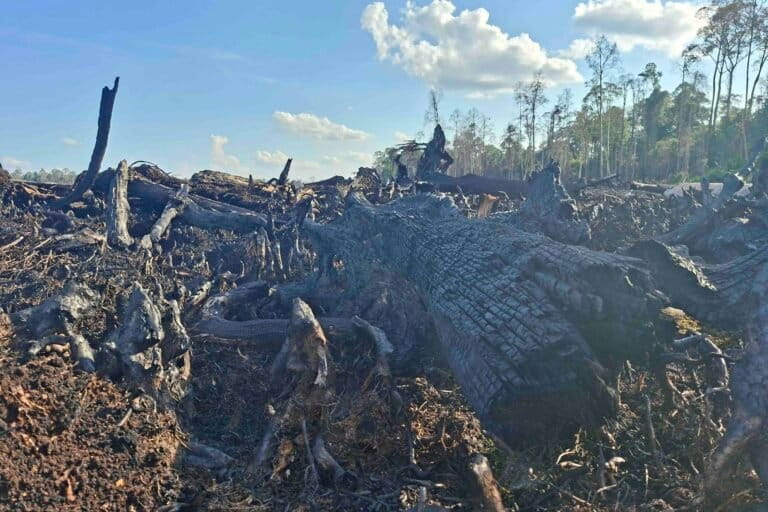
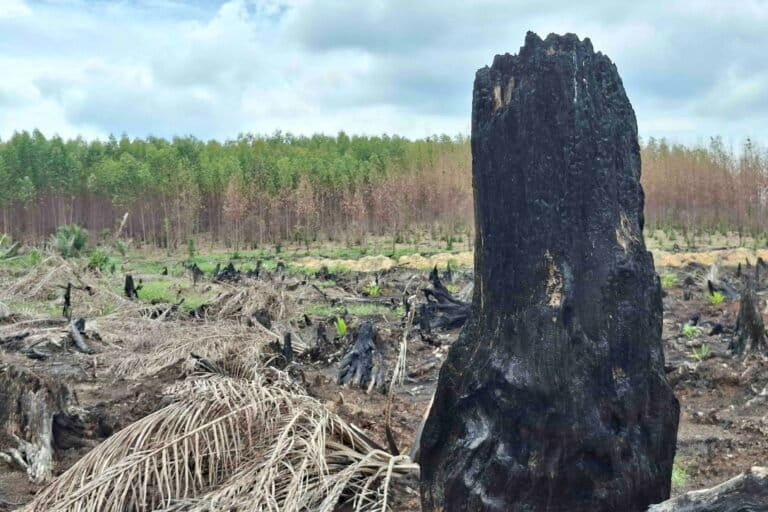
In the peatlands of Dusun Air Raja, Desa Tanjung Leban, Kecamatan Bandar Laksamana, the remnants of destruction are stark. As of May 12, 2026, a police seal from the Criminal Investigation Unit of the Bengkalis Resort Police still stood on a plot of land scorched by fire. The official record lists the damage at two hectares, but the visual evidence tells a grimmer story. Charred tree stumps, blackened roots, and mounds of ash litter the landscape, signaling a fire of far greater intensity.
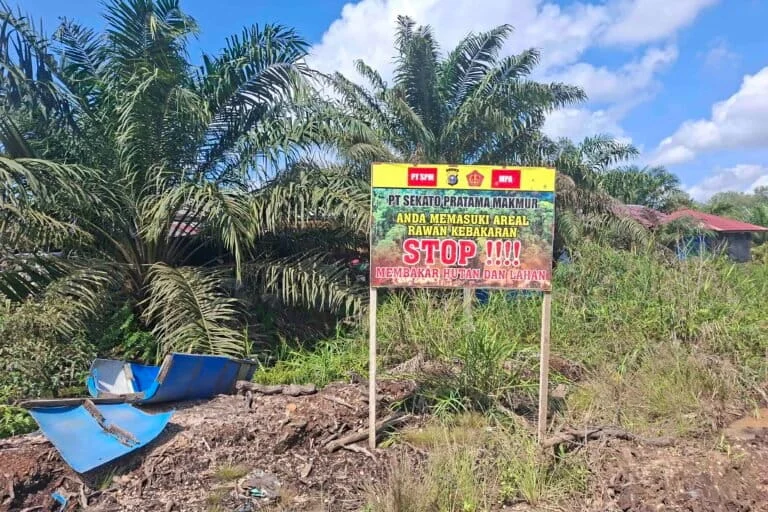
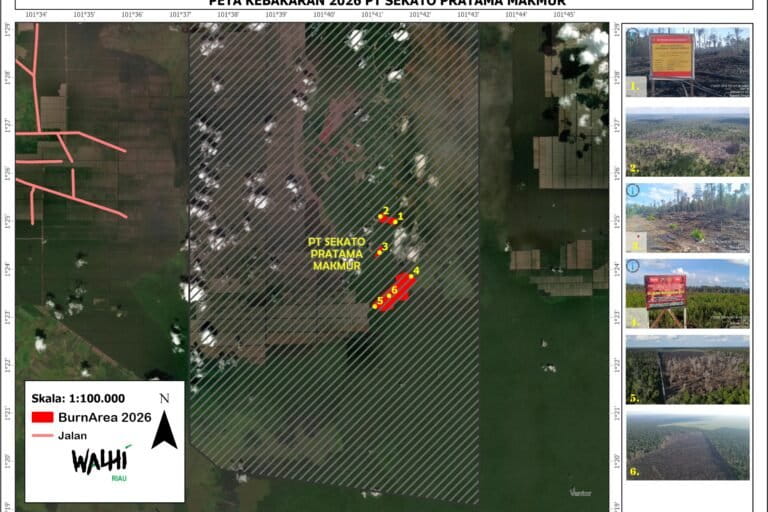
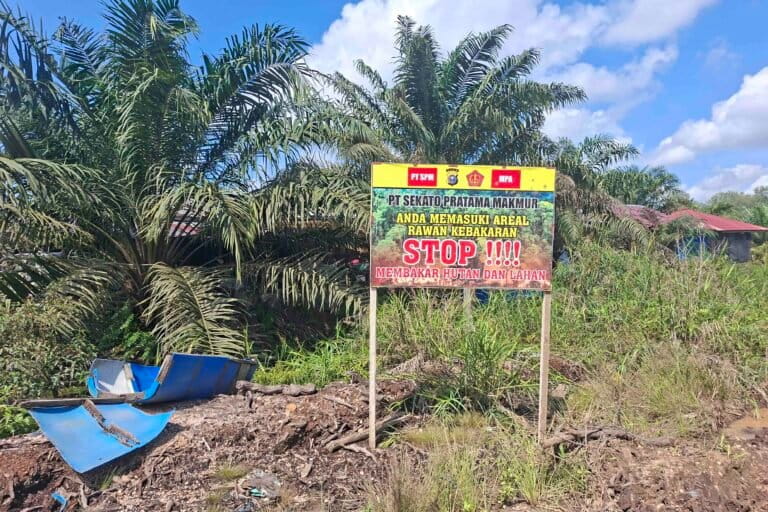
While the police signage at the site omits the name of the land owner, nearby infrastructure—including signage and information boards—explicitly points to PT Sekato Pratama Makmur (SPM). Spatial analysis conducted via map overlays confirms that this area falls within a Permitted Business for Forest Utilization (PBPH) zone held by an APP Sinar Mas business unit.
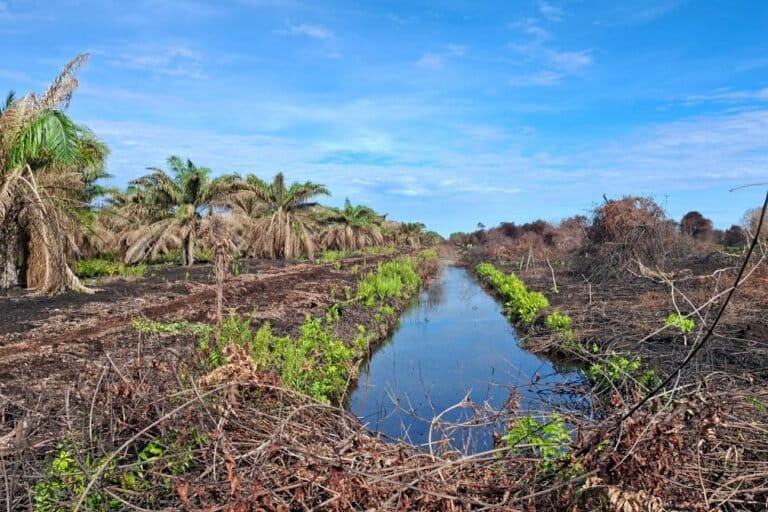
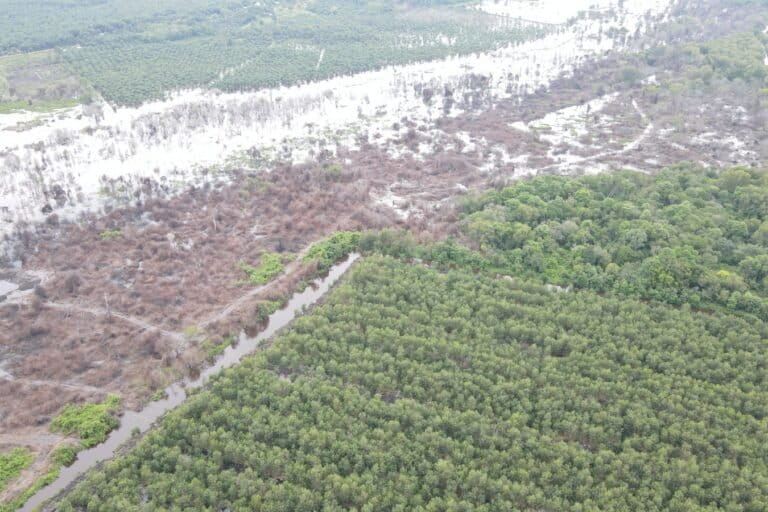
The fires at the SPM concession were not isolated incidents; they raged between February and March 2026. A secondary site, located just one kilometer from the first, displays identical damage. Furthermore, satellite imagery analysis from Sentinel-2 reveals a third, more devastating fire event covering 99.7 hectares. This location, situated between secondary natural forest and acacia plantations, features drainage canals on every boundary—a common feature in industrial forestry that often lowers the water table, making peat exceptionally flammable.
While the total estimated burned area at the SPM concession is 115.3 hectares, police lines and investigation markers are absent from the larger sites. Instead, the area is adorned with generic "Danger: Fire Hazard" signs featuring the emblems of PT SPM, the local Police (Polda Riau), and the Navy, creating a confusing narrative of prevention versus accountability.
Chronology of a Crisis: From Bengkalis to Siak
The destruction is not limited to Tanjung Leban. Approximately 126 kilometers away, on the coast of Desa Meskom, Kecamatan Bengkalis, fires ravaged 164.1 hectares of peatland within the concession of PT Meskom Agro Sarimas (Meskom).
Video footage captured on February 12, 2026, and circulated on social media, shows thick, billowing smoke rising from the brush while excavators operated in the vicinity. Three months later, a site visit confirmed that the land remained a graveyard of blackened timber and burnt peat. The site is critically positioned just 300 meters from the coastline. Without mangrove buffers, the area is prone to severe abrasion, with locals reporting that 15 meters of land is lost to the sea every year. Despite the scale, there is no evidence of police investigations or site sealing at the Meskom location.
Further inland, the crisis reached the concession of PT Riau Andalan Pulp and Paper (RAPP), a subsidiary of the APRIL Group. In March, approximately 71.9 hectares of natural peat forest burned in the Mandau Block, Kampung Olak, Siak Regency. Residents described a grueling effort to extinguish the flames, working day and night throughout the holy month of Ramadan and even during the Eid al-Fitr celebrations. "We didn’t even have a proper Lebaran," one resident remarked, reflecting the exhaustion of a community left to fight fires that encroached on their lives.
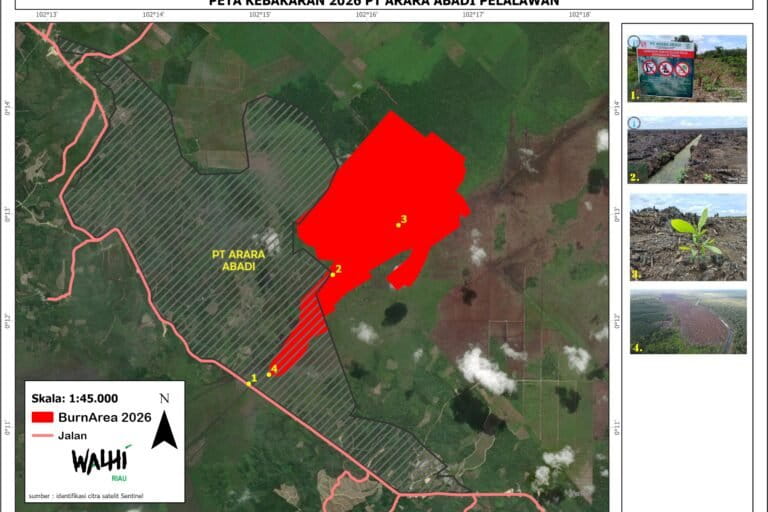
In another instance, PT Arara Abadi—a key APP Sinar Mas unit—faced fire outbreaks in Pangkalan Terap, Pelalawan. Satellite data indicates that over 600 hectares were affected in the surrounding area, with 59.6 hectares located directly within the company’s concession. By May, the site had been cleared and re-planted with acacia, effectively erasing the evidence of the fire before a thorough independent investigation could be conducted.
The Disparity in Enforcement
A recurring grievance among civil society groups is the stark contrast between how corporate entities and smallholder farmers are treated. When a local farmer burns a small plot to plant chilies, they are often swiftly prosecuted. Conversely, massive fires within industrial concessions frequently result in little more than a temporary seal or a lack of follow-up altogether.
Eko Yunanda, Executive Director of Walhi Riau, argues that the lack of accountability is the primary reason for the recurrence of these disasters. "Law enforcement against corporations has not functioned as it should. Crimes involving forest fires must target the ‘big players,’" he asserts. He notes that the government has failed to evaluate permits, even for companies that have repeatedly violated environmental standards.
The skepticism is backed by historical precedent. Riau has a long, troubled history with environmental law enforcement, including the issuance of SP3 (Termination of Investigation Orders) for 14 corporations involved in illegal logging in 2008 and 15 companies linked to fires in 2015-2016. "There has been no serious follow-up," Yunanda adds. "This is a massive failure in governance."
Okto Yugo Setiyo, Coordinator of Jikalahari, points to the bureaucratic fragmentation between the Ministry of Environment and the Ministry of Forestry as a hindrance to justice. "The role of the Law Enforcement Directorate (Gakkum) is becoming increasingly invisible," he says. Jikalahari has reported several companies—including PT Arara Abadi, PT RAPP, and PT Perawang Sukses Perkasa Industri—for fire violations, yet the progress of these cases remains opaque.
Official Responses and the "Prudential" Defense
When contacted for comment, corporate entities largely deflected responsibility. APRIL Group’s Corporate Communications department acknowledged the fire at their RAPP concession but claimed the ignition point originated from community land, asserting they deployed firefighting teams and have since initiated rehabilitation efforts.
APP Sinar Mas and PT Meskom remained largely unresponsive to multiple requests for clarification, despite inquiries sent by investigators.
From the government perspective, Ristianto Pribadi, Head of the Public Relations and International Cooperation Bureau at the Ministry of Forestry, emphasized that the government operates under a "prudential principle." He stated that the presence of fire within a concession does not automatically equate to a violation by the permit holder.
"Before any legal action, there must be a process of verification, data collection, and field evaluation regarding the fulfillment of fire control obligations," Pribadi explained. He added that the government remains committed to objective, evidence-based law enforcement, but maintains that fires can often stem from factors outside a company’s control.
Implications: A Call for Transparency
The ongoing failure to hold large-scale operations accountable for forest fires has profound implications for Indonesia’s environmental commitments and local livelihoods. As climate change increases the frequency of extreme weather, the role of peatlands as carbon sinks becomes even more critical.
Putra Septian, a campaign coordinator for Pantau Gambut, advocates for a transition toward open, evidence-based investigations that the public can access. "There must be legal certainty when negligence, intentionality, or failure to protect the environment is found," he says.
For the people of Riau, the smoke is not just a seasonal inconvenience; it is a symptom of systemic failure. Until the law treats corporate environmental destruction with the same severity as individual infractions, the cycle of fire, smoke, and devastation is likely to continue, leaving the province’s peatlands increasingly fragile and its residents increasingly disillusioned.
As of late June 2026, the investigation into these sites remains in a state of administrative limbo, with civil society groups continuing to press for the disclosure of findings and the revocation of permits for repeat offenders. Without a fundamental shift in the political will to enforce environmental regulations, the promise of a greener, safer Riau remains a distant, obscured horizon.