From Rise to Ruin: The Complex Historical Trajectory of the Indonesian Communist Party (PKI)
Jakarta — The Indonesian Communist Party (PKI) stands as one of the most polarizing and extensively studied political entities in modern Southeast Asian history. Before its dramatic collapse and ultimate proscription in 1966, the party evolved from a nascent colonial-era leftist movement into a formidable political powerhouse.
The trajectory of the PKI spans multiple distinct historical epochs: the germination of anti-colonial leftist movements, violent ideological schisms during the Indonesian National Revolution, a remarkable electoral resurgence through democratic channels in the 1950s, and its catastrophic downfall in the wake of the October 1, 1965 crisis.
Modern historical analysis of the PKI and the events of 1965 requires a careful, nuanced deconstruction. According to the National Archives of the Republic of Indonesia (ANRI), scholarly investigations into this era draw upon a diverse mosaic of domestic and international archives, including collections from Indonesia, the United States, and Japan. Consequently, contemporary historical discourse must meticulously differentiate between documented empirical facts, formal state decrees, and ongoing historiographical interpretations that continue to spark debate among historians, human rights advocates, and political scientists.
1. Main Facts and Foundations
The ideological roots of communism in the Dutch East Indies trace back to the establishment of the Indische Sociaal-Democratische Vereeniging (ISDV) in 1914, a leftist organization founded by Dutch socialists. As anti-colonial consciousness intensified, the organization underwent ideological evolution. By 1920, it transformed into the Perserikatan Komunis di Hindia, before formally adopting the name Partai Komunis Indonesia (PKI).
Driven by radical anti-imperialist sentiment, the PKI orchestrated an insurrection against the Dutch colonial administration in 1926. The rebellion was swiftly suppressed by colonial authorities, leading to mass arrests, exiles—notably to Boven Digoel—and severe restrictions on leftist political organizing. Throughout the remainder of the colonial era, the party operated largely underground or under heavy surveillance.
Following Indonesia’s declaration of independence in 1945, the PKI re-emerged into the open political sphere, positioning itself as a staunch champion of the working class and the anti-colonial struggle. However, deep-seated ideological fractures within the young republic soon precipitated severe internal crises, culminating in the watershed violence of 1948.
2. Chronology of Key Historical Turning Points
The Madiun Affair of 1948
On September 18, 1948, the friction between the republican government and radical leftist factions culminated in the Madiun Affair. Led by elements of the People’s Democratic Front (Front Demokrasi Rakyat or FDR)—a coalition that included the PKI—leftist groups proclaimed the "Soviet Republic of Indonesia" in Madiun, East Java.
The Ministry of Culture’s Encyclopedia of Indonesian History records this event as the pinnacle of armed confrontation between the republican government under President Sukarno and leftist political opposition. Within months, the Indonesian military successfully suppressed the rebellion. Key leaders, including Musso, were killed, and thousands of cadres were detained. While temporarily crippled, the party survived underground, leaving deep historical scars and laying the groundwork for enduring hostility between the military, religious groups, and the communist left.
Resurgence in the 1950s
Despite its near-total decimation in 1948, the PKI demonstrated remarkable organizational resilience. Under the dynamic leadership of D.N. Aidit, Njoto, Lukman, and Sudisman, the party discarded radical insurrectionary tactics in favor of a broad-based, populist strategy. The "New PKI" anchored its support base among trade unions, peasant organizations, women’s groups, and youth movements.
This grassroots mobilization yielded staggering results in the historic 1955 Indonesian legislative election—the country’s first democratic parliamentary poll. Data from the General Elections Commission (KPU) reveals that the PKI secured 6,179,914 votes, capturing 16.36 percent of the national vote share and winning 39 seats in the People’s Representative Council (DPR). The party finished fourth, trailing only the Indonesian National Party (PNI), Masyumi, and Nahdlatul Ulama (NU). In the election for the Constituent Assembly (Konstituante), the PKI expanded its footprint further, drawing approximately 6.23 million votes and securing 80 seats. By the mid-1950s, the PKI had successfully re-established itself as a central pillar of Indonesia’s parliamentary democracy.
The Guided Democracy Era (1959–1965)
Following President Sukarno’s Decree on July 5, 1959, Indonesia transitioned from parliamentary democracy to "Guided Democracy." Political power concentrated heavily in the hands of President Sukarno, while the ideological chessboard shifted toward a precarious equilibrium among nationalists, religious groups, the military, and the communists.
During this period, the PKI enthusiastically endorsed Sukarno’s political formula known as Nasakom (an acronym blending Nasionalisme [Nationalism], Agama [Religion], and Komunisme [Communism]). By the early 1960s, the PKI’s influence pervaded the state apparatus, bolstered by millions of organized members.
However, this expansion intensified structural anxieties. Tensions flared sharply between the PKI and the Indonesian Army (Angkatan Darat), alongside conservative religious organizations. Conflicts escalated over agrarian reform policies (the Basic Agrarian Law implementation), ideological dominance, and the PKI’s controversial proposal for the creation of a "Fifth Force" (arming peasants and workers alongside the official armed services).
The 1965 Crisis (G30S)
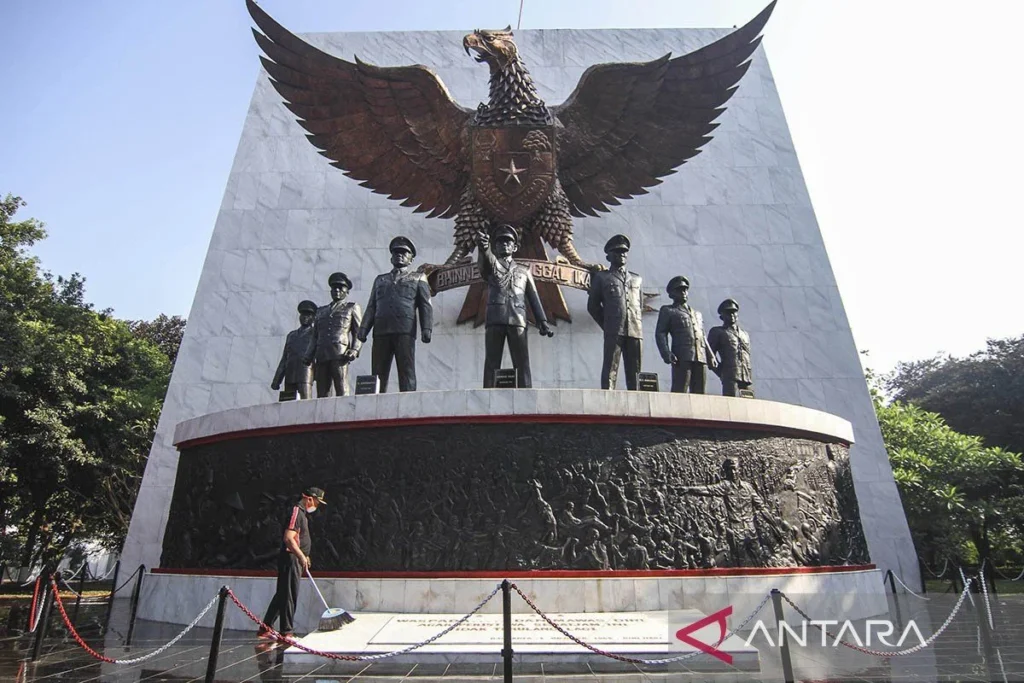
The political tension reached a bloody climax on the night of September 30 to October 1, 1965. A faction of the military, calling itself the September 30 Movement (G30S) and led by Lieutenant Colonel Untung, orchestrated the abduction and assassination of six senior Army generals and one officer. Their bodies were dumped at a well site in Lubang Buaya, Jakarta.
The exact nature, command structure, and extent of the PKI’s institutional complicity in G30S remain subjects of intense historiographical debate. While the official narrative of the New Order regime directly attributed the coup attempt to a masterminded PKI conspiracy, subsequent historical investigations point to a complex convergence of internal military factionalism, intelligence maneuvering, and localized leftist initiatives.
3. Supporting Data and Statistical Overview
To contextualize the PKI’s systemic weight in mid-century Indonesia, institutional datasets provide clear metrics of its reach:
- 1955 Parliamentary Election Results (Top Four Parties):
- PNI: ~8.4 million votes (22.3%) – 57 seats
- Masyumi: ~7.9 million votes (20.9%) – 57 seats
- Nahdlatul Ulama (NU): ~6.9 million votes (18.4%) – 45 seats
- PKI: ~6.18 million votes (16.4%) – 39 seats
- Constituent Assembly (1955): PKI secured ~80 seats, demonstrating deep legislative representation.
- Mass Organizations: By 1965, PKI-affiliated mass organizations—such as BTI (Peasants), SOBSI (Labor), and Pemuda Rakyat (Youth)—claimed a combined membership running into the millions, making it one of the largest communist movements outside the Soviet-Chinese bloc.
4. Official Responses and Post-G30S Retaliation
The failure of the G30S movement triggered a profound transformation in Indonesia’s political landscape. Under the leadership of Major General Soeharto, the Army assumed emergency control, systematically neutralizing the PKI and dismantling its support networks.
Human Rights Violations and Violence (1965–1966)
The months following October 1965 witnessed one of the worst mass tragedies of the 20th century. Investigations by the National Commission on Human Rights (Komnas HAM) document widespread gross human rights violations occurring between 1965 and 1966. These included mass extrajudicial killings, arbitrary detentions, enforced disappearances, torture, sexual violence, forced labor, and forced displacement.
These state-sanctioned and mobilized actions targeted not only active PKI members and cadres, but also extended to suspected sympathizers, left-leaning cultural figures, ethnic Chinese minorities, and entire family lineages, leaving generational trauma that persists today.
Legal Proscription
The institutional dismantling of the party culminated on March 12, 1966, when General Soeharto issued Presidential/Supreme Commander of the Armed Forces Order No. 1/3/1966, formally banning the PKI and its affiliated mass organizations, declaring them outlawed entities.
This executive decision was legally codified through Provisional People’s Consultative Assembly Decree (Tap MPRS) No. XXV/MPRS/1966, enacted on July 5, 1966. The decree explicitly dissolved the PKI across Indonesian territory and strictly prohibited any activities aimed at propagating or developing communism, Marxism, and Leninism. This legal prohibition remains enshrined in the nation’s legal architecture, though modern democratic discourse continuously negotiates its implementation within the bounds of contemporary human rights and constitutional law.
5. Implications and Contemporary Historical Perspectives
More than half a century after the tumult of 1965, the legacy of the PKI and the subsequent political transition continue to shape Indonesian civic and intellectual life.
The Shift to the New Order
The political vacuum created by the decimation of the PKI and the erosion of President Sukarno’s authority facilitated the birth of the New Order regime. Soeharto was formally sworn in as Acting President in 1967 and as full President in 1968, inaugurating a centralized, military-backed administration that governed Indonesia for three decades until its collapse in the democratic Reformation of 1998.
Archival Openness and Ongoing Scholarship
Efforts to reconcile this dark chapter of history rely heavily on documentary evidence. In recent years, institutions like the National Archives of the Republic of Indonesia (ANRI) have released curated manuscript collections containing historical sources from diverse global repositories—spanning Indonesian domestic records, declassified U.S. diplomatic cables, and Japanese wartime and postwar archives. ANRI emphasizes that comprehensive historical research must leverage these multilateral archives to move beyond polemical narratives.
Ultimately, the history of the PKI is far more expansive than the tragic events of 1965–1966. It represents a complex, multi-decade socio-political saga: from the birth of anti-colonial labor politics in the Dutch East Indies, through the devastating ideological fractures of Madiun, the triumph of democratic parliamentary participation in the 1950s, to the catastrophic collapse under Guided Democracy and the enduring human rights questions that continue to challenge Indonesia’s democratic identity today.