From Rise to Ruin: The Complex Historical Trajectory of the Communist Party of Indonesia (PKI)
Jakarta — The Communist Party of Indonesia (Partai Komunis Indonesia, or PKI) stands as one of the most polarizing and influential subjects in modern Southeast Asian history. Before its dramatic collapse and formal prohibition in 1966, the PKI evolved from a nascent colonial-era leftist organization into a formidable electoral heavyweight and a central pillar of President Sukarno’s Guided Democracy.
The trajectory of the PKI is a multi-layered narrative of ideological proliferation, armed insurrections, democratic integration, and catastrophic state-sponsored purges. Decades after its dissolution, examining the party’s history requires a delicate synthesis of documented facts, official state decrees, ongoing historiographical debates, and multi-national archival disclosures.
1. Main Facts: The Arc of a Revolutionary Movement
To understand the PKI’s footprint in Indonesia, historians analyze its evolution across several distinct eras:
- Colonial Roots: The ideological genesis of Indonesian communism traces back to the founding of the Indische Sociaal-Democratische Vereeniging (ISDV) in 1914 by Dutch socialists. By 1920, the movement indigenized, transforming into the Perserikatan Komunis di Hindia before adopting the PKI moniker.
- The 1926 Anticolonial Rebellion: An early, poorly coordinated uprising against the Dutch colonial administration resulted in a swift colonial crackdown, driving the movement underground or into exile.
- Resurgence and the 1948 Madiun Affair: Following Indonesia’s hard-won independence, the PKI reasserted itself, culminating in a disastrous armed conflict with the Republican government in Madiun, East Java, in September 1948.
- Electoral Triumph in the 1950s: Emerging from the ashes of Madiun under the charismatic leadership of D.N. Aidit, the PKI orchestrated a remarkable political comeback, establishing itself as the fourth-largest party in the landmark 1955 democratic elections.
- The Guided Democracy Era: During the late 1950s and early 1960s, the PKI aligned closely with President Sukarno, championing the political doctrine of Nasakom (Nationalism, Religion, and Communism).
- The 1965 Crisis and Total Collapse: The chaotic events of the September 30 Movement (G30S) in 1965 served as the catalyst for the party’s ultimate destruction, leading to mass violence, sweeping anti-communist purges, and its eventual legal ban in 1966 under General Suharto.
2. Chronology of Events: From Inception to Annihilation
The Colonial Era and the 1926 Revolt
The genesis of Indonesian Marxism was uniquely intertwined with the anti-colonial struggle. Following the birth of the ISDV in 1914 and its transition into the PKI in 1920, the party sought to mobilize the burgeoning urban working class and rural peasantry against Dutch hegemony.
However, ideological impatience birthed a premature strategy. In 1926, segments of the PKI launched a regional, uncoordinated insurrection against the Dutch colonial administration. The revolt was systematically crushed. The colonial authorities arrested thousands, executing leaders or exiling them to remote penal colonies like Boven Digoel in Western New Guinea. This dealt a severe blow to the party, forcing it into a period of dormancy and subterranean operation throughout the late colonial period and Japanese occupation.
The 1948 Madiun Affair
With the proclamation of Indonesian independence in August 1945, the political landscape shifted dramatically. Leftist elements, including rehabilitated PKI figures, re-entered the national arena. Tensions between the nascent Republican government—led by Sukarno and Mohammad Hatta—and radical leftist factions escalated steadily amid economic hardship and the ongoing diplomatic-military struggle against the returning Dutch.
On September 18, 1948, the crisis reached a bloody crescendo in Madiun, East Java. Leftist groups, unified under the People’s Democratic Front (Front Demokrasi Rakyat, or FDR) which included the PKI, proclaimed the "Soviet Republic of Indonesia."
According to the Indonesian Ministry of Culture’s Historical Encyclopedia and National Archives of Indonesia (ANRI) records, this open rebellion posed an existential threat to the young republic while it was locked in negotiations with the Dutch. The Republican government, under military leadership, acted decisively. Within months, the rebellion was suppressed. Key leaders—including Musso, one of the party’s founding figures—were killed, and thousands of rank-and-file members were imprisoned. The Madiun Affair left a deep generational scar, cementing profound mistrust between the Indonesian military, religious groups, and the communist movement.
The 1950s: Electoral Resurrection and Mass Mobilization
Despite the devastation of 1948, the PKI demonstrated extraordinary organizational resilience. During the early 1950s, a new crop of dynamic leaders, spearheaded by D.N. Aidit, M.H. Lukman, and Njoto, steered the party away from reckless armed insurrections toward a strategy of legal, parliamentary mass mobilization.
The party successfully rebranded itself as a defender of the common people, peasants (kaum tani), and urban laborers, establishing massive auxiliary organizations for women (Gerwani), youth (Pemuda Rakyat), and trade unions (SOBSI).
This grassroots strategy bore fruit during Indonesia’s first democratic national elections in 1955.
3. Supporting Data: The 1955 General Election
The 1955 elections remain a watershed moment in Indonesian political history, showcasing the formal democratic legitimacy the PKI managed to secure within a decade of its near-annihilation at Madiun.
According to official data from the General Elections Commission (KPU):
- DPR (Parliamentary) Election: The PKI garnered 6,179,914 votes, translating to 16.36 percent of the national vote share. This secured the party 39 seats in the House of Representatives, placing it firmly in fourth position behind the Indonesian National Party (PNI), Masyumi, and Nahdlatul Ulama (NU).
- Constituent Assembly (Konstituante) Election: The party’s electoral clout expanded further in the election for the assembly tasked with drafting a permanent constitution, where the PKI captured approximately 6.23 million votes and secured 80 seats.
These figures confirmed that the PKI had transformed itself from a fringe radical sect into a legitimate powerhouse within Indonesia’s parliamentary democracy, commanding the allegiance of millions.
4. The Guided Democracy Era and Rising Polarization
As Indonesia transitioned from parliamentary democracy to President Sukarno’s autocratic "Guided Democracy" following the Presidential Decree of July 5, 1959, the political equilibrium shifted. Sukarno sought to balance the competing, hostile factions of the Indonesian polity—primarily the nationalist camp, the Islamic organizations, the military (specifically the Army), and the communists.
To co-opt the left while maintaining national cohesion, Sukarno championed the ideological concept of Nasakom (Nationalism, Religion, and Communism). This framework provided the PKI with unprecedented political space, institutional legitimacy, and proximity to the state apparatus. By the early 1960s, the PKI claimed millions of registered members and sympathizers, positioning itself as Sukarno’s most vocal defender against what it termed "right-wing subversion."
However, this rapid expansion fueled existential anxiety within the military—particularly the Army leadership—and conservative Islamic groups. Tensions flared across multiple fronts:
- Agrarian Conflicts: The PKI’s aggressive implementation of land reform laws (Aksi Sepihak) pitted impoverished peasants against wealthy landowners and religious elites.
- Ideological Clashes: The ideological divide between secular/communist forces and Islamic parties (such as the banned Masyumi and NU) deepened.
- The "Fifth Force" Proposal: In 1965, the PKI proposed the arming of a "Fifth Force" consisting of workers and peasants, a move fiercely opposed by the Army high command, who viewed it as a direct threat to the military’s monopoly on arms.
5. The 1965 Turning Point: G30S and State Responses
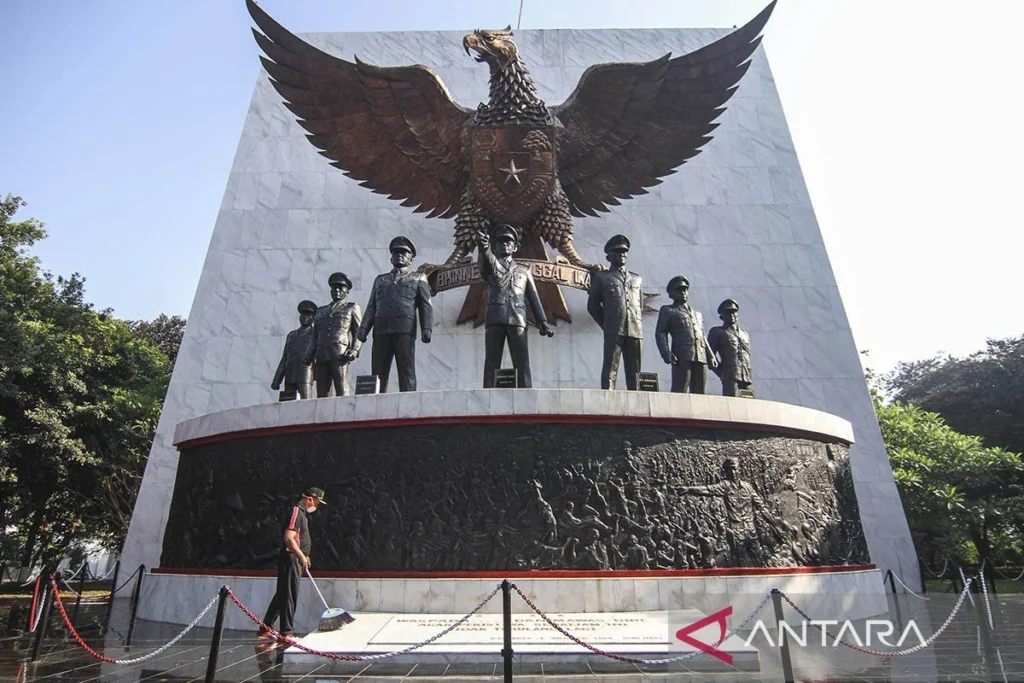
The precarious political balancing act shattered on the night of September 30 to October 1, 1965. A faction of disaffected military officers, styling themselves the September 30 Movement (G30S) and led by Lt. Col. Untung, abducted and murdered six senior Army generals and one officer in Jakarta, dumping their bodies at a well in the Lubang Buaya area.
Historiographical Debates and Official Narratives
The events of G30S remain one of the most intensively debated chapters in modern historiography.
- The New Order Narrative: For over three decades under President Suharto’s New Order regime, the official state narrative placed sole and direct responsibility for the coup attempt on the PKI, framing it as a treacherous plot to overthrow the state and establish a communist dictatorship.
- Alternative Historical Perspectives: Subsequent academic research, international disclosures, and declassified documents have presented a complex matrix of interpretations. Scholars point to internal military factionalism, individual actors within the left, intelligence operations, and the opportunistic maneuvering of major political forces.
The National Archives of Indonesia (ANRI) has repeatedly emphasized that a comprehensive understanding of 1965 requires evaluating diverse archival collections—including domestic records alongside declassified files from the United States, Japan, and other nations. ANRI underscores the necessity of distinguishing between documented empirical facts, official state legal decisions, and ongoing academic interpretations.
6. Official Responses and Institutional Acknowledgment
The aftermath of G30S triggered a catastrophic humanitarian and political crisis. Under the leadership of Major General Suharto, the Army swiftly neutralized the coup attempt and moved systematically to eradicate the PKI.
The 1965–1966 Anti-Communist Purges
Between late 1965 and 1966, Indonesia descended into horrific mass violence. Hundreds of thousands of individuals accused of being members, sympathizers, or associates of the PKI—along with family members and collateral victims—were arrested, detained without trial, or massacred across Java, Bali, and parts of Sumatra.
Decades later, the Indonesian National Commission on Human Rights (Komnas HAM) formally investigated these occurrences. Komnas HAM concluded that the 1965–1966 tragedy constituted a series of gross human rights violations. The documented abuses included mass murder, forced displacement, enslavement, torture, sexual violence, persecution, and enforced disappearances.
Legal Prohibition: The 1966 Decrees
Institutionally, the political annihilation of the PKI was codified through formal state instruments:
- March 12, 1966: General Suharto issued an executive decision officially dissolving the PKI and all its affiliated mass organizations, declaring them illegal entities.
- MPRS Decree No. XXV/MPRS/1966: On July 5, 1966, the Provisional People’s Consultative Assembly (MPRS) ratified this dissolution, formally banning the PKI throughout the territory of the Republic of Indonesia. The decree also prohibited the dissemination or development of Communist, Marxist, and Leninist teachings.
This decree remains a foundational legal landmark in Indonesian constitutional history. Contemporary legal and political discourse regarding the decree often balances state security principles with evolving discussions surrounding human rights, democracy, and historical accountability, as reflected in various People’s Consultative Assembly (MPR) documents.
7. Implications and Legacy
The collapse of the PKI fundamentally restructured the geopolitical and domestic architecture of Indonesia.
The Birth of the New Order
The vacuum left by the demise of the PKI and the marginalization of President Sukarno paved the way for the rise of General Suharto. In 1968, Suharto was formally installed as President, inaugurating the centralized, military-backed New Order regime that governed Indonesia for three decades until its collapse during the Asian Financial Crisis in 1998.
Ongoing Historical Inquiry
More than half a century after the turmoil of 1965–1966, the memory of the PKI and the trauma of the purges continue to cast a long shadow over Indonesian public life. Periodic public debates, institutional clarifications (such as academic discussions involving university symbols or historical texts), and the continuous release of archival materials—such as ANRI’s ongoing archival source publications—demonstrate that the subject remains sensitive yet vital for national self-understanding.
Ultimately, the history of the PKI is far more than a single night of bloodshed in October 1965. It is an intricate, cautionary chronicle of a radical movement’s rise through anti-colonial resistance and parliamentary democracy, its tragic miscalculations in armed rebellion, its meteoric resurgence as a democratic titan, and its catastrophic collapse amid the geopolitical tempests of the Cold War.