Strengthening the Grassroots Economy: President Prabowo Subianto Accelerates the ‘Merah Putih’ Cooperative Initiative
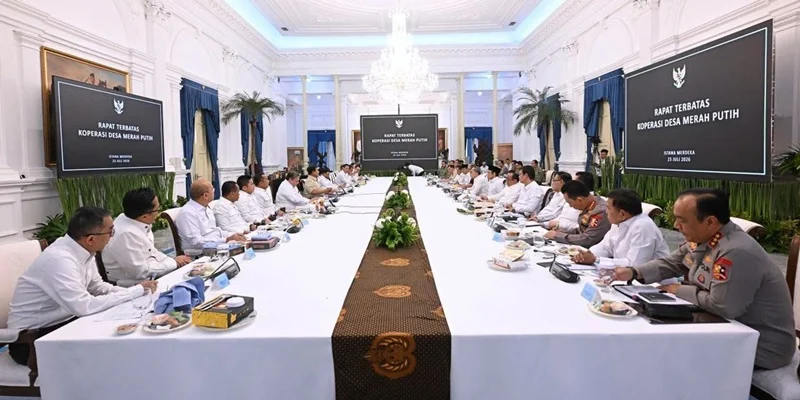
JAKARTA, INDONESIA – In a decisive move to revitalize the nation’s economic backbone, President Prabowo Subianto convened a high-level limited meeting at the Presidential Palace in Jakarta on Thursday, July 23, 2026. The focal point of the session was the strategic acceleration and structural strengthening of the Koperasi Desa/Kelurahan Merah Putih (KDKMP – Village/Sub-district Red and White Cooperatives) and the Koperasi Nelayan Merah Putih (KNMP – Fishermen’s Red and White Cooperatives).
This initiative marks a cornerstone of the administration’s economic policy, aimed at decentralizing growth by empowering local communities, enhancing supply chain efficiency, and ensuring food security from the grassroots level upward.
1. Main Facts: A New Paradigm for Rural Economic Sovereignty
The "Merah Putih" (Red and White) Cooperative initiative is not merely a bureaucratic adjustment but a systemic overhaul of how the Indonesian government intends to manage village-level productivity. The primary goal is to shift from a consumption-based rural economy to a production-based one.
Key facts emerging from the meeting include:
- Strategic Scope: The program targets every village and sub-district in Indonesia, creating a national network of cooperatives that function as micro-economic hubs.
- Integrated Synergy: The President explicitly mandated a "whole-of-government" approach, requiring seamless coordination between the Ministry of Cooperatives and SMEs, the Ministry of Village Affairs, the Ministry of Marine Affairs and Fisheries, and the Ministry of Agriculture.
- Security and Stability: Uniquely, the President has called for the active participation of the Indonesian National Armed Forces (TNI) and the National Police (Polri). This is intended to assist in logistical distribution, infrastructure security, and the professionalization of cooperative management in remote or underdeveloped areas.
- Sustainability Mandate: The program is designed to be self-sustaining, focusing on cooperative ownership by local residents to ensure that the wealth generated remains within the community.
2. Chronology: The Road to the July 23 Directive
The push for the KDKMP and KNMP programs has been a long-gestating project within the Prabowo administration, rooted in his campaign promises to bolster domestic production.
- Early 2026: Following the budget consolidation phase, the government identified rural economic stagnation as a major hurdle to achieving a 7% GDP growth target.
- April – June 2026: Preparatory field studies were conducted across provinces in Sumatra, Java, and Sulawesi to assess the viability of existing village-owned enterprises (BUMDes). The government found that while BUMDes existed, they lacked the scale and professional management necessary for competitive market entry.
- July 23, 2026: President Prabowo Subianto formally presided over the limited meeting at the Presidential Palace. The President emphasized that the "Merah Putih" branding signifies a nationalistic commitment to national self-sufficiency.
- Immediate Future: The government plans to initiate a pilot phase in 500 villages across Indonesia, focusing on regions with high agricultural and maritime potential, to serve as a blueprint for the national rollout.
3. Supporting Data: The Economic Logic Behind the Cooperatives
The decision to focus on cooperatives is backed by compelling socio-economic data regarding the state of rural and coastal Indonesia.
Agricultural Productivity
Current data suggests that smallholder farmers and fishermen often suffer from "middleman exploitation," where the price paid to the producer is a fraction of the market retail price. By consolidating these producers into KNMP and KDKMP units, the government aims to eliminate unnecessary layers of the supply chain.
Demographic Dividends
With the majority of Indonesia’s population residing in rural areas, the cooperative model is seen as the primary vehicle to convert the demographic bonus into actual productivity. According to the National Statistics Bureau (BPS), the poverty rate remains stubbornly high in rural areas compared to urban centers. The KDKMP model aims to provide the capital, technology, and market access necessary to uplift these demographics.
Maritime Potential
Indonesia’s status as an archipelagic nation makes the KNMP program vital. Current reports indicate that while Indonesia has vast maritime resources, the lack of modern cold-chain infrastructure prevents small-scale fishermen from exporting their catch or maintaining quality. The KNMP units are slated to be equipped with government-funded cold storage facilities, powered by renewable energy.
4. Official Responses and Institutional Roles
The meeting served as a clarion call for ministerial cooperation. President Prabowo was firm in his instruction: "There is no room for siloed operations. The success of the Merah Putih Cooperatives is the success of our national food sovereignty."
- The Ministry of Cooperatives: Tasked with drafting the regulatory framework and providing training for professional management. The Ministry will implement a "digital cooperative" platform to ensure transparency and real-time financial tracking.
- The Role of TNI/Polri: In a move that has sparked significant interest, the President tasked the military and police to assist in "operational stability." This includes providing security for cooperative assets in frontier regions and supporting the logistical distribution of goods through their transport assets. Officials have clarified that this is a developmental role, meant to assist the civil administration where bureaucratic reach is thin.
- Ministry of Village Affairs: Responsible for selecting the initial villages for the pilot phase based on their "readiness score," which measures local resource potential and leadership capacity.
5. Implications: A Transformation of the Indonesian Landscape
The implications of this policy are profound and multifaceted. If successful, the KDKMP and KNMP programs could fundamentally alter the economic trajectory of Indonesia.
Empowerment of the "Marhaen" (Common Man)
By placing capital and management power in the hands of the people, the government is moving toward a genuine "People’s Economy." The cooperatives will serve as the primary conduit for government subsidies, replacing inefficient cash-transfer systems with production-based support.
Resilience Against External Shocks
The global supply chain crisis has taught Indonesia that dependency on imports for basic food items is a national security risk. By strengthening village-level production, the government is creating a decentralized food security buffer. If global prices fluctuate, the Merah Putih network can stabilize local markets by increasing the supply of domestically produced goods.
Addressing Structural Inequality
For decades, economic growth has been concentrated in Java and urban industrial zones. The "Merah Putih" initiative acts as a corrective mechanism. By targeting coastal and remote village areas, the government is effectively injecting liquidity into the furthest reaches of the nation, potentially slowing urbanization and reducing the pressure on major cities like Jakarta and Surabaya.
Challenges Ahead
Despite the optimism, experts warn of significant challenges. The primary obstacle will be the quality of leadership at the local level. Managing a cooperative requires financial literacy and ethical standards that may not be present in every village. Furthermore, the integration of TNI/Polri into economic activities will be closely monitored by civil society organizations to ensure it does not impede the democratic functioning of civil institutions.
Conclusion
The July 23, 2026, meeting signals a bold pivot for President Prabowo’s administration. By prioritizing the "Red and White" cooperatives, the government is signaling that the future of Indonesia’s prosperity will be built not from the top down, but from the villages and the sea up. Whether this ambitious plan can navigate the complexities of local politics and bureaucratic hurdles remains to be seen, but the intent—to create a self-reliant and economically empowered citizenry—is undeniably clear.
As the program moves into its pilot phase, the eyes of the nation remain fixed on the Presidential Palace. The success of this initiative could define the legacy of the Prabowo administration, setting a new standard for how a developing nation can leverage its greatest asset: its people.