Indonesia’s Danantara Unleashes Data Integration: Transforming Export Oversight and Capturing $10.5 Billion in Foreign Exchange

JAKARTA – In a landmark shift for Indonesia’s fiscal and economic sovereignty, the newly established Danantara Sumberdaya Indonesia (DSI)—the investment and resource management arm under the Danantara Indonesia sovereign wealth framework—has signaled a paradigm shift in how the nation manages its natural resource wealth.
After just over a month of full-scale operations, CEO Rosan Roeslani has confirmed that the entity has successfully consolidated and managed foreign exchange (forex) data totaling US$ 10.5 billion. This achievement, highlighted by President Prabowo Subianto, marks the first time in Indonesia’s history that the government has been able to synchronize disparate data streams from across multiple ministries to achieve a "single source of truth" regarding the country’s export activities.
The Genesis: Breaking Data Silos
For decades, Indonesia’s export ecosystem was characterized by fragmented information. Data regarding export volumes, tax payments, and customs declarations were sequestered within individual government silos—namely the Ministry of Trade, the Ministry of Energy and Mineral Resources (ESDM), the Ministry of Industry, and the Directorate General of Customs and Excise.
Because these systems were not interconnected, the government often struggled to gain a holistic view of the national export supply chain. This lack of transparency allowed for discrepancies in declared prices, potential tax leakages, and difficulties in tracking the movement of commodities from the port of departure to the final international destination.
The initiative to centralize this data began in earnest on June 1, 2026. By integrating these systems, Danantara has effectively created a centralized digital dashboard that allows the state to monitor the entire lifecycle of an export transaction in real-time.
Chronology of the Integration
The transformation did not happen overnight. The implementation follows a strategic timeline aimed at stabilizing the national economy through digital oversight:
- Pre-June 2026: Export data remained decentralized, leading to inefficiencies and "blind spots" in revenue reporting.
- June 1, 2026: Official launch of the integrated data consolidation system. All major ministries involved in export and import activities were required to feed their data into the Danantara platform.
- July 2026: The system matured, allowing for comprehensive cross-referencing of data.
- July 20, 2026: CEO Rosan Roeslani officially presented the results of the first month of integrated monitoring to the Presidential Palace, confirming the US$ 10.5 billion forex capture.
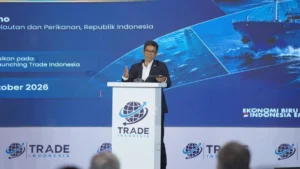
"Starting from June 1 until last week, we have been able to pull data from all agencies and ministries," Rosan Roeslani stated during a press briefing at the Presidential Palace in Central Jakarta. "Whether it is Customs, the Ministry of Trade, the Ministry of Industry, or the Ministry of ESDM—all are now consolidated into one platform."
Supporting Data: Exposing the "Price Gap"
One of the most significant revelations from this new oversight mechanism concerns the pricing of Indonesia’s primary commodities. The government has long suspected that certain exporters were "under-invoicing" their shipments—declaring a price significantly lower than the actual market value to reduce tax burdens and keep more foreign exchange offshore.
The Palm Oil Case Study
Using the new platform, Danantara focused its initial analysis on Refined, Bleached, and Deodorized (RBD) Olein and Palm Oil. The results were startling.
"We were able to compare the ‘declared price’—the price stated by the exporter at the point of sale—against international market indices," Rosan explained. "Previously, there was a massive, consistent gap between these two figures. Because the data from different ministries didn’t talk to each other, it was easy for this discrepancy to go unnoticed."
Historically, this gap was estimated at approximately 30%. Through the new monitoring platform, the government can now track the exact port of departure, the declared volume, the actual customs duties paid, and the corresponding tax payments. By forcing transparency, the government has observed the gap narrowing significantly.
"Since we began enforcing this transparency, the gap has almost vanished. The declared prices are now very close to the market indices," Rosan added.
Official Response: The "Alert" System
To maintain this momentum, Danantara has implemented an automated "Alert System." This system functions as a digital watchdog that flags any anomaly in real-time.
If an exporter reports a shipment volume or price that deviates from standard market expectations or historical trends, the system automatically triggers a notification. This alert is then forwarded to the relevant authorities, such as the Ministry of Finance, the Directorate General of Customs, or the Ministry of Trade, for immediate investigation.
"We don’t just collect data; we use it to act," Rosan said. "We tell the relevant ministry, ‘Look, there is a discrepancy here.’ This empowers the authorities to intervene before tax revenue is lost or before currency is diverted away from the national system."
Strategic Implications: Focusing on the "Big Three"
While the system is designed to cover all exports, Danantara is currently prioritizing three strategic commodities that serve as the backbone of Indonesia’s export revenue:
- Coal: Essential for the national energy supply and a major source of non-tax state revenue (PNBP).
- Palm Oil: Indonesia’s most significant agricultural export, impacting both global food supplies and domestic prices.
- Ferroalloy: A critical component in the global steel industry, reflecting Indonesia’s push for downstream processing and value-added exports.
By focusing on these three sectors, the government aims to solidify its control over the nation’s natural resources, ensuring that the wealth generated from these industries is fully accounted for and contributes directly to the national treasury.
Economic Outlook and Future Prospects
The ability to manage US$ 10.5 billion in foreign exchange within just one month of integrated operations represents a massive win for the Prabowo administration. Economists view this as a crucial step toward stabilizing the Indonesian Rupiah (IDR) and increasing the state’s fiscal capacity.
Improving Fiscal Discipline
The integration of export data is expected to lead to a significant increase in tax revenue. By closing the "price gap" and ensuring that export duties are paid on the true market value of goods, the government is effectively capturing revenue that was previously being lost to administrative inefficiencies or intentional under-reporting.
Enhancing Investor Confidence
For international investors, this move signals that Indonesia is maturing as a global trade partner. A transparent, data-driven export environment reduces corruption, levels the playing field for legitimate businesses, and provides a clearer picture of the country’s economic health.
Challenges Ahead
While the initial results are promising, experts note that the real challenge lies in long-term enforcement. "The system is only as good as the data entered," says one industry analyst. "The government must ensure that no ministry or agency attempts to bypass the integration, and that the ‘alert’ system is followed up with rigorous legal action against repeat offenders."
Rosan Roeslani remains optimistic, noting that the goal is not merely surveillance but the creation of a seamless trade ecosystem. "We are building an architecture that ensures every dollar of Indonesia’s wealth is tracked and utilized for the benefit of the people. This is just the beginning."
Conclusion
The integration of export data under Danantara Indonesia marks a turning point in the nation’s economic history. By transitioning from fragmented, manual oversight to a unified, automated digital platform, the government has reclaimed control over its vital resources. The successful management of US$ 10.5 billion in forex is a testament to the power of digital integration. As the system expands to include more commodities and deeper integration with private sector logistics, Indonesia is positioning itself as a more transparent, robust, and sovereign economic power on the global stage.
The success of this initiative will likely serve as the benchmark for future administrative reforms, proving that when data is transparent, the state’s ability to protect its wealth—and by extension, its citizens—is exponentially strengthened.