Indonesia’s Maritime Paradox: Bridging the Gap Between High Production and Global Trade Value
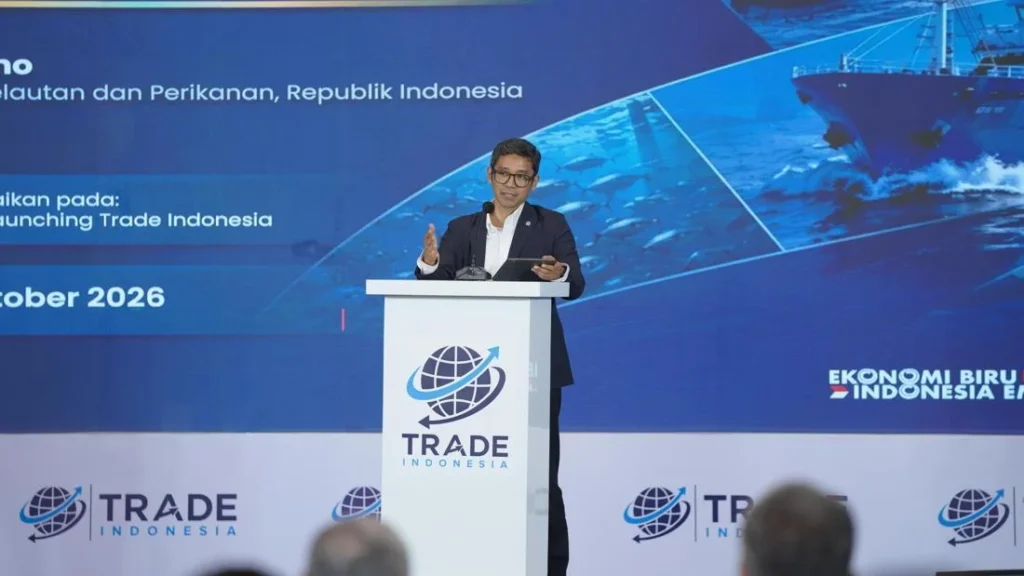
TANGERANG, Banten — Indonesia stands as a giant in the global maritime landscape, boasting the world’s second-largest capture fisheries sector and ranking third in aquaculture production. Yet, despite these staggering volumes, the archipelago nation remains an underperformer in the upper echelons of global seafood trade value.
This juxtaposition of immense biological wealth and unrealized economic potential took center stage on Tuesday, October 13, 2026, during the grand opening of Trade Indonesia at the She La Vie Grand Ballroom in Alam Sutera, Serpong, Tangerang. Addressing business leaders, exporters, and international delegates, Deputy Minister of Marine Affairs and Fisheries (Wamen KKP) Irwan Meilano laid bare the paradox defining Indonesia’s fisheries sector: high volume, low margin.
As global seafood trade reaches unprecedented heights—valued at approximately $184 billion globally and rivaling the international trade of meat—Indonesia is missing out on its fair share of the economic pie. With the Ministry of Marine Affairs and Fisheries (KKP) championing a sweeping "blue economy" framework, the government is signaling an aggressive push to transform Indonesian fisheries from a raw-commodity exporter into a high-value global powerhouse.
1. Main Facts: The Paradox of Volume Versus Value
The core narrative presented by the Ministry of Marine Affairs and Fisheries highlights a critical structural inefficiency in Indonesia’s maritime economy.
- The Production Giants: Indonesia holds the number two spot globally in capture fisheries (trailing only China) and ranks third in aquaculture.
- Export Performance: National fisheries exports reached $6.27 billion last year, marking a commendable 5.2% growth—the highest in five years.
- The Value Gap: Despite massive production and rising exports, Indonesia languishes at 10th place globally in terms of total trade value.
Deputy Minister Irwan Meilano did not mince words when diagnosing the issue during his keynote address at the Trade Indonesia launch. "We produce a lot, but the value is low. Anyone who understands margins will immediately see that there is a serious gap here, and that gap should be viewed as potential. It is an opportunity that we must seize," Irwan stated.
To put this in perspective, Irwan pointed to global benchmarks like Norway. Despite producing a fraction of Indonesia’s volume—roughly 4 million tons—Norway successfully commands an astonishing $17 billion in annual seafood exports. The discrepancy underscores a systemic failure in post-harvest processing, value addition, cold-chain logistics, and brand positioning within the Indonesian archipelago.
2. Chronology of Events
The unveiling of these strategic challenges unfolded through a structured sequence of events during the high-profile launch of the Trade Indonesia platform:
- Tuesday, October 13, 2026: The official inauguration of Trade Indonesia took place at the She La Vie Grand Ballroom in Alam Sutera, Serpong, Tangerang, Banten. The event brought together domestic micro, small, and medium enterprises (MSMEs), industrial seafood titans, and global trade facilitators.
- Keynote Address (October 13, 2026): Deputy Minister Irwan Meilano delivered a comprehensive keynote speech detailing the Ministry’s 2026 strategic vision, emphasizing the transition from volume-based to value-based fisheries management through the blue economy framework.
- Platform Introduction (October 13, 2026): Atta Ul Karim, Founder and Global Head of International Creatives Exchange (ICE)—the parent organization steering Trade Indonesia—took the stage to outline how the newly launched digital and physical trade ecosystem will bridge domestic producers with international buyers.
- Thursday, October 15, 2026: The Ministry of Marine Affairs and Fisheries formally released the official written statements and policy takeaways from the event, underscoring the government’s unwavering commitment to fostering public-private partnerships to upgrade the national fisheries sector.
3. Supporting Data and Comparative Analysis
A deeper dive into the macroeconomic data surrounding Indonesia’s maritime sector reveals both the scale of the challenge and the urgency of reform.
The Global Seafood Market Landscape
Global seafood consumption is at an all-time high, driven by health-conscious consumer trends and a growing global population. The worldwide seafood trade market is valued at $184 billion annually, with over a third of this total crossing international borders via maritime routes.
Indonesia’s Export Trajectory
While the 5.2% growth rate bringing exports to $6.27 billion is celebrated as a five-year high, industry analysts note that the bulk of these exports consist of raw, frozen, or minimally processed commodities (such as raw shrimp, tuna blocks, and seaweed). These products are routinely shipped to intermediary nations, processed, packaged, and re-exported at exponential markups.
The Norwegian Benchmark
- Norway Production: ~4 million tons.
- Norway Export Value: ~$17 billion.
- Indonesia Production: Multi-million tons across sprawling archipelagic waters (spanning capture and aquaculture).
- Indonesia Export Value: $6.27 billion.
The structural contrast between Norway’s heavy investment in traceability, value-added processing (such as smoked and ready-to-eat salmon products), and stringent quality control highlights the exact areas where Indonesia must direct capital and policy interventions.
4. Official Responses and Government Strategy
Faced with the imperative to close the value gap, the Ministry of Marine Affairs and Fisheries is betting heavily on its multi-pillar Blue Economy Strategy. According to Deputy Minister Irwan, this policy framework is not merely an environmental conservation tool, but a comprehensive economic engine.
Core Pillars of the Blue Economy
- Expansion of Conservation Areas: By protecting critical marine habitats, breeding grounds, and coral reefs, the KKP aims to naturally replenish fish stocks. Irwan emphasized that healthier ecosystems yield higher-quality catches, reducing the need for destructive, high-volume overfishing while commanding premium prices.
- Development of Aquaculture: Boosting sustainable aquaculture across coastal, marine, and inland freshwater zones to stabilize supply chains independent of unpredictable wild-catch yields.
- Strict Coastal and Small Island Monitoring: Safeguarding vulnerable marine zones from illegal, unreported, and unregulated (IUU) fishing.
- Marine Plastic Waste Management: Mitigating microplastic contamination in Indonesian waters to meet stringent international health and safety certifications required by premium Western and Asian markets.
Upgrading the Entire Value Chain
Irwan highlighted that these policy agendas directly unlock commercial opportunities across the entire supply chain. Investment is urgently required in:
- Modern feed production and disease-free seed distribution for aquaculture.
- End-to-end cold-chain logistics to prevent post-harvest spoilage in remote islands.
- Advanced processing facilities to turn raw catches into consumer-ready goods.
- Export compliance infrastructure.
"We at the KKP deeply hope that all of us can step up. Fishermen must step up; our export products must step up, both in terms of quality and value. The most important thing is finding the right partners to build investments, and the KKP is ready to support you through that process," Irwan declared.
The Role of Trade Indonesia
Complementing government policy, private sector initiatives like Trade Indonesia are stepping in to resolve the networking and market-access bottlenecks that plague local producers.
Atta Ul Karim, Founder & Global Head of International Creatives Exchange (ICE), explained the platform’s mission during the launch. Trade Indonesia was engineered to cut through bureaucratic red tape and fragmented supply chains by directly connecting domestic business players with verified international partners.
Through integrated business directories, matchmaking events, and global trade networks, the platform aims to transform casual business inquiries into concrete, long-term commercial contracts. "We want to be part of an ecosystem that encourages more Indonesian businesses to grow and reach the international market," Karim noted.
5. Economic Implications and Future Outlook
The strategic push to elevate Indonesia’s fisheries sector carries profound socio-economic and geopolitical implications for the nation.
Empowering Coastal Communities
Indonesia is home to millions of small-scale fishers and coastal farmers who have historically shouldered the economic burden of poverty despite floating on top of abundant marine wealth. By shifting the focus from high-volume extraction to high-value processing, the government aims to directly elevate the household incomes of local fishers—helping them "graduate" from subsistence fishing to profitable enterprise management.
Mineral Wealth Versus Ocean Wealth
Drawing an evocative comparison from his own professional background, Deputy Minister Irwan—who has extensive experience in the mineral resources sector—noted that Indonesia’s marine endowment dwarfs its famed mining reserves.
- "Not many countries are blessed with ocean wealth like ours. I have been heavily involved in mineral resources, and now I see that our marine resources are far more valuable than all of that. What we need is collaboration," he stressed.
Unlike finite mineral deposits, a sustainably managed marine ecosystem is a renewable asset capable of generating generational wealth, provided that strict environmental standards and quality controls are enforced.
The Road Ahead: Quality Over Quantity
To capture a larger slice of the $184 billion global seafood pie, Indonesian stakeholders must undergo a collective mindset shift. Meeting international sanitary, phytosanitary, and traceability standards is non-negotiable.
As Trade Indonesia begins facilitating matches between local entrepreneurs and global buyers, and as the KKP rolls out its blue economy zones, the blueprint is clear. Indonesia has already proven its ability to be a production titan. The defining mission for the remainder of the decade is to convert that raw biological abundance into unshakeable global economic dominance.