Indonesia Calls on China to Champion Regional Stability and ASEAN Centrality at 77th National Day Celebration
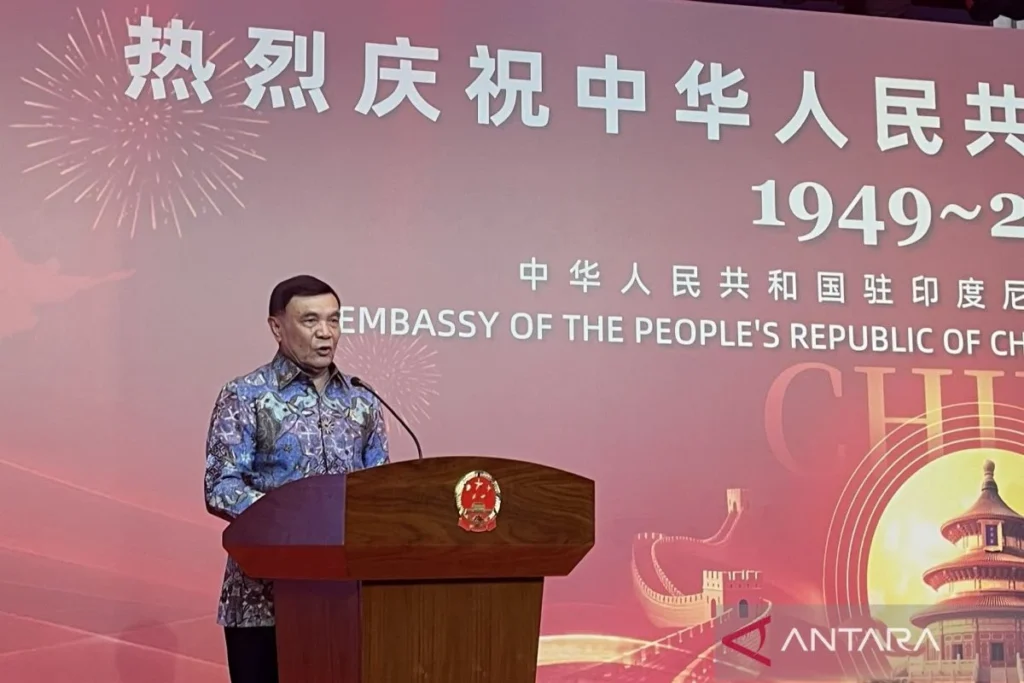
JAKARTA — Coordinating Minister for Political and Security Affairs Djamari Chaniago has urged China to reinforce its commitment to maintaining regional peace and stability in Southeast Asia, while actively upholding ASEAN Centrality. The appeal was made during a high-profile diplomatic reception in Jakarta celebrating the 77th National Day of the People’s Republic of China.
The event, which brought together senior Indonesian government officials, foreign diplomats, and business leaders, served as a platform to take stock of the rapidly evolving bilateral relations between Jakarta and Beijing. Amid escalating geopolitical dynamics in the Indo-Pacific region, Minister Djamari’s remarks underscored Indonesia’s strategic vision for an open, inclusive, and rules-based regional architecture.
Main Facts: A Strategic Diplomatic Engagement
The core of Minister Djamari’s address centered on the profound importance of the bilateral partnership between Indonesia and China, framing it as a critical pillar for regional security.
- The Core Appeal: Indonesia has formally requested China’s continued support for regional stability, peace, and the preservation of ASEAN Centrality—the principle that ASEAN must remain the driving force in shaping the regional architecture of Southeast Asia and the wider Indo-Pacific.
- Inclusive Regionalism: Emphasizing a cooperative approach, Minister Djamari stated that regional security cannot be achieved through exclusivity or bloc-building. Instead, it requires sustained dialogue, mutual trust, strict adherence to international law, and the peaceful management of differences.
- Broadening Partnerships: The scope of Indonesia-China relations extends far beyond traditional domains of trade and foreign direct investment. Both nations are deepening cooperation in political and security frameworks, maritime connectivity, people-to-people exchanges, and coordinated responses to complex global challenges.
- Diplomatic Milestones: Both governments highlighted the success of the Indonesia-China Comprehensive Strategic Dialogue and the inaugural "2+2" ministerial meeting—involving the foreign and defense ministers of both countries—held in Jakarta on August 21.
Chronology of Recent Bilateral Engagements
The diplomatic momentum between Indonesia and China has accelerated significantly over the past several months, marked by high-level exchanges and institutionalized mechanisms designed to foster strategic alignment.
Mid-August: Institutionalizing Security and Foreign Policy Dialogue
On August 21, Jakarta played host to a pivotal round of diplomatic consultations. The Indonesia-China Comprehensive Strategic Dialogue convened to review existing cooperative frameworks and map out future trajectories. Concurrently, the two nations conducted their inaugural "2+2" ministerial meeting. This format brought together Indonesia’s Minister of Foreign Affairs and Minister of Defense alongside their Chinese counterparts. The meeting signaled a qualitative leap in bilateral ties, integrating economic cooperation with rigorous defense and security coordination.
Late August to September: Legislative and Parliamentary Diplomacy
Further cementing the bilateral framework, the leadership of Indonesia’s legislative branch undertook high-level visits to Beijing. Notably, the Speaker of the People’s Consultative Assembly (MPR RI) traveled to the Chinese capital, where discussions reiterated mutual respect for sovereignty and core state policies, including the reaffirmation of the "One China" principle.
Tuesday Night: The 77th National Day Reception
The diplomatic apex of this recent cycle occurred on Tuesday night in Jakarta during the celebration of the 77th National Day of China. Attended by senior Indonesian cabinet ministers, military officials, and the Chinese diplomatic corps, the event provided an official stage for both nations to publicly validate the outcomes of their recent dialogues and project a unified stance on regional peace.
Supporting Data and Context: The Architecture of Indonesia-China Relations
To fully understand the weight of Minister Djamari’s remarks, it is essential to examine the multidimensional nature of the contemporary Indonesia-China partnership.
Trade and Economic Integration
China has remained Indonesia’s largest trading partner for over a decade. Bilateral trade volume encompasses critical raw materials, agricultural products, and high-tech manufactured goods. Infrastructure projects—most notably the Jakarta-Bandung High-Speed Railway ("Whoosh")—have served as physical manifestations of China’s Belt and Road Initiative (BRI) intersecting with Indonesia’s national development strategies. Beyond hard infrastructure, investments have heavily targeted downstream processing industries in Indonesia, particularly in nickel and other transition minerals vital to the global green economy.
Diplomatic and Security Infrastructure
The implementation of the "2+2" ministerial framework marks a maturation of bilateral security ties. Historically, Indonesia maintains a steadfast "free and active" (bebas aktif) foreign policy, avoiding formal military alliances. Consequently, security cooperation with major powers like China focuses on confidence-building measures, joint maritime search and rescue exercises, anti-piracy coordination, and defense diplomacy, rather than collective defense pacts.
Multilateral Alignment and ASEAN
ASEAN Centrality is the cornerstone of Indonesia’s foreign policy. As Southeast Asia’s largest economy and de facto leader of the bloc, Indonesia constantly navigates the strategic competition between major powers—specifically the United States and China—in the South China Sea and the broader Indo-Pacific. By explicitly calling on Beijing to support ASEAN Centrality, Jakarta is signaling that China’s regional ambitions must align with ASEAN-led mechanisms, such as the East Asia Summit (EAS) and the ASEAN Regional Forum (ARF), rather than bypassing them.
Official Responses: Perspectives from Jakarta and Beijing
The statements delivered during the National Day reception offered clear insights into how both capitals view the current state and future path of their bilateral relations.
Indonesia’s Perspective: Consistency and Transparency
Minister Djamari emphasized that the durability of the partnership rests on proactive communication and predictability.
"Trust between Indonesia and China is built through consistency, transparency, communication, and tangible cooperation," Djamari stated during his address.
He reiterated that Indonesia is unwavering in its commitment to an open and inclusive regional architecture. By explicitly linking bilateral relations to regional stability, Jakarta made it clear that its partnership with Beijing serves a broader regional good, rather than bilateral exclusivity.
China’s Perspective: Elevating the Comprehensive Strategic Partnership
Representing Beijing at the event, China’s Chargé d’Affaires to Indonesia, Zhou Kan, welcomed Indonesia’s overtures and reaffirmed Beijing’s readiness to deepen cooperation across all sectors.
"We are also ready to elevate the China-Indonesia Comprehensive Strategic Partnership to a higher level and work together to build a China-Indonesia community with a shared future," Zhou Kan declared.
The Chinese diplomat underscored that Beijing views Jakarta as an indispensable partner in the Global South, praising Indonesia’s independent foreign policy and its constructive role within multilateral forums like the G20, BRICS dialogue partners, and ASEAN.
Implications for Regional Stability and the Indo-Pacific
The dialogue between Indonesia and China holds profound implications not only for bilateral prosperity but also for the geopolitical stability of the wider Indo-Pacific region.
Managing South China Sea Tensions
One of the most delicate aspects of Indonesia-China relations involves maritime security, particularly overlapping claims and maritime rights in the South China Sea. While Indonesia is not a claimant state in the territorial disputes, portions of China’s unilaterally declared "Nine-Dash Line" (or "Ten-Dash Line") overlap with Indonesia’s Exclusive Economic Zone (EEZ) near the Natuna Islands.
By emphasizing the rule of international law—specifically the United Nations Convention on the Law of the Sea (UNCLOS)—and the peaceful management of differences, Minister Djamari’s remarks serve as a diplomatic reminder that adherence to global norms is non-negotiable for regional peace. The call for institutionalized dialogue ensures that potential maritime flashpoints can be managed through diplomatic channels rather than escalation.
The Test of ASEAN Centrality
For ASEAN, the coming years will test its ability to maintain unity and relevance amid intensifying US-China strategic competition. When major powers like China publicly endorse ASEAN Centrality, it provides diplomatic breathing room for Southeast Asian nations. However, translating diplomatic rhetoric into actionable restraint and cooperative maritime governance remains a continuous challenge. Indonesia’s proactive diplomacy ensures that Beijing remains engaged with ASEAN-led frameworks, reducing the risk of regional fragmentation.
Economic Resilience Amid Global Uncertainty
With global supply chains facing disruptions, protectionism on the rise, and macroeconomic volatility impacting emerging markets, the deepening economic and technological partnership between Indonesia and China provides a stabilizing anchor. Joint ventures in digital economy, green energy transition, and supply chain resilience will determine how effectively both nations can insulate themselves from external economic shocks.
Conclusion
As Indonesia and China continue to refine their Comprehensive Strategic Partnership, the balance between economic pragmatism and strategic autonomy remains paramount. Minister Djamari Chaniago’s address at the 77th Chinese National Day celebration effectively reaffirmed Indonesia’s diplomatic doctrine: welcoming robust, mutually beneficial cooperation with Beijing while firmly anchoring that partnership within the overarching framework of regional peace, international law, and undeniable ASEAN Centrality.