By: Muhammad Zulfikar (Adapted by AI) October 2026
Main Facts
Underneath the scorching sun of Desa Toro in Kulawi Sub-district, Sigi Regency, Central Sulawesi, a quiet revolution is taking place. Surrounded by sweeping rice fields and lush green hills, the simple L-shaped building of Madrasah Ibtidaiyah Swasta (MIS) Alkhairaat Toro pulses with a new kind of energy. Its dirt courtyard, sprinkled with small gravel, serves as the playground for students who are experiencing a technological awakening.
For the residents of this remote valley, the arrival of internet access is nothing short of a miracle. Until recently, the village suffered from deep digital isolation. Today, thanks to the grassroots initiative known as the Sekolah Internet Komunitas (Community Internet School), Desa Toro is rapidly transforming into a thriving digital village.
Founded in 2024 through a collaborative effort between local youth and civil society organizations Roa Jaga Roa and Common Room, the initiative has altered the trajectory of education, economy, and community life in Desa Toro. Once forced to travel an arduous 85-kilometer journey across treacherous, pothole-ridden mountain roads to Palu City just to complete computer-based exams, students and residents now access a world of knowledge from their own backyard.
The initiative has successfully integrated internet literacy into everyday life, improving local livelihoods through e-commerce, modernizing agricultural practices, and opening up global markets for local tourism. However, this journey is not merely about plugging in cables; it is a masterclass in community resilience, digital safety, and grassroots empowerment in the face of persistent infrastructure challenges.
Chronology: The Journey to Connectivity
From Isolation to Innovation (2024)
The story of Desa Toro’s digital transformation began with a vision shared by a group of determined local youth. Recognizing the profound educational and economic barriers faced by their community—where children struggled to access external knowledge and had to commute to Palu City for basic digital examinations—they decided to take matters into their own hands.
In 2024, in partnership with Roa Jaga Roa and Common Room, the Sekolah Internet Komunitas was officially established. Eight pioneering local youths underwent rigorous training, learning foundational technical skills such as network cable installation, router configuration, and basic system troubleshooting.
Among them was Fitri, a 27-year-old coordinator who initially battled self-doubt. In a region where technical infrastructure work was traditionally stereotyped as male labor, Fitri defied cultural expectations. She dismantled her own hesitations to pursue a singular, unwavering goal: making Desa Toro a benchmark for digital village development in Sigi Regency and across Central Sulawesi.
Adapting to Challenges: The Masjid Classroom
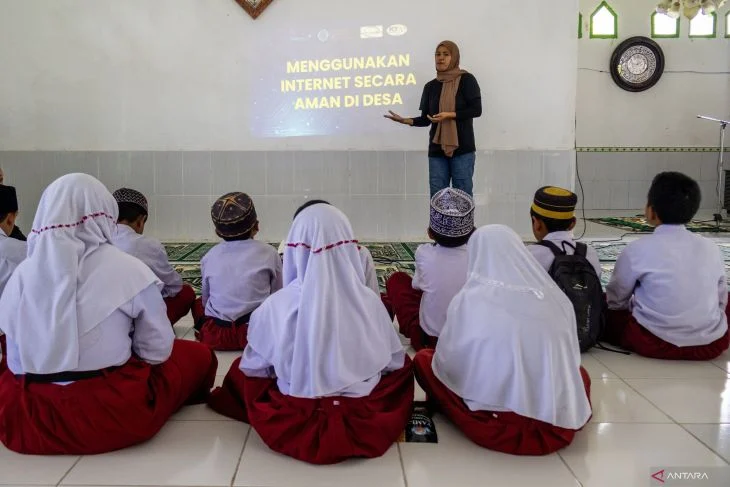
The resilience of the Sekolah Internet Komunitas was put to the test during a routine digital literacy outreach program at MIS Alkhairaat Toro. Just as students were eagerly anticipating an interactive projector-based lesson on internet safety rather than staring at traditional blackboards, the village experienced a sudden power outage.
Refusing to let the blackout stall their progress, Fitri and her team pivoted quickly. They approached the administrators of a nearby mosque, securing permission to utilize the house of worship. Equipped with a single laptop, a projector, and a battery backup system, the educators transformed the mosque into an impromptu digital classroom. Children who had just completed their Zuhr prayers gathered inside, their fatigue instantly replaced by curiosity as they dove into modules covering hoax detection, cyber hygiene, and the ethical use of technology.
Expanding Horizons: Beyond the Classroom
Over the span of two years, the network expanded rapidly, touching nearly every facet of rural life in Desa Toro:
Education: MIS Alkhairaat Toro students can now conduct online research and prepare for digital assessments locally, eliminating the hazardous 85-km journey to Palu City.
Commerce: Homemakers who previously relied on door-to-door selling now market traditional goods and local crafts nationwide via social media and digital marketplaces.
Agriculture & Trades: Local farmers utilize online resources to track optimal planting seasons, research advanced fertilizer applications, and learn modern agricultural techniques. Meanwhile, local vehicle mechanics turn to YouTube tutorials to troubleshoot complex motorcycle engine repairs.
Supporting Data and Technical Overview
The operational success of Desa Toro’s community internet network is supported by both grassroots determination and targeted regional policy frameworks.
The Cost of Isolation: In 2025, prior to comprehensive digital safety interventions, community members in parts of Sigi Regency suffered cumulative financial losses reaching Rp1 billion due to online scams and digital fraud. This crisis catalyzed aggressive, localized digital literacy campaigns.
Provincial Digital Equity Funding: The momentum in Desa Toro aligns seamlessly with the Central Sulawesi provincial government’s flagship program, "Berani Berdering" (Bravely Ringing), designed to eliminate blank spots in remote regions.
Budget Allocation (2026): The Provincial Government of Central Sulawesi allocated Rp10.3 billion in the 2026 fiscal year to expand the Berani Berdering program to 150 target villages.
Regional Quotas: Recognizing their recent graduation from disadvantaged region status, Sigi Regency and Tojo Una-Una Regency were prioritized, receiving dedicated allocations for 15 villages each, while other districts received 12 villages each.
Official Responses and Perspectives
Grassroots Leadership: Fitri, Coordinator of Sekolah Internet Komunitas
Fitri emphasizes that technical connectivity must be matched by robust digital protection. Following the devastating financial scams experienced by villagers in 2025, the community school made digital safety its highest priority.
"This education has yielded tangible results," Fitri stated proudly. "In several hamlets where we have conducted intensive outreach, we have successfully driven the number of online scam victims down to zero. Now, children can, to a certain extent, filter out harmful information from beneficial knowledge."
Educational Validation: Nurlia, Teacher at MIS Alkhairaat Toro
The pedagogical impact of the community internet school has drawn high praise from local educators. Nurlia recalls the immense difficulty teachers previously faced just to draft lesson plans or secure stable internet connections, often requiring trips to neighboring villages or Palu City.
"Before this community initiative existed, we were completely cut off," Nurlia shared. "Now, teachers can effortlessly design digital teaching materials. More importantly, the digital literacy training has transformed our students. They are learning critical thinking. As educators, we realize that screens carry risks, which is why our school enforces a strict ban on students bringing personal mobile phones to class unless explicitly authorized for supervised learning activities."
To mitigate online risks at home, MIS Alkhairaat Toro actively collaborates with parents, urging them to configure two-step verification on devices and install parental control applications to monitor children’s digital footprints.
Government Endorsement: Wahyu Agus Pratama, Head of Diskominfosantik Central Sulawesi
Wahyu Agus Pratama, Head of the Communication, Informatics, Cyberspace, and Statistics Office (Diskominfosantik) of Central Sulawesi, lauded Desa Toro as an exemplary best practice model for community-driven digital transformation.
"The existence of the Community Internet School in Desa Toro perfectly mirrors the spirit of our ‘Berani Berdering’ initiative," Wahyu noted. "We hope that community-led programs like this continue to scale local economic potentials while working in tandem with government infrastructure expansion to completely eradicate blank spots in Central Sulawesi."
Implications: The Future of Desa Toro and Rural Indonesia
The transformation of Desa Toro holds profound implications for rural development policy throughout Indonesia. It proves that bridging the digital divide requires more than simply erecting telecommunication towers; it demands community-owned infrastructure coupled with intensive, localized digital literacy.
1. Social and Educational Equity
By neutralizing geographical isolation, Desa Toro has leveled the playing field for its youth. Children are no longer disadvantaged by distance. They possess early exposure to global information networks, setting higher academic aspirations and developing critical thinking skills necessary to navigate the modern information ecosystem safely.
2. Economic Resilience and Local Autonomy
The shift toward e-commerce and digital literacy has unlocked micro-entrepreneurship. Women, farmers, and local artisans are no longer bound by traditional geographic bottlenecks. By connecting directly to national markets, household incomes are stabilizing and diversifying.
3. A Blueprint for Sustainable Policy
Desa Toro serves as a living blueprint for how public-private partnerships—bridging grassroots activists, non-profit organizations like Roa Jaga Roa and Common Room, and regional government agencies—can accelerate national development goals. If scaled correctly, the synergy between community-led education and provincial programs like Berani Berdering can serve as a scalable framework to modernize Indonesia’s thousands of remaining remote villages, ensuring that digital independence is achieved safely, inclusively, and sustainably.