PMKRI Leadership Embarks on a New Era: 2026–2028 Term Anchored in Pastoral Wisdom and National Civility
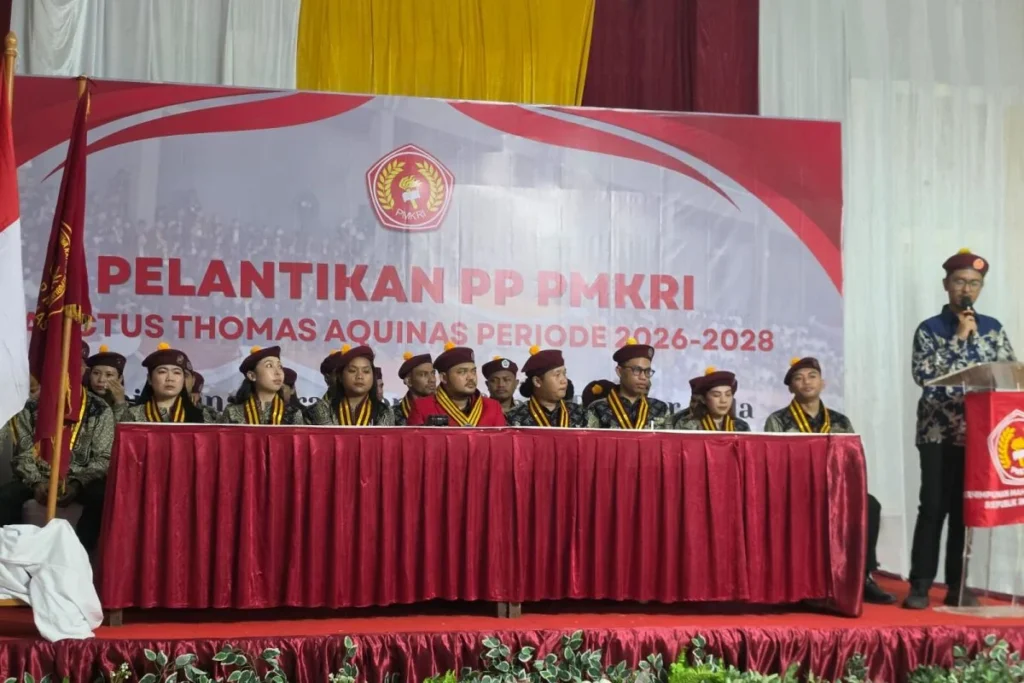
JAKARTA — In a solemn yet vibrant ceremony steeped in spiritual reflection and intellectual fervor, the Central Board of the Association of Catholic University Students of the Republic of Indonesia (PP PMKRI Sanctus Thomas Aquinas) officially inaugurated its new leadership for the 2026–2028 administrative term. Held in Jakarta on Monday, September 28, the event marked the beginning of a crucial two-year chapter for one of the nation’s most historic and influential Christian student movements.
At the helm of this new chapter is Christian Rettob, who assumed the role of Chairman of the Presidium of PP PMKRI for the 2026–2028 period. In his inaugural address, Rettob laid out an ambitious yet grounded vision for the organization. He firmly declared that the movement’s trajectory over the next two years will be deeply anchored in the national advice, moral corrections, and pastoral reflections articulated within the Pastoral Letter of the Indonesian Bishops’ Conference (KWI—Konferensi Waligereja Indonesia).
As Indonesia continues to navigate complex social, political, and economic landscapes, Rettob emphasized that the core mission of PMKRI will be to manifest a "path of hope" amidst national dynamics. This vision translates into a church and a student movement walking hand-in-hand to nurture public civility and reinforce humanitarian solidarity across the archipelago.
"PMKRI, with all the capabilities and potentials possessed by its cadres, will strive to internalize and implement these national advices," Rettob stated, as cited in an official press statement released in Jakarta on Tuesday.
The inauguration was not merely an administrative handover; it served as a powerful rallying cry for Catholic youth across Indonesia to step up as moral guardians, intellectual catalysts, and active participants in societal development.
Main Facts
The inauguration of the PP PMKRI 2026–2028 board is a landmark event for the organization, characterized by several key pillars:
- Core Ideological Anchor: The new administration’s strategic direction is explicitly guided by the Pastoral Letter of the Indonesian Bishops’ Conference (KWI), focusing on public civility and humanitarian solidarity.
- Leadership Team: Christian Rettob officially took office as the Chairman of the Presidium of PP PMKRI for the 2026–2028 term, succeeding the previous administration.
- Dual Focus on Action and Cadre Development: The organization has committed to balancing grassroots social action alongside continuous, rigorous intellectual, spiritual, and organizational capacity-building for its members.
- Preservation of Ideals: Senior alumni and founding figures, represented by Gaudens Wodar (Chairman of the Presidium of PP PMKRI for 1988–1990), issued a stern warning to the new board to fiercely guard their idealism against external compromises.
- Spiritual Foundation: The event was consecrated through a solemn Holy Eucharist (Misa) and a Rite of Commissioning, led by prominent clergy members who challenged the youth to translate faith into impactful public service.
- Broad Solidarity: The ceremony drew widespread attendance, featuring prominent leaders from various national student and youth organizations, alongside a formidable reunion of former PP PMKRI Chairmen spanning four decades from 1985 to the present day.
Chronology of the Inauguration Event
The proceedings of September 28, 2026, followed a meticulously structured program that blended liturgical sanctity with organizational gravity, reflecting PMKRI’s dual identity as a Catholic institution and a secular student movement.
1. The Eucharistic Celebration and Commissioning
The day’s events commenced with a solemn Holy Mass, pastoral blessings, and the formal commissioning of the incoming board members. The Eucharistic celebration was presided over by Father Hans Jeharut, who was accompanied by concelebrants Father Lukas Kelwulan and Father Joseph El.
During his homily, Father Hans urged the newly appointed board members not to view the inauguration as an endpoint or a mere ceremonial milestone. Instead, he challenged them to immediately translate their organizational mandate into concrete, tangible works within society. Father Hans stressed that PMKRI holds a vital historical mission to help construct a higher standard of public civility, pushing student cadres to design movements that leave a lasting, positive footprint on the lives of ordinary citizens.
2. The Formal Inauguration and Presidential Address
Following the liturgical service, the official transition of power and swearing-in ceremony took place. Christian Rettob delivered his maiden speech as the newly installed Chairman of the Presidium. He outlined how the organization plans to operationalize the KWI’s Pastoral Letter over the next 24 months.
Rettob noted that the path of hope in contemporary Indonesia requires a deliberate, collective effort. By walking alongside marginalized communities and civil society, PMKRI aims to heal social fractures and champion human dignity. He formally exhorted all regional branches and individual cadres to align their local agendas with the overarching vision of fostering public civility and humanitarian solidarity.
3. Alumni Wisdom and Intergenerational Dialogue
A unique highlight of the chronology was the passing of the torch not just in terms of administration, but in philosophical resilience. Gaudens Wodar, representing the Anggota Penyatu (Unifying Members/Alumni Association) and drawing from his own tenure as Chairman of the Presidium from 1988 to 1990, addressed the hall. His remarks provided a historical bridge, connecting the struggles of past decades with the modern challenges facing today’s youth.
The event concluded with a grand reception and networking session, bringing together current leaders, alumni stretching back to the mid-1980s, and invited guests from peer student organizations across Indonesia. This gathering reinforced the extensive social capital and institutional memory that underpins PMKRI’s operational framework.
Supporting Data and Institutional Context
To fully understand the weight of PMKRI’s 2026–2028 strategic direction, one must examine the organizational ecosystem and historical weight it carries within Indonesia’s socio-political fabric.
Organizational Longevity and Alumni Network
Founded on March 17, 1947, PMKRI has functioned for nearly eight decades as a primary incubator for Catholic intellectuals, public servants, politicians, lawyers, and civil society leaders in Indonesia. The presence at the inauguration of former Presidium Chairmen spanning from 1985 to the present day highlights the unique intergenerational continuity of the association. This robust alumni network (Anggota Penyatu) acts as both a safety net and a sounding board for active cadres, ensuring that the organization does not drift from its foundational ethos during times of political turbulence.
Alignment with the Indonesian Bishops’ Conference (KWI)
The decision to ground the 2026–2028 strategic roadmap in the KWI’s Pastoral Letter reflects a deliberate pivot toward moral theology in public life. The Indonesian Catholic Church, through the KWI, frequently issues pastoral guidance addressing socio-economic disparities, environmental degradation, corruption, and threats to national pluralism. By binding its movement to these documents, PMKRI positions itself not merely as a political pressure group, but as an extension of the Church’s social teachings (Caritas and Justitia) in the public sphere.
The Dual Track: Grassroots Action and Cadre Formation
Rettob’s strategic framework emphasizes a symbiotic relationship between external action and internal strengthening. According to internal organizational documents and structural traditions, PMKRI’s sustainability depends on two simultaneous tracks:
- External Impact: Engaging directly with societal issues—such as advocating for marginalized communities, participating in public discourse on human rights, and partnering with local and central governments on developmental issues.
- Internal Development: Maintaining a tiered cadre training system (Basic, Intermediate, and Advanced Training) designed to fortify members intellectually through critical philosophy and theology, spiritually through retreats and liturgical life, and organizationally through democratic governance.
Official Responses and Key Messages
The speeches and charges delivered during the inauguration encapsulate the ethical boundaries and expectations placed upon the new leadership team.
Christian Rettob: Internalizing National Advice
In his address, Chairman Christian Rettob underscored that high-sounding rhetoric must be replaced by deep internalization and practical implementation.
"PMKRI, with all the capabilities and potentials possessed by its cadres, will strive to internalize and implement these national advices," Rettob affirmed.
He stressed that the organization’s initiatives must directly address the moral and ethical deficits sometimes observed in contemporary Indonesian public life, making the preservation of national unity and ethical governance a non-negotiable priority.
Gaudens Wodar: The Invaluable Currency of Idealism
Perhaps the most visceral warning of the day came from veteran leader Gaudens Wodar. Speaking on behalf of the senior alumni, Wodar addressed the perennial temptation faced by student leaders: co-optation by partisan interests or pragmatic compromises.
"This is one of the precious treasures of the association that must be guarded. Do not let it be easily bought. Guard your idealism," Wodar cautioned the new board members with sharp conviction.
His words served as a sobering reminder that student movements lose their moral legitimacy the moment they become transactional tools for external power brokers. For PMKRI, maintaining an independent, critical, yet constructive voice remains its highest currency.
Father Lukas Kelwulan: Preserving Catholic Identity
Adding a profound spiritual and existential dimension to the warnings, Father Lukas Kelwulan reminded the newly sworn-in officials of their foundational identity. He cautioned them against diluting their moral compass in the face of modern secular pressures or political opportunism.
"You have been educated since childhood with holy, sacred, and apostolic Catholic values. Guard that, do not let any situation make you lose that," Father Lukas asserted firmly.
This admonition served to bridge the gap between faith and public duty, reminding cadres that intellectual brilliance and political acumen must always be tempered by Christian virtue, humility, and a preferential option for the poor and marginalized.
Implications for PMKRI and the Broader National Landscape
The inauguration of the PP PMKRI 2026–2028 board under Christian Rettob carries significant implications both for the internal ecosystem of the student organization and for Indonesia’s wider socio-political environment.
1. Strengthening Public Advocacy and Civil Society Engagement
By committing to the KWI’s Pastoral Letter, PMKRI signals an intensification of its advocacy work. In an era where civil space and public civility are frequently tested by polarization, populist rhetoric, and economic inequality, a principled student movement grounded in ethical theology can serve as an effective mediator. The emphasis on humanitarian solidarity suggests that the incoming board will likely prioritize campaigns related to social justice, environmental stewardship (tying into broader Catholic encyclicals like Laudato si’), and the defense of Indonesia’s pluralistic foundations (Pancasila and the 1945 Constitution).
2. Constructive Partnerships with the State
While maintaining its critical idealism—as strongly advised by veteran Gaudens Wodar—PMKRI simultaneously recognizes the necessity of institutional engagement. As highlighted in parallel organizational commitments regarding partnerships with central and local governments, the new leadership faces the delicate task of being a "critical partner" to the state. They must be capable of offering intellectual and policy contributions to national development while retaining the moral courage to hold authorities accountable when policies clash with public welfare and human rights.
3. Elevating the Quality of Youth Leadership
In a broader national context where youth demographics dominate the electorate, the moral and intellectual caliber of student organizations like PMKRI sets a benchmark for the nation’s future leaders. By insisting on rigorous internal training—spanning intellectual depth, spiritual grounding, and organizational discipline—PMKRI ensures that its graduates step into national life not as opportunistic careerists, but as morally grounded public servants.
As Christian Rettob and his team formally take up the mantle for the 2026–2028 term, the eyes of thousands of cadres nationwide and a proud community of alumni are turned toward the future. Armed with the pastoral wisdom of the KWI, the warnings of elder statesmen, and a renewed commitment to public civility, PP PMKRI stands poised to navigate the turbulent waters of modern Indonesian democracy with integrity, faith, and unyielding hope.