From Sci-Fi to Reality: The Dawn of Humanoid Combat Sports in Shenzhen
Introduction: The Realization of a Cinematic Vision
In 2011, the blockbuster film Real Steel, starring Hugh Jackman, captivated global audiences with a vision of a future where human boxers were replaced by towering, remote-controlled mechanical titans. At the time, the idea of agile, bipedal humanoid robots engaging in high-intensity martial arts was relegated to the realm of expensive CGI and imaginative storytelling. Critics and engineers alike suggested that the laws of physics, specifically regarding bipedal balance and hydraulic latency, would keep such spectacles firmly in the world of fiction for decades.
Fast forward fifteen years to July 2026, and the city of Shenzhen—often dubbed the "Silicon Valley of Hardware"—has proven the skeptics wrong. The "Ultimate Robot Knock-out Legend" (URKL) has officially transitioned from a conceptual dream into a visceral, metal-clashing reality. This inaugural event marks a watershed moment in both the entertainment and robotics industries, signaling a new era where high-stakes sports and cutting-edge artificial intelligence converge in the center of the ring.
Main Facts: The URKL Phenomenon
The Ultimate Robot Knock-out Legend (URKL) is the world’s first professional sports league dedicated exclusively to full-contact, humanoid robot combat. Unlike previous iterations of robot fighting—such as the popular BattleBots series, which featured low-profile, wheeled "wedges" and spinning blades—the URKL focuses on bipedal humanoids that mimic the form and movement of human athletes.
The event, organized by Shenzhen-based robotics pioneer EngineAI, took place at the Shenzhen Nanshan Cultural and Sports Center. The competition utilizes a standardized hardware platform: the EngineAI T800. Standing at 1.73 meters (approximately 5 feet 8 inches), the T800 is a marvel of modern engineering, designed to withstand the immense centrifugal forces of spinning kicks and the blunt-force trauma of heavy-duty uppercuts.
Key highlights of the event include:
- Standardized Hardware: All 32 competing teams utilize the T800 chassis, ensuring that the victory depends on the team’s proprietary software, control algorithms, and pilot strategy.
- Global Participation: Despite being hosted in China, the tournament attracted 32 elite teams from across the globe, representing top-tier technical universities and private R&D firms.
- High-Stakes Combat: The matches are not choreographed. They are live, high-intensity bouts where robots are programmed to seek knockouts while maintaining their own structural integrity.
Chronology: A Night of Metallic Fury
The URKL inaugural night began with a grand opening ceremony on Thursday evening, setting a tone of high-tech spectacle that rivaled the production value of the Olympic Games. The Nanshan Cultural and Sports Center was packed with a capacity crowd, a mix of tech enthusiasts, venture capitalists, and curious locals.
The Opening Ceremony
The event was inaugurated with a speech by martial arts legend Donnie Yen. Known for his role in the Ip Man series, Yen’s presence bridged the gap between traditional Chinese martial arts and the future of robotics. Following the opening remarks, the lights dimmed, and the "White Eagle" and "Matador" robots were introduced to the ring under pulsating neon lights.
The Main Event: White Eagle vs. Matador
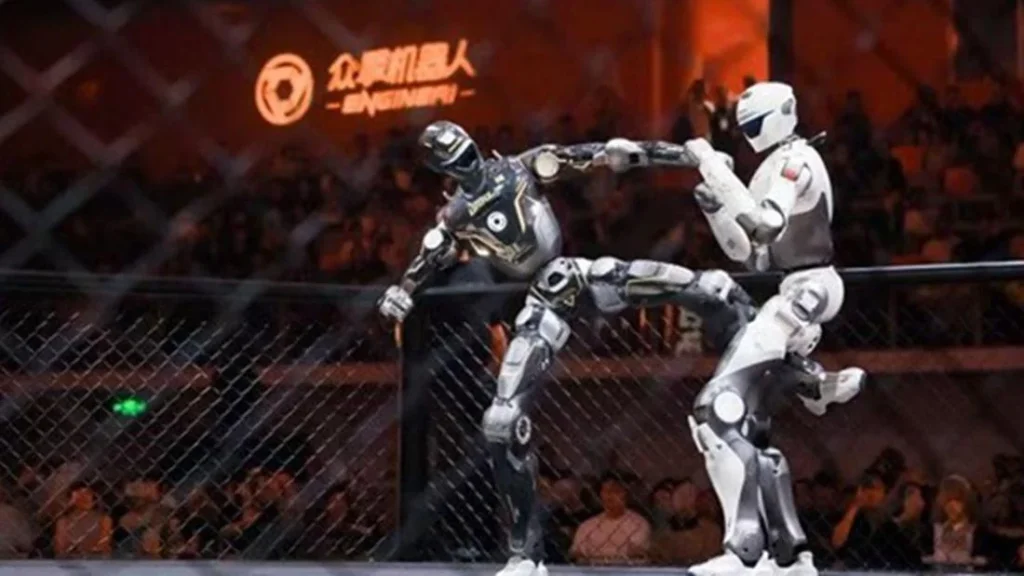
The debut match served as a proof-of-concept for the entire league. White Eagle, representing a local Shenzhen engineering collective, faced off against Matador, a robot tuned by an international consortium of developers.
From the opening bell, the atmosphere was electric. The two T800 units did not merely shuffle toward each other; they displayed a level of "dynamic perception" previously unseen in public demonstrations. They circled one another, testing range with jabs. The crowd erupted when White Eagle successfully executed a spinning back-kick, a move that requires immense computational power to maintain balance upon impact.
The climax of the match occurred in the second round. After a flurry of exchanges, White Eagle landed a precise, high-torque uppercut. The force of the blow surpassed the structural threshold of Matador’s neck actuators. In a scene reminiscent of a Hollywood thriller, Matador’s head was severed from its chassis, leading to an immediate victory for White Eagle and a standing ovation from the audience.
The Tournament Progression
Following the opening bout, the tournament transitioned into a knockout format. Over the course of the weekend, the 32 teams were whittled down as the robots suffered various degrees of mechanical failure, from shattered optical sensors to hydraulic leaks. Each match provided a wealth of data for the engineers, who were seen frantically coding and swapping modular parts in the "pit" area between rounds.
Supporting Data: The Engineering Behind the T800
The success of the URKL is built upon the technical capabilities of the EngineAI T800. To understand the magnitude of this achievement, one must look at the specifications that allow a 1.73-meter humanoid to fight.
1. Posture Control and Balance
The primary challenge of bipedal combat is maintaining balance. When a robot throws a punch, its center of gravity shifts. When it receives a punch, it must absorb and dissipate that kinetic energy. The T800 utilizes a "Whole-Body Control" (WBC) algorithm that processes data from inertial measurement units (IMUs) at a rate of 1,000 times per second, allowing it to adjust its stance instantaneously to prevent a fall.
2. Impact Absorption
EngineAI developed specialized "shock-absorbent joints" for the T800. These joints use a combination of harmonic drives and liquid-cooled actuators that can momentarily "yield" during an impact to prevent the metal from snapping, then immediately regain rigidity to counter-attack.
3. Judging Criteria
The URKL does not rely solely on knockouts. Matches are scored by a panel of human judges and an AI "referee" based on four distinct categories:
- Effective Aggression: The number of landed strikes that cause visible displacement or damage to the opponent.
- Body Stability: The ability to maintain a bipedal stance under pressure and the speed of recovery after a fall.
- Defense and Evasion: The successful use of parries, blocks, and lateral movement to avoid damage.
- Overall Durability: The functional state of the robot at the end of the round, including sensor health and limb mobility.
Official Responses: Visionaries and Icons
The event drew significant commentary from leaders in both the entertainment and technology sectors, highlighting the dual nature of the URKL as both a sport and a laboratory.
Donnie Yen, Actor and Martial Artist:
"Today is the first time I have witnessed real robots fighting in a ring. Watching this historic breakthrough in person is a completely different experience from seeing it on a movie screen. The precision of the machinery and the fluidity of the movements are truly extraordinary. It is no longer just about gears and wires; it is about the spirit of competition translated into code."
Zhao Tongyang, CEO of EngineAI:
During a post-event press conference, Zhao emphasized that the URKL is a means to an end. "Our goal is to promote the commercialization of humanoid robots. By putting these machines in a high-stress environment like a combat ring, we accelerate the R&D cycle. The failures we see tonight—like a head being knocked off—are invaluable data points. This competition drives industrialization. The technology we develop for balance and impact resistance in the ring will eventually be used in search-and-rescue robots, elderly care, and domestic service."
Shenzhen Municipal Government Representative:
A spokesperson for the Nanshan District Bureau of Industry and Information Technology noted: "The URKL exemplifies Shenzhen’s commitment to the ‘Robot +’ strategy. We are not just manufacturing hardware; we are creating an ecosystem where software, entertainment, and advanced manufacturing intersect to lead the global market."
Implications: The Future of Robotics and Society
The successful launch of the URKL has far-reaching implications that extend beyond the walls of the sports arena.
1. Accelerated Technological Spillover
The "stress-test" environment of robot combat is perhaps the fastest way to improve humanoid agility. The algorithms developed to help a T800 dodge a punch are the same algorithms that will help a future robot navigate a cluttered disaster zone or walk steadily on a moving ship. By gamifying R&D, EngineAI has created a self-funding model for advanced robotics research.
2. The Birth of a New Entertainment Economy
The URKL has the potential to become a massive global franchise. With 32 teams already involved, the league is looking at broadcasting rights, team sponsorships, and even "pilot" celebrities. Much like Formula 1 serves as a testing ground for consumer automotive technology, URKL could become the premier showcase for the next generation of consumer electronics.
3. Ethical and Safety Considerations
As humanoid robots become more capable of "baku hantam" (brawling), discussions regarding safety protocols will intensify. The T800 is a powerful machine; the force required to decapitate another metal robot is more than enough to be lethal to a human. The URKL currently operates under strict "kill-switch" protocols and physical barriers, but as the AI becomes more autonomous, the industry will need to establish rigorous ethical guidelines for the "combat" programming of machines.
4. Geopolitical Technological Leadership
The fact that this event took place in Shenzhen, with predominantly Chinese-designed hardware, underscores China’s aggressive push to dominate the humanoid robotics market by 2030. While companies like Boston Dynamics (USA) have long led in agility demonstrations, the URKL represents a shift toward mass-produced, standardized, and commercially viable humanoid platforms.
Conclusion
The "Ultimate Robot Knock-out Legend" in Shenzhen has officially moved the needle of human history. What was once a cinematic fantasy in Real Steel is now a tangible, clanging reality. As the 32 teams refine their algorithms for the next round of the tournament, the world watches not just for the spectacle of the fight, but for the glimpse it provides into a future where humanoid machines are an integral part of our lives—be it in the ring, the factory, or the home. The decapitation of "Matador" was not just a loss for one team; it was a loud, metallic announcement that the age of the humanoid has truly arrived.