Beyond the Drawer: UCLA Researchers Transform Old Android Smartphones into the Brains of Advanced Bipedal Robots
JAKARTA — In an era defined by rapid technological obsolescence, millions of discarded or forgotten smartphones sit gathering dust in household drawers worldwide. While most consumers view these aging devices as electronic waste destined for recycling plants or landfills, a team of forward-thinking researchers at the University of California, Los Angeles (UCLA) has unlocked a remarkably innovative second life for them.
Rather than letting yesterday’s technology fade into obscurity, these scientists have successfully repurposed older Android smartphones to serve as the high-powered central nervous system and computational core for an autonomous, bipedal robot. Christened "PhoneBot," this groundbreaking creation is capable of walking independently, tracking human movements in real-time, and even recovering its footing autonomously after a fall.
By bypassing the need for expensive, specialized computing hardware and proprietary sensor suites, the UCLA project fundamentally democratizes the field of robotics. It bridges the gap between consumer electronics and advanced automation, proving that the pocket-sized computer you abandoned years ago still possesses more than enough processing power to drive mechanical marvels.
Main Facts: Anatomy and Capabilities of PhoneBot
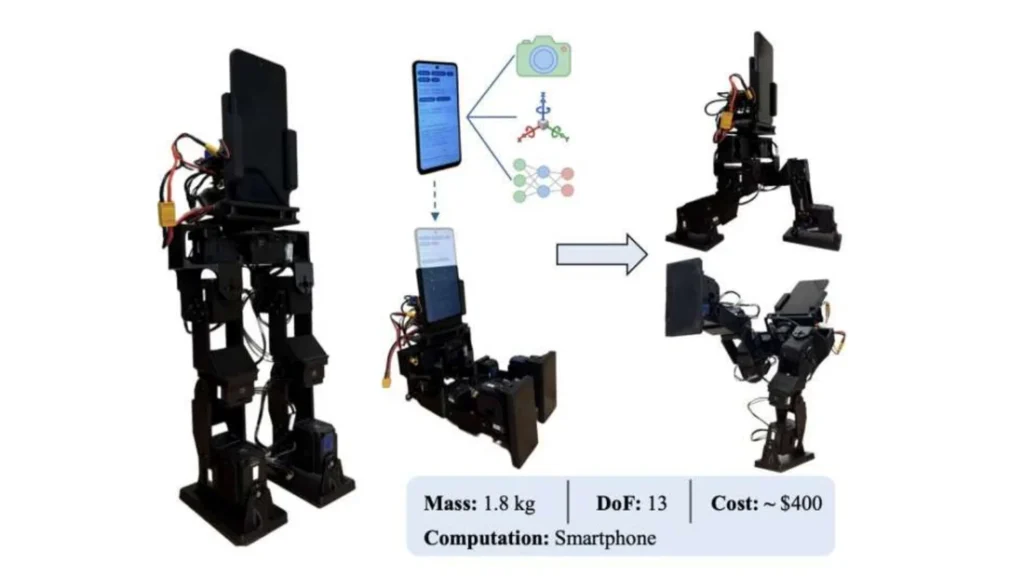
At its core, PhoneBot is a masterclass in resourceful engineering. Standing at approximately 48 centimeters (18.9 inches) tall and tipping the scales at a modest 1.8 kilograms—a total weight that includes the mounted smartphone—the robot strikes a delicate balance between structural integrity and agile mobility.
Unlike traditional humanoid robots that require dedicated, high-end microcomputers, complex vision systems, and expensive LiDAR arrays, PhoneBot leverages the deeply integrated hardware already present inside a standard smartphone.
The Smartphone as the Central Nervous System
When integrated into the robot, the smartphone is mounted securely on the upper torso, positioned directly above the hips. In this command position, the phone’s onboard hardware takes on multiple critical responsibilities:
- Computer Vision and Tracking: The smartphone’s primary camera acts as the robot’s eyes. It continuously scans the immediate environment, processes visual data to recognize surroundings, and actively tracks the movement of human operators.
- Spatial Awareness and Orientation: The internal Inertial Measurement Unit (IMU)—comprising accelerometers and gyroscopes—provides real-time feedback regarding the robot’s physical posture, velocity, and spatial orientation.
- Central Processing: The smartphone’s internal processor executes the complex software algorithms that dictate locomotion and behavioral responses. Once the software calculates the necessary movements, command signals are transmitted via Wi-Fi to an onboard microcomputer, which subsequently relays instructions directly to the mechanical actuators.
Mechanical Design and Actuation
Despite its budget-friendly profile, PhoneBot is mechanically sophisticated. The robot is propelled by a total of 13 individual motors. Each of its two legs features six degrees of freedom driven by six distinct motors, allowing for fluid, articulated walking patterns. An additional thirteenth motor is dedicated entirely to rotating the robot’s upper body. This specific design choice allows the camera to pan from side to side to scan the environment without requiring the robot to constantly shift its feet, vastly improving efficiency and stability.
Chronology: From Concept to Autonomous Bipedal Locomotion
The realization of PhoneBot did not happen overnight; it represents a meticulous timeline of prototyping, software integration, and physical testing.
Phase 1: Conceptualization and Hardware Sourcing (Early Development)
The project began with a fundamental question: How can we lower the financial barrier to entry for robotics research? The UCLA research team realized that modern smartphones are essentially dense packages of high-performance computing, advanced sensors, and wireless connectivity. By designing a lightweight mechanical chassis around a standard phone form factor, they could slash development costs. The hardware cost for the chassis, frame, and actuators was kept to an estimated $400 USD (approximately Rp 6.7 million), excluding the cost of the smartphone itself.
Phase 2: Multi-Device Compatibility Testing
To ensure the platform was truly versatile and not reliant on ultra-specific hardware, the researchers subjected PhoneBot to rigorous compatibility tests using four distinctly different Android smartphones spanning several generations:
- Honor 9 (Released 2017): An aging flagship representing older budget constraints.
- Moto G (2024 Edition): A modern, budget-friendly consumer device.
- Moto G (2025 Edition): An iterative update testing slightly newer mid-range architectures.
- Samsung Galaxy A16 5G: A contemporary, highly accessible 5G-enabled smartphone.
During these trials, researchers discovered that all four devices successfully managed the core competencies of the robot: sensory input, movement control, and camera-based vision processing. However, minor limitations emerged; for instance, the 2017 Honor 9 struggled with advanced mapping features due to the absence of up-to-date Google Play Services and required framework dependencies.
Phase 3: Physical Demonstrations and Real-World Stress Tests
Following successful bench testing, PhoneBot was put through a series of demanding physical demonstrations:
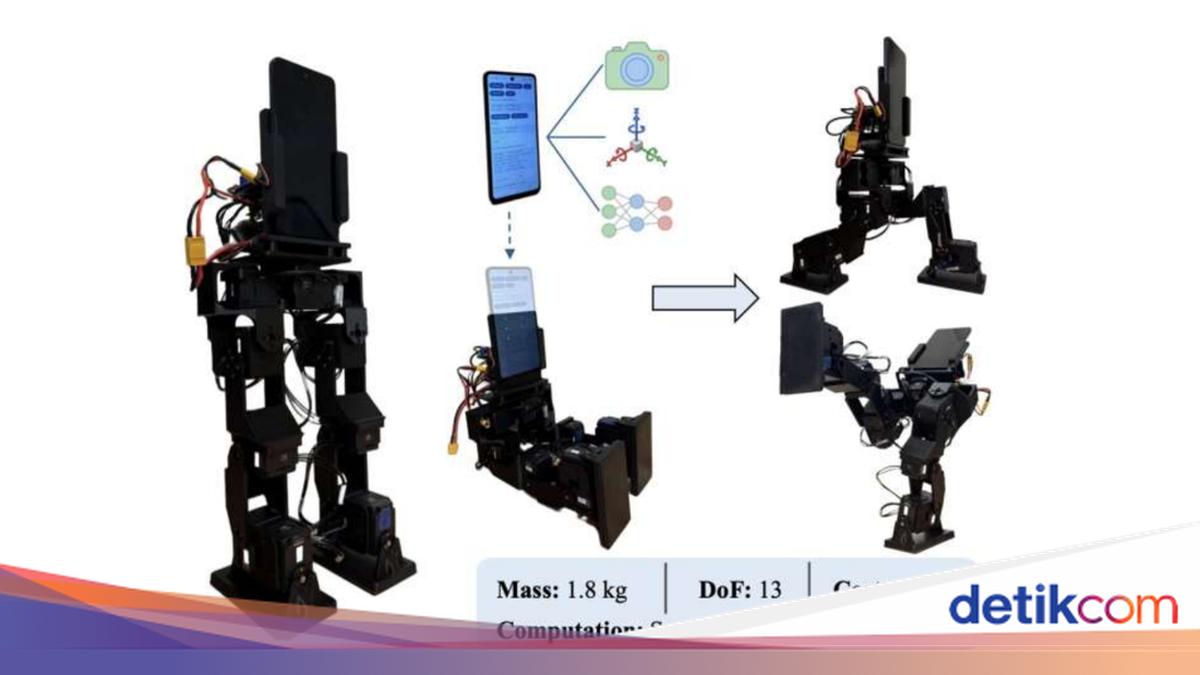
- Bipedal Walking: The robot successfully executed stable, forward bipedal locomotion across flat indoor surfaces.
- Human Tracking: Utilizing its mounted camera and real-time image processing, PhoneBot visually locked onto a human researcher and autonomously followed their path across a room.
- Self-Righting Mechanism: In one of the most impressive displays of dynamic control, the robot was intentionally laid flat on its stomach. Using its integrated motor coordination and spatial awareness sensors, PhoneBot successfully executed a complex sequence of physical movements to push itself back up into an upright, standing position.
Supporting Data and Technical Breakdown
To fully appreciate the scope of the UCLA PhoneBot initiative, examining the financial, computational, and mechanical metrics provides vital context.
| Technical Parameter | Specification / Detail |
|---|---|
| Total Height | ~48 cm (18.9 inches) |
| Total Weight | 1.8 kg (including the smartphone) |
| Hardware Cost (Excluding Phone) | ~$400 USD (~Rp 6.7 million) |
| Actuation System | 13 Total Motors (6 per leg, 1 for torso rotation) |
| Communication Protocol | Wi-Fi bridge between Smartphone and Onboard Microcomputer |
| Tested Devices | Honor 9 (2017), Moto G (2024), Moto G (2025), Samsung Galaxy A16 5G |
The utilization of low-cost, commercially available hobbyist motors does present inherent physical limitations. Because the actuators are designed for budget applications, they impose strict constraints on the robot’s payload capacity and dynamic intensity. PhoneBot cannot currently carry heavy external payloads, nor is it optimized for high-speed running or aggressive acrobatics. Furthermore, its current locomotion algorithms are strictly calibrated for smooth, flat indoor terrain.
Official Responses and Academic Vision
The unveiling of PhoneBot has sent ripples through the international academic and robotics communities. In statements released alongside their technical documentation, the UCLA research team emphasized that PhoneBot was conceptualized from the ground up as an open-source platform.
"The primary obstacle in modern robotics education and grassroots research has never been a lack of brilliant ideas; it has always been the prohibitive cost of hardware," noted lead members of the research collective. "By demonstrating that a discarded smartphone can replace a thousand-dollar computing and sensor stack, we are opening doors for classrooms, independent makers, and developing-world institutions."
Academic peers have widely praised the project for its ingenuity in the realm of sustainable technology. By extending the functional lifecycle of consumer electronics, the project aligns closely with global initiatives aimed at reducing electronic waste (e-waste). Instead of hazardous lithium-ion batteries and complex circuit boards rotting away in landfills, they are actively contributing to advanced scientific inquiry.
Furthermore, educational institutions have expressed profound interest in adopting the PhoneBot framework. Computer science and engineering departments can utilize the open-source blueprints to teach students mobile robotics, computer vision integration, and kinematics without requiring millions of dollars in laboratory endowments.
Implications and Future Horizons
While PhoneBot represents a massive leap forward in accessible engineering, the UCLA researchers are candid about its current boundaries and are already charting an ambitious roadmap for the future.
Overcoming Current Limitations
At present, PhoneBot lacks upper-body appendages. The absence of arms means the robot is restricted to mobility and tracking tasks, unable to physically interact with or manipulate its environment. Additionally, its inability to traverse rough, uneven terrain limits its deployment to controlled indoor environments.
The Roadmap Ahead
To address these shortcomings, the research team has outlined several critical upgrades slated for future iterations of the project:
- All-Terrain Locomotion: Developers are actively working on advanced machine learning algorithms and adaptive balance control systems to allow PhoneBot to navigate gravel, grass, slopes, and broken indoor flooring.
- Integration of Lightweight Arms: Future versions will incorporate lightweight, low-cost robotic manipulators, enabling the robot to pick up objects, open doors, and perform basic assistive tasks.
- E-Waste Upcycling Advocacy: The team hopes to partner with environmental organizations to collect functional, discarded smartphones on a larger scale, turning e-waste collection drives into community-driven robotics workshops.
A Paradigm Shift for Robotics
The broader implications of the PhoneBot project extend far beyond the laboratory walls. As artificial intelligence models become increasingly optimized to run locally on mobile processors, the synergy between smartphones and robotics will only deepen. We may soon see a world where upgrading your phone doesn’t mean tossing the old one away, but rather retiring it to a mechanical body that can help around the house, monitor your home security, or serve as an educational companion for your children.
Ultimately, UCLA’s PhoneBot challenges our perception of obsolescence. It serves as a powerful reminder that with enough creativity, code, and mechanical ingenuity, yesterday’s pocket-sized computer can easily become the beating heart of tomorrow’s robotics revolution.