From ACL Rupture to Global Glory: How Rodri Defied the Odds to Claim the 2026 World Cup Golden Ball
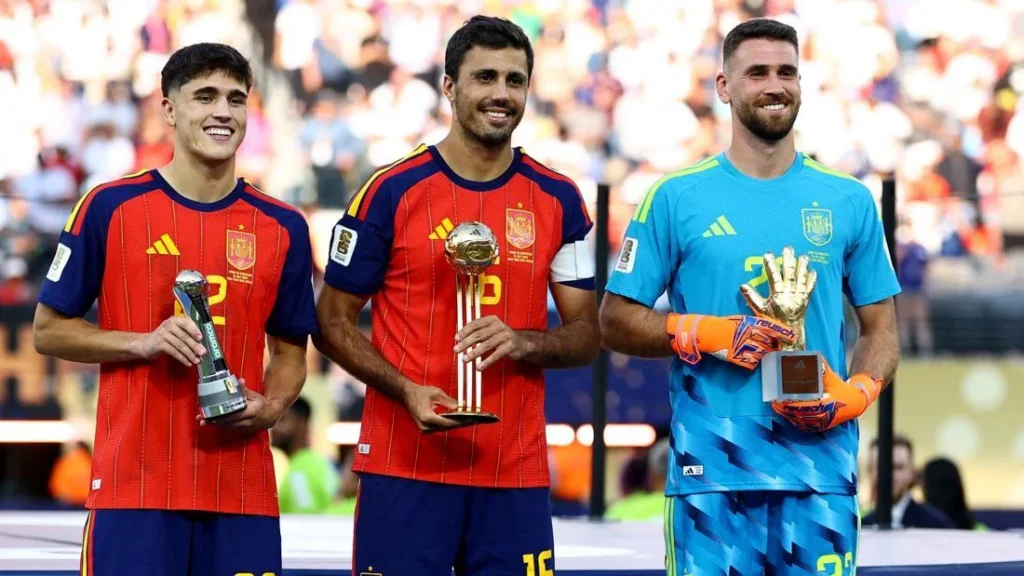
JAKARTA – In the annals of football history, there are stories of talent, stories of tragedy, and then there are stories of absolute, unwavering resilience. Rodrigo Hernández Cascante, universally known as Rodri, has just authored the most improbable chapter in modern football history. On the global stage of the 2026 FIFA World Cup, the Spanish midfield maestro did not merely participate; he conquered. By hoisting the World Cup trophy for Spain and being awarded the prestigious Golden Ball as the tournament’s best player, Rodri has cemented his status as a sporting immortal, standing shoulder-to-shoulder with legends like Lionel Messi, Zinedine Zidane, and Ronaldinho.
Yet, this triumph is far more than a tale of tactical brilliance. It is a story of a man who stared into the abyss of a career-threatening injury and refused to blink.
The Darkest Hour: September 22, 2024
To understand the magnitude of Rodri’s achievement, one must look back to the cold reality of autumn 2024. On September 22, during a high-stakes Premier League clash between Manchester City and Arsenal, the football world stood still. In a routine challenge, Rodri’s knee buckled. The diagnosis that followed sent shockwaves through the sport: a complete rupture of the Anterior Cruciate Ligament (ACL) and significant damage to the meniscus.
For any professional athlete, an ACL injury is the "spectre of death." It is a complex, painful, and notoriously difficult recovery process that often robs players of their pace, their agility, and their psychological edge. The medical verdict was clear: Rodri would be sidelined for the remainder of the 2024-2025 season. As the months passed, pundits and critics began to whisper that the reigning 2024 Ballon d’Or winner might never return to the level of dominance that made him the heartbeat of both Manchester City and the Spanish National Team.
A Chronology of Redemption
The road to the 2026 World Cup was paved with solitude, grueling rehabilitation, and relentless dedication.
- September 2024: The injury occurs. Surgery is performed, and the long road to recovery begins.
- October 2024 – February 2025: Rodri undergoes intense physical therapy. During this phase, he focuses on psychological fortitude, distancing himself from the noise of the media to focus on his knee’s structural integrity.
- March 2025 – May 2025: The "re-conditioning" phase. Rodri begins light ball work. He later describes this period as a time of "re-learning how to trust the body."
- June 2025 – August 2025: Gradual integration back into Manchester City’s training camp. He misses the end of the club season to ensure he is 100% prepared for the demands of the upcoming campaign.
- September 2025 – May 2026: A steady return to form. His performances in the Premier League show a player who has not lost his tactical intelligence, though his movement is carefully managed by medical staff.
- June 2026: The World Cup begins. Rodri starts every match, becoming the engine room of a Spanish side that tears through the tournament.
- July 2026: Spain is crowned champion, and Rodri is crowned the world’s best player.
The Guardiola Prophecy
While the world doubted, one man remained steadfast in his conviction: Pep Guardiola. The Manchester City manager, who has overseen some of the most remarkable career arcs in football, saw the injury not as an end, but as a crucible for Rodri.
In an interview with Sky Sports during the height of the skepticism surrounding Rodri’s fitness, Guardiola offered a bold, almost prophetic assessment. "You ask when Rodri will return to his best form? He will do it at the 2026 World Cup," Guardiola stated firmly.
Guardiola acknowledged the harsh reality of sports medicine—that most players struggle to regain their peak for months after such a surgery—but he distinguished Rodri from the rest. "Rodri is an extraordinary player. But there is no player who can look great immediately after an eight-month layoff. So, wait for the World Cup. When you see him there, you will realize he is back."
Guardiola’s confidence was rooted in his intimate knowledge of Rodri’s character. He knew that the Spaniard possessed a mental fortitude that outweighed any biological damage to his ligaments.
The Mindset of a Champion
In a candid conversation shared via the Manchester City official channels on July 20, 2026, Rodri opened up about the internal battle he faced during his recovery.
"I felt very good, but you have to be honest with yourself," Rodri admitted. "In my mind, everything was fine, but your body tells a different story. I didn’t feel my knee was unstable, but I knew I needed to work on the strength of my quadriceps and surrounding muscles. That was the most important thing."
Rodri revealed that the recovery forced him to evolve. He had to incorporate unconventional training methods—new routines designed to strengthen the joints in ways he had never needed to focus on before. He spent significant time away from the spotlight, surrounded by family, working on parts of his body that had been neglected during years of constant competitive play.
"I had to do things I normally wouldn’t do," he said. "I had to be patient, stay positive, and focus on the small gains. Every day was about getting a little bit stronger."
The Impact on Global Football
Rodri’s victory at the 2026 World Cup changes the narrative of sports medicine. For years, the "ACL curse" has been a source of fear for athletes. Rodri’s success proves that with the right combination of modern medical science, extreme discipline, and psychological resilience, the "impossible" comeback is achievable.
His performance in the 2026 tournament was not merely about individual skill; it was about leadership. As the anchor of the Spanish midfield, he dictated the tempo, broke up opposition attacks with surgical precision, and served as the tactical brain on the pitch. By the time the final whistle blew in the championship match, there was no debate: he was the player of the tournament.
Implications for the Future
The implications of this story are profound:
- Medical Advancement: Rodri’s successful return will likely lead to a re-evaluation of rehabilitation timelines for elite athletes. His case highlights the importance of individualizing recovery based on the player’s psychological readiness as much as their physical healing.
- Legacy and Longevity: By winning the Golden Ball after such a major setback, Rodri has moved into a tier of "all-time greats" who have overcome adversity. This will undoubtedly influence how future generations of players view their own injury setbacks.
- The "Rodri Blueprint": Manchester City and the Spanish National Team now possess a model of excellence. The way Rodri handled his recovery—from the initial diagnosis to the pinnacle of world football—serves as a blueprint for professional athletes everywhere.
Conclusion
As the dust settles on the 2026 World Cup, the footballing world looks at Rodri with a mix of awe and respect. He was once a man whose career hung in the balance, threatened by the snap of a ligament in a rainy September match in London. Today, he is a World Champion and a Golden Ball winner.
Rodri’s journey is a powerful reminder that while the body can be broken, the spirit of a true champion is unbreakable. He did not just return to the pitch; he returned to the top of the world. As Guardiola predicted, the world waited, and the world saw exactly what the Spaniard was capable of. The story of Rodri’s 2026 World Cup is, and will remain, one of the greatest comeback stories in the history of sport.