FIFA Unveils World Cup 2026 Team of the Tournament: Spain and France Dominate as Surprise Selections Spark Global Debate
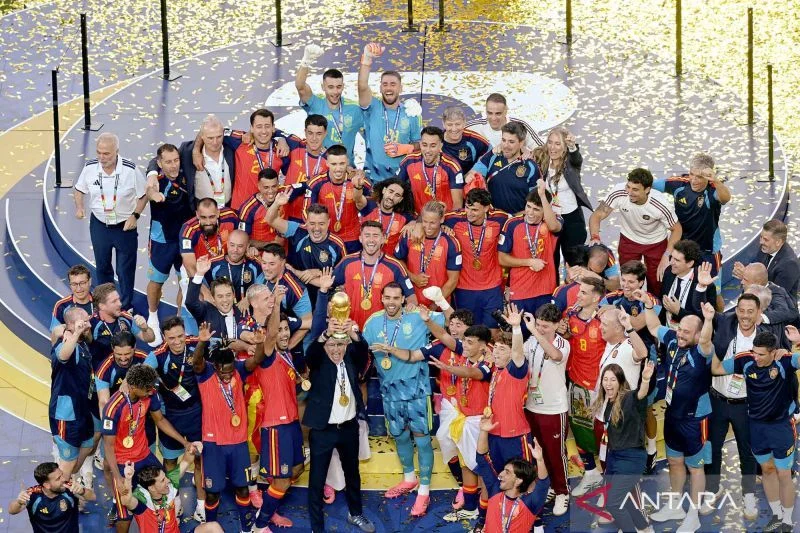
JAKARTA — Following the conclusion of the historic FIFA World Cup 2026, jointly hosted across Canada, Mexico, and the United States, football’s global governing body has officially announced its prestigious Team of the Tournament. The newly crowned world champions, Spain, alongside tournament runners-up France, emerged as the most dominant forces in the selection, with each nation contributing three players to the final eleven.
Arranged in a highly dynamic 4-3-3 formation, the Team of the Tournament features elite talent from six different countries, reflecting the global parity and competitive balance witnessed throughout the expanded tournament. While the lineup honors several expected superstars who defined the tournament’s narrative, it also includes stunning omissions and wildcard selections that have ignited intense debates among pundits, players, and fans worldwide.
Main Facts: The Elite Eleven Revealed
The FIFA Technical Study Group (TSG) settled on a balanced 4-3-3 blueprint to showcase the standout performers of the 2026 cycle. The final roster is distributed among six nations: Spain (3), France (3), Argentina (2), England (1), Cape Verde (1), and Norway (1).
The Official FIFA World Cup 2026 Best XI:
- Goalkeeper: Vozinha (Cape Verde)
- Defenders: Pedro Porro (Spain), Dayot Upamecano (France), Lisandro Martínez (Argentina), Marc Cucurella (Spain)
- Midfielders: Jude Bellingham (England), Rodri (Spain), Michael Olise (France)
- Forwards: Lionel Messi (Argentina), Erling Haaland (Norway), Kylian Mbappé (Prancis)
             Mbappé (FRA)      Haaland (NOR)      Messi (ARG)

               Bellingham (ENG)   Rodri (ESP)   Olise (FRA)

Cucurella (ESP)  L. Martínez (ARG)  Upamecano (FRA)  Porro (ESP)

                             Vozinha (CPV)
Spain’s tactical discipline and France’s explosive transition play are clearly reflected in the spine of this lineup. However, the inclusion of Cape Verde’s veteran goalkeeper Vozinha and Norway’s goal-machine Erling Haaland—despite Norway not reaching the final weekend—highlights FIFA’s commitment to individual brilliance over team achievements alone.
Chronology: How the Best XI Shaped the Tournament
The path to the Best XI was forged through iconic moments, starting from the group stages in June and culminating in the dramatic final matches in July.
The Group Stage: A Veteran Hero Emerges
The narrative of the tournament was set on opening matchday when underdog Cape Verde faced off against a formidable Spanish side. In a match expected to be a routine victory for La Roja, 40-year-old goalkeeper Vozinha produced a masterclass performance. His acrobatic saves secured a historic 0-0 draw, preventing Spain from scoring what would be their only scoreless match of the tournament.
Meanwhile, Norway’s Erling Haaland began his relentless campaign, scoring crucial goals in the group stages to single-handedly carry his team into the knockout rounds, proving his world-class caliber on the grandest stage.
The Knockout Rounds: Defensive Fortresses and Midfield Metronomes
As the tournament transitioned to the single-elimination bracket, defensive structures tightened. Spain’s fullbacks, Pedro Porro and Marc Cucurella, became indispensable. Their ability to lock down the flanks while providing offensive width allowed Spain to march through the round of 16 and quarterfinals, conceding only a single goal during the entire knockout run.
In midfield, Rodri acted as Spain’s metronome, dictating tempo and neutralizing opposing counterattacks. Simultaneously, France’s Michael Olise emerged as a creative revelation, unlocking defenses with pinpoint crosses, while England’s Jude Bellingham drove his team forward with late-box arrivals and clutch goals.
The Semifinals and Final: Heartbreak and Glory
By the time the tournament reached its final four, the star power of Kylian Mbappé and Lionel Messi took center stage. Mbappé’s clinical finishing guided France past a defensively stout semi-final opponent, despite France conceding only two goals up to that point due to the heroic interventions of center-back Dayot Upamecano.
For Argentina, the road to the final was marked by grit and emotion. Defender Lisandro Martínez was a warrior at the back, starting seven of Argentina’s eight matches. However, tragedy struck in the final when Martínez suffered an injury that forced him off the pitch. Despite his absence in the closing minutes, his contributions were vital in securing Argentina’s place in the final. In that final, Lionel Messi, at 39 years old, put on a virtuoso performance, cementing his legacy by guiding the Albiceleste to their third World Cup final appearance in the last four editions.
Supporting Data: A Statistical Deep Dive
The selections made by the FIFA Technical Study Group are backed by staggering individual and team metrics recorded over the month-long tournament.
Individual Tournament Statistics:
====================================================================
Player             Country     Metric of Note
--------------------------------------------------------------------
Kylian Mbappé      France      10 goals, 4 assists (Golden Boot)
Lionel Messi       Argentina   8 goals, 4 assists
Jude Bellingham    England     7 goals (3rd in Golden Boot race)
Erling Haaland     Norway      7 goals
Michael Olise      France      7 assists (1 shy of all-time record)
Vozinha            Cape Verde  18 saves (Clean sheet vs. Spain)
Orlando Gill       Paraguay    28 saves (Most active goalkeeper)
====================================================================
Goalkeeping Anomalies
The choice of Vozinha as the tournament’s top goalkeeper raised eyebrows, given that Spain’s Unai Simón officially won the Golden Glove. However, data shows Vozinha’s impact was immense:
- Total Saves: Vozinha recorded 18 saves (the 8th highest in the tournament).
- Shot-to-Save Ratio: The Cape Verdean veteran faced higher-quality expected goals (xG) per shot than most of his peers.
- The Busiest Keeper: Paraguay’s Orlando Gill was statistically the busiest goalkeeper of the tournament, registering 28 saves, though his team failed to progress as far.
Defensive Dominance
Spain’s defensive metrics were historic:
- Goals Conceded: Spain’s backline, anchored by Porro and Cucurella, allowed only 1 goal throughout the entire competition.
- Upamecano’s Impact: Dayot Upamecano was the defensive anchor for a French side that conceded just 2 goals leading up to the semifinals, boasting a 78% duel success rate.
Midfield Mastery
The midfield trio combined tactical intelligence, goalscoring threat, and elite playmaking:
- Rodri (Golden Ball Winner): Completed 93% of his passes in the opposition half and covered more distance (averaging 11.8 km per match) than any other midfielder.
- Michael Olise: Provided 7 assists, falling just one short of the legendary French midfielder Raymond Kopa’s all-time World Cup record of 8 assists, set back in 1958.
- Jude Bellingham: Finished as the third-highest scorer of the tournament with 7 goals, an unprecedented return for a box-to-box midfielder in the modern era.
Historical Attacking Output
The front three put up numbers that rewrite the history books:
- Kylian Mbappé: Captured the Golden Boot with 10 goals and 4 assists. This haul brought his lifetime World Cup tally to 22 goals across three editions (2018, 2022, 2026), officially making him the all-time top scorer in FIFA World Cup history.
- Lionel Messi: Even at 39, Messi contributed 8 goals and 4 assists, meaning he was directly involved in 12 goals during Argentina’s run to the final.
- Erling Haaland: Scored 7 goals in just 5 matches, demonstrating unmatched efficiency in front of goal.
Official Responses and Selection Controversies
As with any major tournament awards, the announcement of the Best XI has met with mixed reactions, sparking fierce debates among football federations, former players, and analysts.
The Cubarsí and Laporte Omission
The most prominent controversy surrounds Spain’s central defense. Despite Spain boasting the best defensive record in the tournament, neither Aymeric Laporte nor Pau Cubarsí found a place in the Best XI.
The exclusion of the 19-year-old Cubarsí has drawn sharp criticism from Spanish football officials. Cubarsí was officially named the FIFA World Cup 2026 Best Young Player, making his exclusion from the Team of the Tournament a baffling paradox.
"It is difficult to comprehend how the tournament’s official Best Young Player, who anchored a defense that conceded only one goal, is left out of the Best XI," noted a Spanish football analyst. "While Lisandro Martínez and Dayot Upamecano had stellar tournaments, Cubarsí’s consistency was unmatched."
The Goalkeeper Debate
Spanish fans and media have also voiced disappointment over Unai Simón’s omission. Simón, who took home the Golden Glove trophy for keeping the most clean sheets and lifting the World Cup trophy, was bypassed in favor of Vozinha.
FIFA technical representatives defended the decision, stating that Vozinha’s individual performances carried a higher degree of difficulty given Cape Verde’s defensive limitations compared to Spain’s star-studded lineup.
Tactical and Future Implications for World Football
The selections in the FIFA 2026 Team of the Tournament signal broader tactical trends that are likely to shape domestic and international football over the next four-year cycle leading to 2030.
The Rise of Inverted and Playmaking Fullbacks
The inclusion of Pedro Porro and Marc Cucurella highlights the evolution of the fullback position. No longer tasked purely with defensive duties, modern fullbacks are expected to act as auxiliary playmakers. Spain’s system allowed both players to tuck into midfield during possession phases, creating numerical overloads that allowed Rodri to dictate play effortlessly.
Longevity vs. The New Generation
The 2026 tournament represented a fascinating intersection of eras. On one hand, the inclusion of Lionel Messi (39) and Vozinha (40) proves that experience, elite positioning, and mental fortitude can still triumph over youth on the world stage.
On the other hand, the dominance of Mbappé, Haaland, Bellingham, and Olise indicates that the transition of power is complete. These athletes combine physical dominance with technical precision, setting a new physical standard for international football.
Ultimately, the FIFA World Cup 2026 Team of the Tournament serves as a testament to a tournament defined by historic individual achievements, tactical sophistication, and the undeniable magic of underdog stories. As these eleven players return to their respective clubs, their performances in North America will be remembered as the gold standard of football’s modern era.