Beyond the Numbers: Why Your Reseller Network is Stagnant and How to Build a High-Performing Sales Force
JAKARTA — In the modern landscape of digital commerce and direct-to-consumer brand scaling, the allure of a sprawling reseller network often overshadows sustainable operational health. Many business owners measure success by the sheer volume of partner registrations, celebrating when thousands of individuals sign up to distribute their products. However, a stark and frustrating reality frequently follows: within weeks, the vast majority of these partners go dark.
For many enterprises, having a massive roster of registered resellers does not equate to having a formidable, revenue-generating sales force. When partner lists continuously expand yet sales stagnate, business leaders are forced to confront a hard truth—something is fundamentally flawed within their recruitment, retention, and enablement architecture.
To transform a dormant network of passive sign-ups into an active, motivated legion of brand advocates, organizations must look past vanity metrics and overhaul how they attract, incentivize, and support their sales partners.
Main Facts: The Anatomy of a Failing Reseller Ecosystem
Industry analysts and business consultants point to several structural missteps that plague growing brands attempting to scale through partner networks.
1. The Trap of Indiscriminate Recruitment
The primary catalyst for a failing reseller network is often flawed at the very top of the sales funnel: recruitment. Driven by the desire for rapid market penetration, many companies adopt an open-door policy, welcoming anyone who applies without vetting their alignment with the brand.
These volume-driven recruitment strategies fail to evaluate whether applicants possess basic sales acumen, an understanding of the target demographic, or a genuine affinity for the product. Consequently, brands end up with a bloated database of inactive accounts—individuals who signed up on an impulse, only to realize they lack the resources, interest, or capability to sell the merchandise.
2. Ambiguous and Demotivating Incentive Structures
Even when capable individuals join a network, their longevity often depends on financial motivation. A poorly structured commission model can quickly drain a reseller’s enthusiasm.
If commission tiers are overly complicated, payouts are delayed, or profit margins fail to compensate for the effort required to market the products, partners will naturally shift their focus elsewhere. Without clear financial incentives that scale rewarding performance, resellers lose the momentum necessary to push through slow sales cycles.
3. The Absence of Onboarding and Ongoing Enablement
Perhaps the most widespread operational failure is the "sink or swim" approach to partnership management. Many companies supply a product catalog and a digital banner, expecting resellers to magically figure out how to generate conversions.
In reality, modern consumers demand sophisticated marketing, authentic product reviews, and seamless purchasing experiences. Without structured onboarding, continuous training, digital marketing toolkits, and mentorship, new resellers quickly feel overwhelmed and abandoned.
4. The Vicious Cycle of Churn and Burn
Without data-driven oversight, businesses often fall into an exhausting, reactive loop. They notice their active reseller pool shrinking, panic, launch a new recruitment drive to inflate numbers temporarily, and watch those new recruits fade away just as quickly.
Without diagnosing why partners stop selling—whether due to pricing pressure, lack of support, or shifting market demands—companies merely bleed resources trying to fill a leaking bucket.
Chronology: The Lifecycle of a Struggling Reseller Program
To understand how businesses transition from high-growth optimism to operational stagnation, it is helpful to examine the typical timeline of a mismanaged reseller network.
Phase 1: The Honeymoon Period (Months 1–2)
- The Launch: The business introduces its reseller program with aggressive marketing, promising lucrative side-income opportunities.
- The Surge: Hundreds or thousands of applications flood in. The founders celebrate the viral reach and large database of partners.
- Initial Activity: Driven by launch excitement, a small percentage of resellers make initial social media posts or pitch to friends and family, resulting in an initial bump in sales.
Phase 2: The Momentum Decay (Months 3–6)
- The Reality Check: The easy sales (warm markets like close friends and family) dry up. Resellers realize that generating cold leads requires actual marketing skills and persistence.
- The Silence: Support channels become flooded with basic questions that go unanswered due to understaffed support teams. Commission payouts cause confusion because the tracking system is opaque.
- The Disengagement: Frustrated by low conversions and a lack of fresh promotional materials, 70% to 80% of the newly recruited resellers stop posting products entirely.
Phase 3: The Panic and Pivot (Months 7–12)
- The Revenue Slump: Overall sales drop despite the massive database size. Leadership realizes that 90% of their registered resellers are completely inactive.
- The Blame Game: Management blames the resellers for being "lazy," while resellers blame the company for providing poor margins and zero guidance.
- The Cycle Repeats: Instead of auditing the program, the company launches "Batch 2" of recruitment, repeating the exact same foundational mistakes.
Supporting Data and Industry Insights
Market studies on indirect sales channels and affiliate/reseller ecosystems consistently highlight the disparity between registered partners and active revenue generators.
- The Pareto Principle in Direct Sales: Data across various direct-to-consumer and social commerce industries reveal that roughly 80% of total revenue is typically generated by just 20% of the reseller network. The remaining 80% of registered partners contribute marginally to the bottom line, often costing more in administrative overhead than they yield in sales.
- The Cost of Acquisition vs. Retention: Business analysts emphasize that acquiring a new reseller costs up to five times more in marketing and promotional spend than retaining and upskilling an existing, moderately performing partner. Yet, companies routinely misallocate budgets toward top-of-funnel recruitment rather than middle-of-funnel enablement.
- Training ROI: According to sales enablement research, partners who undergo structured onboarding and receive regular marketing asset updates achieve an average sales volume 3.4 times higher than those left to navigate sales materials independently.
Strategic Shift: Building a Resilient Sales Force
Transforming a stagnant reseller base into a high-performing sales force requires a paradigm shift. Companies must stop treating resellers as mere directory entries and begin treating them as extended business partners.
1. Quality Over Quantity in Recruitment
Sustainable networks are built on selective alignment. Businesses must establish clear criteria for prospective resellers, evaluating their digital footprint, audience demographics, and willingness to learn. By creating a slightly more selective application process, brands can cultivate higher perceived value and attract partners who are genuinely invested in long-term collaboration.
2. Transparent and Scalable Incentive Frameworks
Financial models must be mutually beneficial. Companies should design commission structures that reward tiered performance—offering higher margins for top-tier sellers, bonuses for hitting monthly volume milestones, and transparent tracking dashboards so partners can view their earnings in real-time.
3. Comprehensive Enablement and Mentorship
Equipping a sales force requires modern tools. Winning brands provide their resellers with:
- Ready-to-use copywriting templates and high-resolution visual assets for social media.
- Regular product knowledge webinars and sales technique workshops.
- Dedicated communication channels (such as private community groups) where top performers can share tips with newer recruits.
4. Data-Driven Performance Audits
A healthy system relies on continuous tracking. Business leaders must segment their partner database into active, dormant, and high-growth tiers. By conducting exit surveys or automated check-ins with partners who stop selling, companies can gather invaluable feedback to refine their pricing, products, and support mechanisms.
Addressing the Challenge: The Upcoming Professional Masterclass
Recognizing the urgent need for structured guidance in managing partner networks, industry experts are stepping in to provide actionable frameworks for business owners and sales managers.
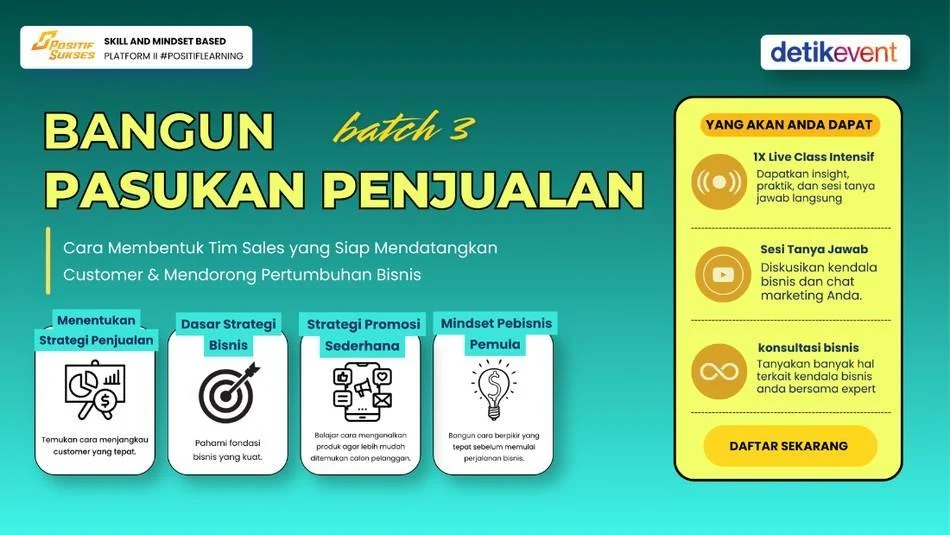
To address these exact pain points, professional education provider Lampung Cerdas has officially announced the upcoming execution of a specialized intensive program titled "Bangun Pasukan Penjualan Batch 3" (Build a Sales Force Batch 3).
Designed specifically for entrepreneurs, brand owners, and sales directors struggling to scale their distribution channels, this program aims to dismantle counterproductive recruitment habits and rebuild partner ecosystems from the ground up.
Program Details and Logistics:
- Format: Online interactive live session.
- Date: Tuesday, September 15, 2026.
- Duration: 2 hours of intensive, high-impact learning.
- Additional Benefits: Complimentary post-session consultation and live interactive Q&A.
- Organizer: Lampung Cerdas.
What Participants Will Learn:
- Strategic Partner Filtering: How to attract and select resellers who match the brand’s core target market.
- Incentive Architecture: Designing commission frameworks that sustain long-term motivation rather than short-lived hype.
- Operational Enablement: Creating scalable onboarding programs and equipping partners with high-converting marketing collateral.
- Retention and Lifecycle Management: Identifying early warning signs of partner disengagement and implementing systems to reactivate dormant accounts.
Implications: The Future of Scalable Commerce
The implications of failing to restructure partner networks extend far beyond short-term revenue dips. In an increasingly competitive digital marketplace, brands that rely on bloated, inactive reseller lists waste valuable marketing capital and damage their brand reputation through inconsistent customer experiences.
Conversely, companies that invest time in structuring a disciplined, well-trained, and motivated sales force create a resilient moat around their business. A loyal network of active resellers provides organic reach, authentic social proof, and stable cash flow that traditional paid advertising alone cannot replicate.
For business owners currently navigating stagnant sales growth or feeling disillusioned by underperforming partner programs, treating the root cause rather than the symptoms is no longer optional—it is a prerequisite for survival and scale.
Business owners, founders, and sales managers looking to revamp their distribution strategies and maximize partner performance can secure their spot in the upcoming masterclass. Registration for Bangun Pasukan Penjualan Batch 3 is now officially open via detikevent.