Beyond the March: Unraveling the History, Symbolism, and Precision of Paskibraka’s Iconic 17-8-45 Formation
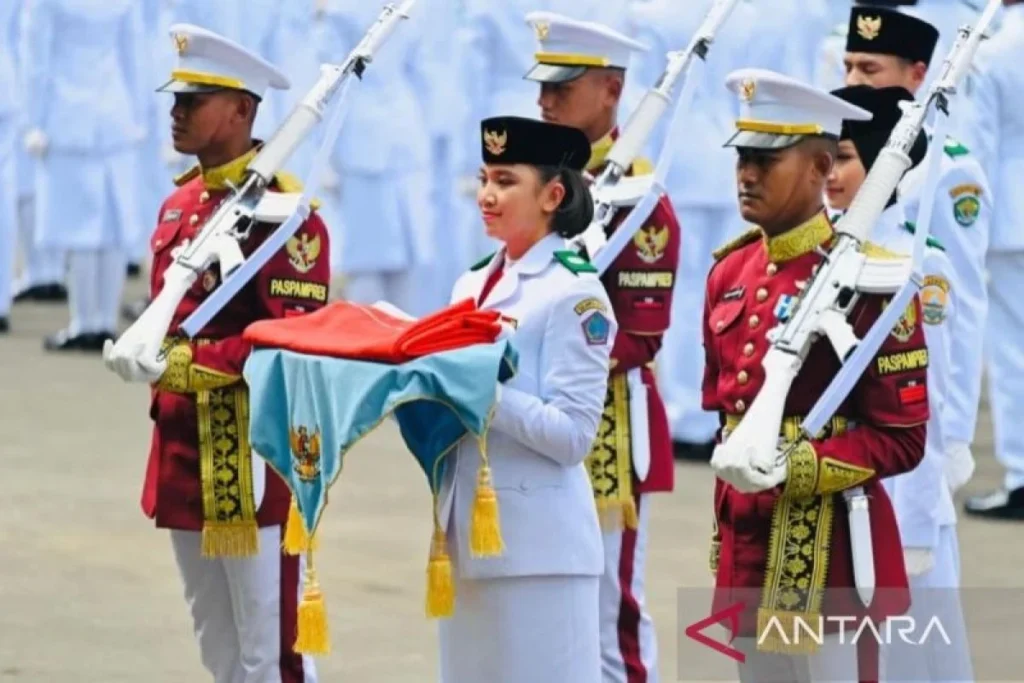
JAKARTA — Every August 17th, millions of eyes across Indonesia—and around the world—turn toward the State Palace or local government grounds to witness one of the most solemn and anticipated moments of the nation’s Independence Day celebrations: the hoisting of the Sang Saka Merah Putih (The Sacred Red-and-White Flag).
While the theatrical precision, synchronized marching, and flawless posture of the Pasukan Pengibar Bendera Pusaka (Paskibraka—the Heritage Flag Hoisting Troop) consistently captivate audiences, the formation in which they march is far more than a mere military-style drill. It is a living, breathing timeline of the nation’s birth.
At the heart of this tradition lies the legendary 17-8-45 formation. Far from being an arbitrary arrangement of youth cadets, this structural layout is a profound mathematical and historical homage to the exact date Indonesia proclaimed its independence: August 17, 1945.
Main Facts: Anatomy of the 17-8-45 Formation
To the untrained eye, the Paskibraka troop moving across the plaza looks like a unified wall of disciplined youth. However, military protocol and ceremonial tradition divide the unit into three distinct, highly specialized subgroups. Each group carries a specific designation, a unique operational duty, and a numerical value that directly corresponds to the components of Indonesia’s Independence Day.
The formation is meticulously broken down into:
- Pasukan 17 (The 17 Group): Positioned at the vanguard of the formation, this group acts as the pathfinders, escorts, and guides. The number 17 explicitly represents the date—the 17th—of the Proclamation of Indonesian Independence.
- Pasukan 8 (The 8 Group): Marching directly behind the vanguard, this is the core operational unit. Tasked with the sacred responsibility of carrying and hoisting the duplicate of the historic Heritage Flag, this elite group embodies the number 8, representing August, the eighth month of the year.
- Pasukan 45 (The 45 Group): Bringing up the rear of the procession, this unit serves as the honor guard. Armed with ceremonial mock rifles, they provide security and flank protection for the core group. The number 45 signifies 1945, the historic year Indonesia broke free from colonial shackles.
When combined, the numbers 17, 8, and 45 form an unbreakable numerical trinity: 17-8-45 (17 August 1945). This clever architectural choreography ensures that every time the flag is raised, the nation visually and physically steps through the calendar date of its liberation.
Chronology: The Evolution of Paskibraka and Husein Mutahar’s Vision
The existence of this iconic formation did not happen by accident; it is the product of creative statecraft and historical adaptation, heavily spearheaded by one of Indonesia’s greatest nationalist figures, Husein Mutahar.
The Genesis in Yogyakarta (1946)
The roots of the flag-hoisting troop trace back to the dark and turbulent days of the Indonesian National Revolution. In 1946, the young Republic had been forced to move its capital from Jakarta to Yogyakarta due to allied military interventions and Dutch attempts to reclaim the colony.
Amidst the chaos of war, President Sukarno instructed his aide-de-camp, Husein Mutahar, to organize a special flag-hoisting ceremony for the first anniversary of the proclamation on August 17, 1946. Recognizing the symbolic weight of the occasion, Mutahar devised a minimalist yet profoundly meaningful approach. He selected five extraordinary youths—representing different regions and backgrounds—to carry and raise the flag. This decision was designed to project national unity at a time when the republic was fighting for its physical survival.
Institutionalization under President Soeharto (1967)
Two decades later, as the nation entered the New Order era, the state sought to formalize national youth participation in state ceremonies. In 1967, President Soeharto summoned Husein Mutahar once again, tasking him with reviving and systematizing the national flag-hoisting ceremony.
Drawing inspiration from his 1946 makeshift arrangement in Yogyakarta, Mutahar expanded the concept to reflect the scale of a sovereign nation. He designed a three-tiered structural hierarchy that transformed a simple group of flag-bearers into a complex, regimented battalion. It was during this period that the 17-8-45 formation was officially codified, balancing historical symbolism with military precision.
By 1973, Mutahar officially coined the term Paskibraka (an acronym blending Pasukan Pengibar Bendera Pusaka), replacing the previous moniker Pasukan Penggerek Bendera. Under his guidance, the troop grew from a local Jakarta phenomenon into a nationwide institution, with elite youth selected from all provinces to undergo rigorous centralized training.
Supporting Data: Operational Roles and the Burden of Precision
Achieving the seamless execution of the 17-8-45 formation requires months of grueling physical, mental, and psychological conditioning. Each subgroup within the formation operates under intense pressure, where a single misstep can mar a national broadcast viewed by millions.
Detailed Breakdown of Group Duties
-
Pasukan 17 (The Escorts):
Comprising youth representatives positioned at the front and flanks, their primary duty is to set the rhythm, pace, and alignment of the entire formation. They act as the vanguard, clearing the physical and visual path for the main body of the troop. Their marching cadence dictates the tempo of the entire ceremony. -
Pasukan 8 (The Core / Flag Bearers):
Widely considered the most coveted and high-pressure assignment in the troop, Pasukan 8 includes the main flag bearer (Pembawa Baki), the raising team, and the core support units. Surrounded on all sides by their peers, they bear the physical burden of handling the flag. Every movement—from bending the knee to stepping onto the dais—is practiced thousands of times to ensure the flag never touches the ground and is unfurled with flawless geometric precision. -
Pasukan 45 (The Honor Guard):
Positioned at the rear, Pasukan 45 carries symbolic firearms (wooden rifles with fixed bayonets). Representing the freedom fighters of 1945, this group provides the acoustic and visual reinforcement of military honor. Their synchronized rifle movements and sharp, echoing turns add a layer of solemn gravity to the proceedings.
The Rigorous Selection Pipeline
The journey to becoming part of this formation is arduous. Millions of high school students across Indonesia’s 38 provinces compete in multi-layered selections spanning school, district, provincial, and national levels. Those who make it to the national capital undergo months of intensive quarantine and training camps managed by the Pancasila Ideology Development Agency (BPIP). They are drilled not only in marching drill (PBB) and stamina, but also in national history, leadership, and ideological grounding.
Official Responses and Administrative Adaptations
While the 17-8-45 formation remains the gold standard for Independence Day ceremonies, contemporary state protocol allows for flexibility depending on the specific nature of national observances.
According to statements from the Pancasila Ideology Development Agency (BPIP)—the state body currently overseeing the Paskibraka program—the structural design of youth troops can be adapted to reflect unique national milestones.
For instance, during specific commemorative events, such as the Hari Lahir Pancasila (Birth of Pancasila) ceremonies, BPIP has occasionally introduced alternative formations. Notably, formations consisting of five distinct groups have been utilized to symbolize the five foundational principles of the Pancasila.
Despite these occasional ceremonial variations, BPIP officials consistently emphasize that the 17-8-45 framework remains irreplaceable for August 17th celebrations. State officials view the formation as an intangible cultural heritage asset that bridges generations, reminding current bureaucratic and civilian leaders of the sacrifices made during the birth of the republic.
Implications: Preserving National Memory and Cultural Identity
The enduring popularity of the 17-8-45 formation holds deep socio-cultural and political implications for modern Indonesia.
1. A Living Classroom of History
In an era where younger generations are increasingly detached from physical textbooks and traditional historical narratives, Paskibraka serves as a dynamic, visible bridge to the past. The troop’s movements translate abstract historical dates into visceral, emotional experiences. For millions of teenagers who watch or participate in the ritual, the numbers 17, 8, and 45 cease to be mere digits; they become synonymous with national sacrifice, identity, and pride.
2. Fostering National Unity and Diversity
Because Paskibraka members are handpicked from every corner of the archipelago—from Aceh to Papua—the formation serves as a micro-cosm of Indonesia’s national motto, Bhinneka Tunggal Ika (Unity in Diversity). When Pasukan 17, 8, and 45 march in lockstep, they project a powerful image of collective harmony. Ethnic, religious, and regional backgrounds dissolve into a singular uniform, united by the shared goal of honoring the flag.
3. Cultivating Leadership and Discipline
Beyond its symbolic value, the training required to execute the 17-8-45 formation acts as an elite leadership incubator. Alumni of the Paskibraka program frequently go on to occupy prominent roles in public service, the military, law enforcement, business, and civil society. The extreme mental toughness, punctuality, and peer accountability instilled during the preparation for the formation leave an indelible mark on the participants’ professional lives.
Conclusion
As Indonesia continues to march forward into the 21st century, facing modern geopolitical and economic challenges, traditional ceremonies retain an anchor-like quality for the national psyche.
The 17-8-45 formation is much more than a masterclass in military choreography. It is a physical poem dedicated to August 17, 1945—a structural manifestation of gratitude, resilience, and patriotism. Every time the boots hit the asphalt in synchronized harmony, and every time the red and white flag climbs the mast under the watchful eyes of Pasukan 17, 8, and echoes of Pasukan 45, the spirit of the Indonesian revolution is vividly brought back to life.