
ASPRINDO Reinvigorates Economic Agenda: New Leadership Installed in South Sulawesi Amidst Calls for "Economic War"

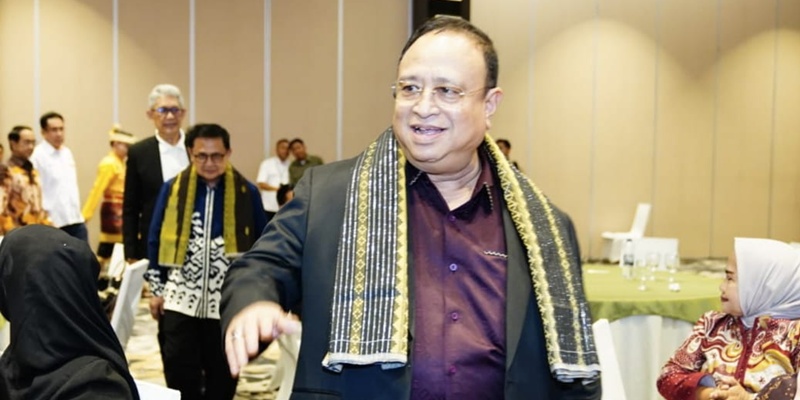
MAKASSAR – The Indonesian Native Entrepreneurs Association (ASPRINDO) has officially inaugurated its new leadership board for the South Sulawesi region (DPW Sulsel) for the 2025–2030 term. The ceremony, held on Sunday evening, July 19, 2026, at The Rinra Hotel, Makassar, marks a pivotal shift in the organization’s strategy as it seeks to reposition indigenous entrepreneurs as the primary drivers of the regional and national economy.
The leadership transition follows the unfortunate passing of the previous DPW Sulsel Chairman in March 2026. Under the stewardship of DPP ASPRINDO Chairman Jose Rizal, the organization is now pivoting toward a more aggressive, collaborative, and technology-driven business model.
The Core Mandate: A Call for Economic Sovereignty
The inauguration event was attended by a distinguished assembly of stakeholders, including the Rector of Hasanuddin University (UNHAS) and Member of the ASPRINDO Advisory Board, Prof. Dr. Jamaluddin Jompa, as well as the Chairman of the ASPRINDO Expert Council, Prof. Dr. Didin S. Damanhuri. The presence of regional government officials (Forkopimda), academics, and business leaders underscored the strategic importance of this transition.
In his keynote address, Chairman Jose Rizal delivered a spirited rallying cry. While acknowledging that South Sulawesi’s economic growth consistently outpaces the national average, he posed a critical question that has long simmered in the halls of economic policy: "To what extent does this growth translate into tangible wealth for indigenous entrepreneurs?"
"The data shows impressive macro numbers, but the question remains: how much of that economic output is actually entering the pockets of ASPRINDO members?" Rizal remarked. He characterized the inauguration not merely as an administrative formality, but as a "declaration of economic war."
"This is a war against poverty, a war against the ‘good enough’ mentality," Rizal asserted. "ASPRINDO members must stop waiting for opportunities to come to them. It is time to get into the fields, the seas, and the factories. We must actively pursue collaboration with the government to ensure our members are the primary beneficiaries of regional development."
Strategic Pillars for 2025–2030: The Kampung Industri Initiative
A central component of the new leadership’s agenda is the development of Kampung Industri (Industrial Villages). This program is designed to create localized hubs that streamline the business ecosystem. By clustering resources, the initiative aims to solve systemic hurdles for small and medium-sized enterprises (SMEs).
Chairman Rizal highlighted four key pillars for this new era of collaboration:
- Resource Integration: Pooling capital and raw materials to achieve economies of scale.
- Technological Adoption: Moving away from traditional methods to increase production efficiency.
- Capital Accessibility: Creating pathways for members to secure institutional funding.
- Branding and Global Competitiveness: Elevating the quality and marketability of indigenous products so they can penetrate international markets.
The initiative seeks to transform the traditional image of indigenous businesses from small-scale subsistence operations into professionalized, competitive entities that leverage technology to close the gap between rural production and urban consumption.
Academic-Industrial Synergy: The Role of Knowledge
Prof. Dr. Jamaluddin Jompa, speaking on behalf of the academic sector, emphasized that the gap between the university and the factory floor must be bridged. As the Rector of Hasanuddin University, he pledged that the academic community is prepared to move beyond theoretical research.
"The academic world is ready to synergize and collaborate with entrepreneurs," Prof. Jompa stated. "We have a vast array of research and innovation currently sitting in laboratories that can be directly implemented in business operations. Furthermore, we are aggressively promoting entrepreneurship on our campuses to ensure that the next generation of graduates are job creators, not just job seekers."
This sentiment reflects a growing trend in Indonesia’s economic policy: the "Triple Helix" model, which relies on the interaction between government, academia, and industry to drive innovation. Prof. Jompa’s involvement signals a formalization of this relationship, where UNHAS provides the technical expertise and market research necessary to help ASPRINDO members scale their operations.
Addressing Economic Inequality: The Constitutional Mandate
The discourse during the inauguration took a more profound turn when Prof. Dr. Didin S. Damanhuri addressed the structural challenges facing indigenous entrepreneurs. He framed the existence of ASPRINDO not through a lens of exclusion, but as a constitutional necessity.
"This is not about a dichotomy between ‘pribumi’ (indigenous) and non-indigenous," Prof. Damanhuri explained. "This is a direct fulfillment of the mandate found in Article 33 of the 1945 Constitution. The goal is to reduce the systemic economic inequality that has, for too long, favored only a select few."
Article 33 of the Indonesian Constitution stipulates that the economy shall be organized as a common endeavor based on the principle of kinship, and that branches of production important to the state and affecting the lives of the many shall be controlled by the state for the greatest prosperity of the people. Prof. Damanhuri argued that ASPRINDO’s current push is essentially a mechanism to decentralize economic power, ensuring that the fruits of Indonesia’s development reach the grassroots level.
The Road Ahead: Seven Clusters of Excellence
The newly appointed Chairman of the South Sulawesi branch, Ir. Abu Hasan, expressed his readiness to accept the mantle of leadership. Understanding the magnitude of the expectations placed upon him, Hasan revealed that he has already conceptualized a comprehensive roadmap for the region.
The strategy hinges on "seven clusters of work programs." While specific details of the clusters are currently being finalized, they are expected to focus on:
- Agro-Industry: Leveraging South Sulawesi’s strength in agriculture and fisheries.
- Digitalization: Helping traditional businesses adopt e-commerce and digital logistics.
- Human Capital Development: Training programs for workers in the SME sector.
- Supply Chain Optimization: Reducing the cost of goods sold (COGS) through improved logistics.
- Regulatory Advocacy: Representing member interests in regional policy-making.
- Financial Literacy: Training members on tax compliance and capital management.
- Market Expansion: Strategic partnerships to get local products into modern retail chains.
"Insya Allah, ASPRINDO entrepreneurs in this region are ready to ‘level up’ and build a strong competitive advantage," said Ir. Abu Hasan. "We are moving from survival mode to growth mode."

Implications for the Indonesian Economy
The revitalization of ASPRINDO in South Sulawesi serves as a microcosm for a broader national movement. If the "Kampung Industri" model succeeds in South Sulawesi, it is expected to be adopted as a blueprint for other provinces across the archipelago.
1. Shift in Political Economy
The rhetoric used by Jose Rizal suggests that indigenous entrepreneurs are becoming more politically conscious and organized. By framing business as an "economic war," the organization is signaling to policymakers that they expect preferential treatment—or at the very least, a level playing field—when it comes to government procurement, infrastructure projects, and credit access.
2. The Rise of the "Techno-Entrepreneur"
By inviting the Rector of UNHAS to the table, ASPRINDO is betting that technology and scientific research will be the differentiator for future success. This shift away from resource-extractive businesses toward value-added production is critical if Indonesia is to escape the "middle-income trap."
3. Impact on SMEs
For the average SME owner in South Sulawesi, the potential benefits are significant. If the organization can successfully negotiate better interest rates for micro-loans or provide shared access to advanced machinery, it could significantly lower the barrier to entry for local manufacturers.
4. Addressing Regional Disparity
South Sulawesi has long been the economic gateway to Eastern Indonesia. By strengthening the capacity of local entrepreneurs in Makassar, ASPRINDO is effectively bolstering the entire eastern region’s economic resilience.
Conclusion
The inauguration of the new DPW ASPRINDO South Sulawesi board represents more than just a personnel change. It is a strategic pivot towards a more assertive, collaborative, and research-backed business model.
As the organization embarks on its 2025–2030 journey, the challenge will lie in execution. Translating the fiery rhetoric of "economic war" into concrete, profitable outcomes for thousands of small-scale entrepreneurs will require patience, political capital, and unwavering discipline. However, with the backing of academia and a clear mandate rooted in the national constitution, ASPRINDO appears well-positioned to turn the tide for indigenous businesses in the region.
As the meeting concluded, the consensus among attendees was clear: the era of passive participation is over. The coming years will be a litmus test for whether the indigenous entrepreneurial class can truly become the engine of prosperity that the nation’s founders envisioned.