Reality Check on Lunar Colonization: Why a Million-Person City on the Moon Would Drain Its Water Reserves in a Century
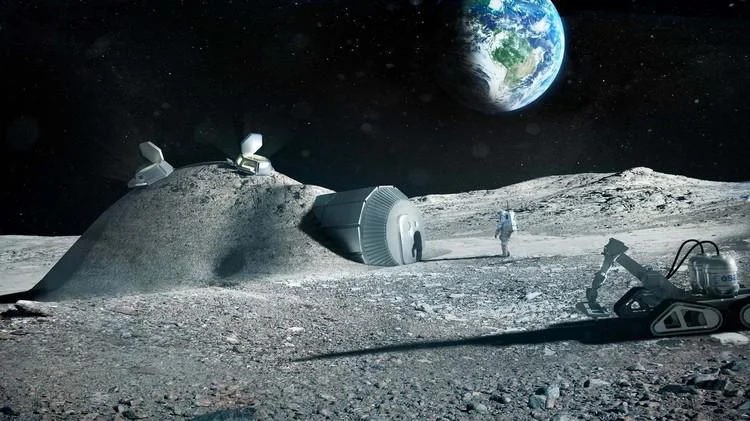
Jakarta — Ambitions to establish sprawling, self-sustaining human settlements on the Moon—championed by billionaire visionaries like SpaceX founder Elon Musk and Blue Origin architect Jeff Bezos—may be running up against a hard, unyielding physical limit: water.
A sobering new scientific analysis conducted by astronomers at the Smithsonian Astrophysical Observatory has thrown cold water on grandiose visions of lunar urbanization. According to their findings, an urban settlement housing one million people on the lunar surface would completely exhaust a hypothetical, highly optimistic one-billion-ton reserve of lunar water in roughly 100 years.
While a billion tons sounds like an astronomical figure—theoretically enough to submerge New York City’s Central Park to a depth of 120 meters (higher than the Statue of Liberty)—it shrinks rapidly when weighed against the daily survival needs of a massive human population, which requires water not just for drinking, but for hygiene, advanced agriculture, breathable oxygen generation, and rocket fuel production.
Main Facts: The Mathematical Reality of Lunar Habitation
The core finding of the study, recently published in the journal Frontiers in Space Technologies, highlights a severe disparity between the ambitious industrial visions for the Moon and the actual resources available on our nearest celestial neighbor.
While generating electrical power for a lunar metropolis is technically feasible through high-altitude solar towers near the lunar poles or compact nuclear reactors, water acquisition is an entirely different bottleneck. Unless engineers can drastically reduce water loss rates—pushing efficiency far beyond current space station standards—or discover massive, untapped subterranean ice deposits, the concept of a million-strong lunar city remains mathematically unviable.
Key takeaways from the study include:
- The Billion-Ton Benchmark: To give colonization plans the benefit of the doubt, researchers based their baseline calculations on one billion tons of water, a figure more than ten times larger than current conservative estimates of accessible surface ice in permanently shadowed lunar craters.
- Consumption Rate: Without absolute recycling, a population of one million people would completely deplete that one-billion-ton supply in a mere 2.4 years.
- The Recycling Imperative: Operating at the International Space Station’s (ISS) current state-of-the-art recycling efficiency (roughly 98%), that same one-billion-ton reserve would sustain a million residents for approximately one century.
- The Sustainable Scale: If the population is drastically reduced to 100,000 residents utilizing the same high-level recycling technology, the water supply could stretch for 1,000 years, placing it firmly in the category of generational sustainability.
Chronology of Lunar Exploration and Water Discoveries
To understand how scientists arrived at these stark conclusions, it is necessary to examine the timeline of humanity’s quest to locate and quantify water on the Moon.
- Pre-2000s (The Dry Moon Hypothesis): For decades following the Apollo missions, the Moon was widely characterized as an entirely bone-dry, desolate world, devoid of volatile compounds due to solar wind stripping and the lack of an atmosphere.
- The 2000s–2010s (Discovery of the Cold Traps): Over the past two decades, orbital spacecraft equipped with advanced spectrometers and radar instruments began detecting hydrogen signatures inside deep craters near the lunar poles. Scientists identified these regions as "cold traps"—areas permanently shielded from sunlight for roughly 4 billion years where water ice delivered by ancient comets and asteroids could remain preserved.
- 2013 (Early Optimism): Initial estimates published in scientific literature suggested that polar ice reserves could span several hundred million tons, fueling early excitement about in-situ resource utilization (ISRU).
- 2022 (The Conservative Reassessment): A more rigorous, updated analysis published in 2022 tempered these expectations. Researchers concluded that the eight most ice-rich polar craters combined likely harbor only around 34 million tons of accessible surface water.
- Present Day (The Smithsonian Reality Check): Recognizing that real-world extraction will face logistical losses, researchers deliberately amplified the baseline water reserve to one billion tons—far exceeding empirical data—to test whether even an ultra-abundant lunar supply could support industrial-scale civilization. It could not.
Supporting Data: Breaking Down Human Consumption on the Moon
The Smithsonian researchers built their mathematical model by synthesizing public research on lunar volatile distribution alongside empirical metrics derived from human resource usage on Earth and aboard the International Space Station.
Sustaining human life in a sealed extraterrestrial habitat is an intensive metabolic and logistical challenge. Every drop of water consumed for hydration, sanitation, and crop irrigation eventually vaporizes into the atmosphere and must be captured and purified.
The Cost of Breathing and Eating
According to the study’s models—which factor in U.S. water-use statistics paired with highly optimistic assumptions that lunar vertical farming will operate far more efficiently than terrestrial agriculture—a single lunar inhabitant would consume approximately 500 tons of water per year.
[1 Million Residents] x [500 Tons of Water/Person/Year] = 500 Million Tons Consumed AnnuallyWithout closed-loop recycling, a one-billion-ton reservoir would vanish in under 30 months. Even with the ISS’s benchmark 98% recycling loop, the resource depletion curve remains steep over multi-generational timelines.
Official Responses and Industry Implications
The findings directly challenge the grand economic and technological roadmaps laid out by private space industry leaders.
- The Bezos Vision: Jeff Bezos, founder of Blue Origin, has repeatedly advocated for shifting heavy manufacturing and energy-intensive industries away from Earth and onto the Moon to preserve our home planet’s biosphere.
- The Musk Vision: Elon Musk has envisioned self-sustaining cities on the lunar surface as stepping stones toward multi-planetary civilization, projecting population growths that mirror science fiction narratives.
However, the authors of the Smithsonian study argue that industrial viability requires a massive labor force. To make a measurable economic impact on Earth’s gargantuan economy, a lunar settlement would arguably need to scale up to roughly 1% of Earth’s population—approximately 80 million people.
The "Lunar Village" Alternative
The researchers are quick to clarify that their findings do not spell the end of human presence in space. Instead, they advocate for scaling down expectations.
A "Lunar Village" supporting a permanent crew of about 1,000 residents—comparable to the winter-over populations maintained by scientific researchers in extreme environments like Antarctica—could operate comfortably without pushing lunar water reserves to a breaking point.
The crisis only manifests when planners attempt to leap from scientific outposts to millions-strong industrial metropolises.
Strategic Implications for Future Space Governance
As space-faring nations and private corporations increasingly turn their sights toward the lunar south pole—the prime real estate for ice-mining operations—the study serves as an urgent cautionary tale.
- Resource Scarcity Management: Treating lunar ice as an infinite, inexhaustible asset is a dangerous economic gamble. Miscalculating initial water budgets could lead to catastrophic economic failure for commercial lunar ventures before they truly begin.
- Technological Frontiers: To push past the 98% recycling barrier achieved on the ISS, engineers will need to innovate closed-loop life support systems capable of near-absolute efficiency (99.75% or higher), a feat that remains technologically unproven on a municipal scale.
- Early Regulatory Frameworks: The study’s authors emphasize the necessity of rigorous, cooperative water resource planning from the outset. Rather than engaging in a terrestrial-style land rush to stake claims on polar ice deposits, space agencies and corporate entities must establish transparent management frameworks to ensure that limited volatile supplies are preserved, shared, and sustained for future generations.
Ultimately, while one billion tons of water remains an extraordinary scientific discovery, it is finite. Recognizing its strict limits today may prevent a monumental ecological and economic crisis on the Moon tomorrow.