The PISA 2025 Alarm: Assessing the Current State and Future of Indonesia’s Education System

By Andi Soemarli Rasak (Head of K-12 Academics, Ruangguru) and Christin Widjaja (Academic Manager, Ruangguru)
Introduction: A Wake-Up Call for Indonesian Education
In 1983, the United States was shaken by a landmark report entitled A Nation at Risk. The document did more than simply highlight poor student performance; it issued a stark warning: if the educational system failed to reform immediately, the nation’s future would be compromised.
Today, Indonesia stands at a critical historical juncture, requiring an identical moment of profound national reflection.
This urgency does not stem from treating the Programme for International Student Assessment (PISA) as the sole arbiter of educational quality, nor from an unhealthy obsession with international rankings. Rather, the release of the PISA 2025 results exposes a more fundamental reality: while Indonesia officially meets the OECD’s data quality standards, our foundational competencies remain alarmingly fragile, and the proportion of students achieving high-level proficiency is exceedingly small.
The debate should no longer focus on the superficial question: "What rank is Indonesia?"
After all, the composition of PISA participating nations shifts with every cycle. PISA 2022 evaluated 81 countries and economies, while PISA 2025 expanded to 91 participants. The 2025 cycle welcomed new entrants such as Armenia, Ecuador, Kenya, Rwanda, Zambia, Dushanbe (Tajikistan), and Kurdistan (Iraq), while nations like Jamaica and Panama were absent from the roster. Consequently, shifts in national rankings often reflect changes in the competitive field rather than sudden leaps or drops in domestic capabilities.
Instead, the true barometer of progress lies in long-term score trends, the proportion of students falling short of basic competencies, and the narrow sliver of learners capable of advanced reasoning. The most pressing question we must ask is: How many Indonesian children are genuinely equipped to understand the world, solve complex problems, make informed decisions, and innovate?

Chronology and Main Facts: Unpacking the PISA 2025 Data
On September 8, 2026, the Organisation for Economic Co-operation and Development (OECD) officially released the results of PISA 2025. Spanning 91 countries and economies, the assessment in Indonesia involved 14,168 students across 419 schools, meeting all rigorous international quality standards.
A comparative analysis of Indonesia’s average scores reveals marginal fluctuations:
- Science: +6 points
- Reading: +7 points
- Mathematics: -2 points
Despite these minor adjustments, the OECD concluded that Indonesia’s 2025 performance remains largely plateaued around the 2022 levels, continuing to sit below the nation’s historical high-water mark achieved in 2015.
However, obsessing over these numerical adjustments obscures the structural configuration of the problem. A granular examination of the OECD performance distribution tables reveals two stark realities:
- The Broad Base of Underperformance: An overwhelming 60.9% of Indonesian students fall below Level 2 simultaneously in science, reading, and mathematics. This means roughly 6 out of every 10 students fail to meet the minimum baseline proficiency threshold established by PISA across all three core domains.
- The Narrow Peak of Excellence: Conversely, only 0.1% of Indonesian students reached Level 5 or 6 in at least one of the three domains—roughly translating to one out of every one thousand students.
These statistics must not be misconstrued as indictments of Indonesian youth. These are not "failing children"; rather, they are children operating within an educational ecosystem that has not yet successfully ushered them into basic or advanced competencies. The systemic shape is glaringly disproportionate: the base is far too wide, and the peak is far too narrow.
If left unaddressed, this educational pyramid threatens to turn Indonesia’s much-touted demographic dividend into a demographic burden. Millions of young people risk entering the productive workforce without the necessary competencies to work, adapt, and innovate.
Supporting Data: The Anatomy of Competency Gaps
To understand what these performance levels mean in practical terms, one must examine what students are expected to do at baseline thresholds versus advanced tiers.

The Minimum Threshold (Level 2)
At Level 2, students are expected to apply basic knowledge to familiar situations:
- Reading: Locating main ideas in moderately long texts, following explicit information criteria, and reflecting on a text’s purpose when prompted.
- Mathematics: Recognizing how simple scenarios can be represented mathematically, such as comparing route distances or converting prices.
- Science: Using simple data to assess whether a conclusion is logical.
These are baseline life skills, not elite scientific capabilities. Without them, individuals become acutely vulnerable to misinformation, struggle to interpret employment contracts, find data-driven decision-making nearly impossible, and lag behind in an increasingly digital labor market.
The Advanced Tier (Levels 5 and 6)
Conversely, a modern global economy requires innovators, not just instruction-followers. At Levels 5 and 6, students must apply knowledge creatively and autonomously to unfamiliar situations, synthesize complex data, and select sophisticated problem-solving strategies.
The fact that only 0.1% of Indonesian students reach this tier highlights our most glaring equity and excellence gap: we must rescue struggling learners while simultaneously ensuring our highest-potential youth are not intellectually starved by under-challenging classrooms.
Capitalizing on Positive Human Potential
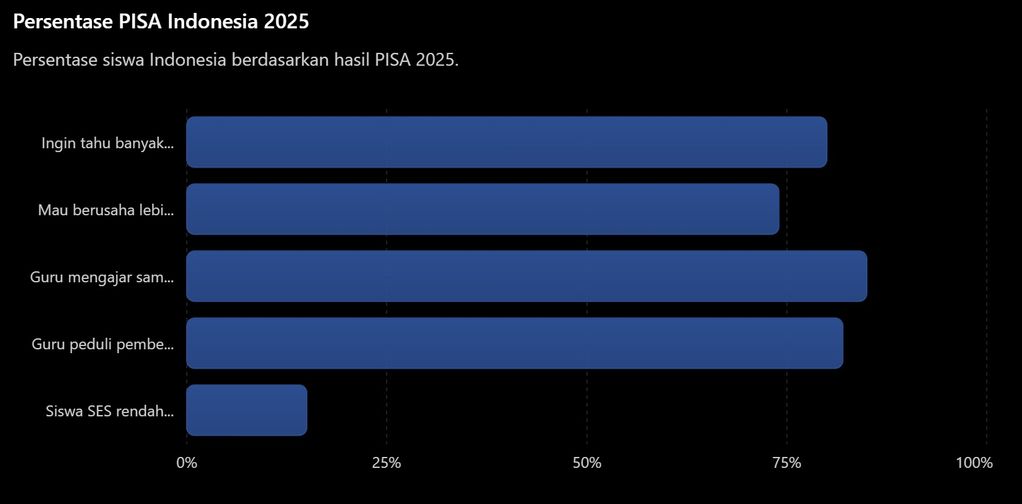
Crucially, PISA 2025 data proves that Indonesia does not suffer from a deficit of curiosity or willpower.
- 80% of Indonesian students express broad curiosity (surpassing the OECD average of 73%).
- 74% report a willingness to exert extra effort when facing difficult tasks (compared to an OECD average of 60%).
- 85% note that their teachers persist until concepts are understood, and 82% feel their teachers show personal attention to their learning.
- 15% of disadvantaged socio-economic students successfully broke into the top performance quartile domestically, proving that socioeconomic background is not destiny.
- Regional achievement gaps are also narrowing; compared to Malaysia, Indonesia’s score gap between 2018 and 2025 has compressed across all three subjects (from 62 to 34 points in math, 44 to 28 in reading, and 42 to 32 in science).
Our fundamental problem is not a lack of curiosity, student effort, or dedicated educators. The crisis lies in how this human capital is translated into tangible, measurable competencies.
Official Responses and Strategic Directions
While public discourse often paints Indonesian educational reform as directionless, a closer look at national assessments—such as the National Assessment (Asesmen Nasional), the Academic Potential Test (UTBK), and Academic Ability Tests (TKA)—reveals a deliberate pivot toward critical literacy, numeracy, and reasoning over rote memorization.
This direction aligns precisely with modern industrial demands. Employers no longer seek graduates who have merely memorized vast arrays of facts; they require individuals capable of learning new skills, processing data, collaborating, and making sound decisions.
However, realizing this vision requires bridging the persistent chasm between idealistic curriculum frameworks and daily classroom execution.
Historical Curriculum Evolution: Idealisme vs. Execution
Indonesia has never lacked visionary educational frameworks:
- Competency-Based Curriculum (KBK): Emphasized demonstrated student capabilities over completed content.
- KTSP: Empowered schools to design localized curricula.
- Curriculum 2013: Encouraged active knowledge construction through scientific observation, questioning, and reasoning.
- Kurikulum Merdeka: Emphasizes deep conceptual understanding, relevance, and meaningful learning experiences.
Yet, despite these noble blueprints, the ground reality often stalls. Teachers may embrace terms like "competency" or "deep learning" without receiving concrete, actionable guides on how to manifest them daily. Classrooms remain overwhelmingly one-directional and rote-driven due to administrative burdens, rigid content pacing, and scarce pedagogical mentoring.
Implications and Actionable Solutions
To convert the PISA 2025 alarm into sustainable progress, structural interventions must target four critical pillars:
1. Embed Literacy and Numeracy Across All Subjects
Literacy is not solely the domain of language teachers, nor is numeracy the exclusive responsibility of math instructors. Students must be trained to read biological graphs, evaluate historical primary sources, interpret economic percentages, and construct evidence-based arguments across every academic discipline. Classrooms must shift away from the race to "finish the syllabus" and toward rigorous problem-solving.
2. Leverage Data for Targeted Interventions
Schools must systematically map student needs using National Assessments, TKA, UTBK, and school diagnostics. Struggling students require structured, consistent tutoring and remediation, while high-potential learners need enrichment clubs, research projects, and complex problem-solving challenges that push them beyond their comfort zones.

3. Equip Teachers with Practical Pedagogical Support
Professional development must move beyond one-off seminars or passive module distributions. Educators require continuous coaching on designing competency-based assessments, analyzing diagnostic data, and cultivating collaborative school cultures where teachers refine pedagogical practices based on empirical student performance evidence.
4. Enforce Disciplined Technology Integration
PISA 2025 noted that Indonesian students spend an average of 2.5 hours daily on digital devices for schoolwork, alongside 1.3 hours on non-academic activities. Distraction correlates directly with lower scores. Schools must establish clear digital boundaries while actively training students to use Artificial Intelligence (AI) responsibly—as a cognitive scaffolding tool rather than an intellectual shortcut.
Collaborative Ecosystems: The Role of Educational Providers
Systemic transformation cannot be achieved by government mandates alone. It requires an integrated ecosystem involving schools, local governments, foundations, and educational technology pioneers.
Organizations like Ruangguru and Brain Academy Center by Ruangguru—operating nearly 400 branches nationwide and serving upwards of 60,000 students annually—play a pivotal strategic role. Through frameworks like Learn It! Love It! Live It! (Aku Paham, Aku Suka, Aku Bisa), students are guided through structured scaffolding that moves them from dependency to autonomous mastery. By coupling conceptual depth with targeted test preparation (for UTBK, TKA, and PISA-style competencies), such networks bridge the gap between national curriculum ideals and classroom execution.
Concurrently, specialized initiatives must identify and nurture early-stage talents, ensuring that the top 0.1% of high-achieving youth receive advanced development pathways.
Furthermore, robust B2B partnerships—providing schools with diagnostic tests, teacher training, competency-based question banks, and interactive digital learning tools—ensure that assessment data translates into immediate, actionable classroom strategies.
Conclusion: From Alarm Bells to Decisive Action
PISA must stop being treated as a triennial media event defined by transient hand-wringing and cyclical debate over rankings. It must serve as an empirical baseline for short-, medium-, and long-term educational targets.
Achieving the vision of Indonesia Emas 2045 (Golden Indonesia 2045) will not be accomplished through slogans, glossy curricula, or distributed hardware alone. It will be built upon millions of microscopic classroom victories: a student finally comprehending a complex text, an educator pioneering an intuitive explanation, a school utilizing diagnostic data to rescue a struggling learner, and a young innovator granted the space to excel.
The alarm of PISA 2025 has sounded. The challenge ahead is no longer recognizing the gravity of the situation, but systematically translating that awareness into measurable, accountable, and enduring educational reform.