PT Freeport Indonesia Projects State Revenue to Surge Past $8 Billion by 2028 Driven by Production Recovery and High Commodity Prices
JAKARTA — PT Freeport Indonesia (PTFI), operator of one of the world’s largest copper and gold mines, has announced ambitious financial projections that point to a massive windfall for the Indonesian state treasury over the coming years.
In a high-stakes hearing with Commission XII of the House of Representatives (DPR) at the Parliament Complex in Jakarta, PTFI President Director Tony Wenas revealed that the company expects its fiscal contributions to the Indonesian government to reach $2.6 billion (approximately Rp 40 trillion) this year. Looking further ahead, Wenas outlined an exponential trajectory that will see these state revenues nearly double by 2027 and triple by 2028, fueled by a full recovery in underground mining operations, soaring production volumes, and robust global commodity markets.
The announcements provide a clear window into the financial health of the mining giant and its critical role in funding Indonesia’s national development budget through taxes, dividends, Non-Tax State Revenue (PNBP), and various regional and national levies.
1. Main Facts: The Numbers Behind the Projections
The financial roadmap presented by PTFI to lawmakers maps out a lucrative three-year period for the Indonesian government. The breakdown of state revenues highlights not only the scale of Freeport’s operations in Mimika, Papua, but also the sensitivity of these forecasts to global metal prices.
2026 Fiscal Outlook
For the current year, PTFI projects a total contribution of $2.6 billion (approx. Rp 40 trillion). This figure encompasses corporate income taxes, export duties, regional taxes, dividends paid to state-owned mining holding company MIND ID, and PNBP.
Crucially, Wenas pointed out that this projection is built on conservative baseline assumptions:
- Copper Price Assumption: $4.75 per pound.
- Gold Price Assumption: $4,000 per ounce.
However, current market realities are outperforming these baseline assumptions. Spot prices for copper are currently hovering around $6.5 per pound, while gold is commanding roughly $4,500 per ounce. If these elevated market prices persist through the fiscal year, actual contributions could comfortably exceed the baseline projections.
The 2027 Leap
The growth curve steepens dramatically in 2027. PTFI projects that state revenue from its operations will surge by roughly 77% to $4.6 billion. This jump is not merely a product of price speculation; it is anchored in a fundamental operational rebound.
The 2028–2029 Horizon: The $8 Billion Milestone
The most striking figure in PTFI’s long-term forecast is the projected stabilization of state contributions at $8 billion (more than Rp 120 trillion) annually starting in 2028, 2029, and stretching into the subsequent decade. This milestone represents a historic high for single-entity corporate contributions to the Indonesian state budget, cementing PTFI’s status as one of the country’s most vital economic engines.
2. Chronology: From Parliamentary Debates to Operational Roadmaps
The revelation of these staggering financial forecasts did not happen in a vacuum. It was the result of a structured parliamentary review process designed to hold strategic natural resource companies accountable to the state.
The Parliamentary Setting
On Tuesday, September 15, 2026, the leadership and executives of PT Freeport Indonesia stepped before Commission XII of the DPR—the parliamentary commission overseeing energy, environment, and investment. The hearing was convened to review the company’s annual work plan, environmental compliance, downstream processing milestones, and financial projections for the medium term.
Presentation of the Slide Deck
During the proceedings, Tony Wenas walked lawmakers through a detailed slide presentation tracking the correlation between operational recoveries and state revenue.
- Opening the Briefing (Early Session): Wenas established the baseline for 2026, detailing how taxes, dividends, and PNBP are calculated using the $4.75 copper and $4,000 gold assumptions. He juxtaposed these baseline metrics against the bullish current market prices of $6.5 per pound for copper and $4,500 per ounce for gold.
- Unveiling the 2027 Growth Curve: Moving to the subsequent fiscal year, Wenas explained the mechanics behind the leap to $4.6 billion. He directed lawmakers’ attention to production metrics, noting that the resolution of operational bottlenecks would unlock massive reserves.
- The Long-Term Forecast (2028 and Beyond): Concluding the core financial briefing, Wenas delivered the headline projection: the stabilization of annual state revenues at the $8 billion threshold beginning in 2028. He emphasized that this plateau is sustainable over the long term, backed by the immense remaining reserves of the Grasberg mineral district.
Following the presentation, members of Commission XII engaged in a rigorous question-and-answer session, pressing PTFI executives on environmental remediation, local workforce development, and the precise distribution of dividends to the central government versus regional authorities in Papua.
3. Supporting Data: Production Recovery and the Grasberg Block Cave
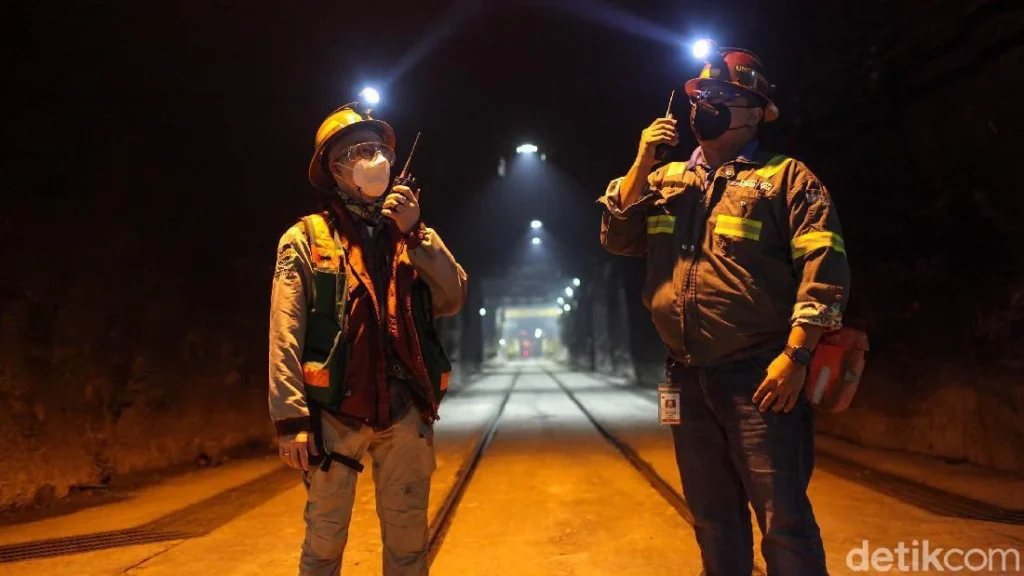
A deeper analysis of PTFI’s operational metrics explains why company leadership is so confident in its ability to deliver exponential revenue growth to the state. The forecasted financial windfall is a direct consequence of shifting from open-pit mining to underground mass-mining technologies—specifically, the Grasberg Block Cave (GBC).
Overcoming Operational Hurdles
In late 2023 and 2024, PTFI faced severe disruptions, notably a catastrophic fire at its Manyar smelter facility in Gresik, East Java, alongside localized geotechnical challenges in Papua. These events temporarily constrained processing capacity and forced a recalibration of export volumes.
However, by 2025 and moving firmly into 2026, the company has successfully stabilized its supply chain and processing infrastructure. The domestic downstream processing requirements—mandated by Indonesian law—are now fully integrated into PTFI’s business model, allowing the company to capture higher domestic value-added margins.
Volume Projections: 2026 vs. 2027
The quantitative leap between 2026 and 2027 illustrates the production recovery curve:
- Gold Production:
- 2026: Projected at approximately 700,000 ounces (roughly 21 metric tons).
- 2027: Projected to jump to 1 million ounces (roughly 31 metric tons)—a staggering 42% increase in precious metal output.
- Copper Production:
- 2026: Estimated at 800 million pounds.
- 2027: Estimated to surge to 1.3 billion pounds—a 62.5% expansion in industrial metal volume.
These production volumes are driven by the maturity of the underground Grasberg Block Cave and Deep Mill Level Zone (DMLZ) mines. As these massive block caves reach peak production capacity, ore grades and extraction efficiency improve concurrently.
4. Official Responses: Parliament and Corporate Leadership
The projections elicited a mix of cautious optimism, fiscal scrutiny, and strategic foresight from both legislative overseers and corporate executives.
Tony Wenas’s Perspective
Addressing the lawmakers, Tony Wenas stressed that PTFI’s contributions are multi-layered. They are not limited to corporate income tax alone, but represent a complex ecosystem of state entitlements.
"That was what I demonstrated earlier, that for the 2026 projection, the planned state revenue is $2.6 billion, or around Rp 40 trillion. This is comprised of taxes, dividends, and other non-tax state revenues (PNBP)," Wenas explained to the commission.
He added, "When we look ahead compared to the plan for 2027, there is a significant increase in state revenue to $4.6 billion. This aligns directly with the production increases I outlined in the previous slide… And by 2028, 2029, and onwards, state revenues in the form of taxes, PNBP, dividends, and other levies are expected to reach $8 billion, or over Rp 120 trillion per year."
Parliamentary Reactions
Members of Commission XII welcomed the optimistic forecasts but used the platform to demand accountability regarding corporate governance, environmental safety, and the equitable distribution of wealth to the indigenous populations of Papua.
Several legislators pointed out that while a projected $8 billion annual injection into the state budget is transformative for national finances, the central government must ensure that a fair share of these funds is channeled directly back into Papua’s infrastructure, education, and healthcare sectors to bridge regional development disparities. Lawmakers also emphasized the importance of rigorous environmental oversight, particularly regarding tailings management and post-mining land reclamation liabilities.
5. Implications: Economic, Geopolitical, and Fiscal Impacts
The realization of PTFI’s revenue projections carries profound implications for Indonesia’s macroeconomic stability, its state-owned enterprise (SOE) landscape, and its standing in the global green energy transition.
Macroeconomic and Fiscal Strengthening
An annual state revenue injection of Rp 40 trillion in 2026, scaling up to more than Rp 120 trillion ($8 billion) by 2028, provides the Ministry of Finance with substantial fiscal breathing room. In an era of global economic uncertainty and volatile capital flows, predictable, high-volume commodity revenues help stabilize the national budget, support the national currency (Rupiah), and fund flagship government programs—ranging from infrastructure development to social welfare and human capital investments.
The Role of MIND ID and Dividend Distribution
As the majority shareholder of PTFI through PT Mineral Industri Indonesia (MIND ID)—which holds a 51% stake—the Indonesian government stands to capture a lion’s share of the dividend distributions embedded within these revenue figures. These dividends flow directly into state coffers and SOE holding accounts, providing capital that can be reinvested into other strategic sectors, such as downstream nickel processing, electric vehicle (EV) supply chain development, and renewable energy infrastructure.
Critical Mineral Security and the Energy Transition
Copper is the indispensable metal of the global energy transition. Without vast quantities of copper, the manufacturing of electric vehicles, wind turbines, solar panels, and upgraded power grids is impossible. By securing a stable, expanding domestic supply of copper—and processing it within national borders via domestic smelters—Indonesia is positioning itself not merely as an exporter of raw dirt, but as a critical node in the global green supply chain.
Challenges on the Horizon
Despite the glowing financial forecast, observers note that risks remain. Global commodity markets are notoriously cyclical; a sudden global economic slowdown or a sharp contraction in Chinese industrial demand could depress copper and gold prices below PTFI’s baseline assumptions. Furthermore, operational risks—ranging from geotechnical stability in deep underground mines to labor relations and regulatory shifts—will require vigilant management by PTFI’s executive team.
Nevertheless, as PT Freeport Indonesia enters this new chapter of high-volume underground extraction and domestic downstream processing, the company stands poised to deliver unprecedented financial returns to the Republic of Indonesia, firmly cementing its status as a cornerstone of the nation’s economic sovereignty.