Navigating the Coretax Era: Why Professional Competency is the New Gold Standard in Indonesian Taxation
JAKARTA – The landscape of Indonesian taxation is undergoing a seismic shift. As the Directorate General of Taxes (DGT) moves toward the full implementation of the Coretax Administration System (CTAS), the traditional methods of handling tax compliance—often characterized by manual inputs and fragmented processes—are rapidly becoming obsolete. For corporations, tax consultants, and financial professionals, this transition is not merely a software update; it is a fundamental redefinition of tax governance.
As the implementation deadline looms, a critical competency gap has emerged. For practitioners unfamiliar with the intricacies of the Coretax environment, the transition presents tangible risks: inaccurate reporting, compliance bottlenecks, and a potential decline in the operational efficiency of finance departments. To bridge this divide, the Piranha Smart Center (PSC), in strategic collaboration with the SET Academy, has launched the Certified CoreTaxify Professional (CCP) certification program—a comprehensive initiative designed to transform theoretical knowledge into actionable, system-based proficiency.
The Paradigm Shift: From Theoretical Compliance to Systemic Expertise
Historically, Indonesian tax education has been heavily weighted toward legislative theory. Professionals spent years memorizing the nuances of the Income Tax Law (PPh) and the intricacies of Value Added Tax (PPN). However, the Coretax system demands a hybrid expertise: the ability to marry deep regulatory knowledge with high-level technical aptitude.
The Coretax system is designed to integrate various tax processes into a single, cohesive digital ecosystem. This unification means that a single error in data entry or a misunderstanding of the system’s logic can have cascading effects across multiple tax reporting modules.
"Tax competency in the modern era is no longer just about understanding the law; it is about mastering the environment where that law is enforced," explains a lead instructor at the SET Academy. "Our CCP program is built on the philosophy that unless a practitioner can navigate the digital interface with the same fluency as they understand the tax code, their compliance status remains at risk."
The CCP Curriculum: A Deep Dive into Digital Compliance
The Certified CoreTaxify Professional (CCP) curriculum is meticulously engineered to address the end-to-end lifecycle of tax administration. By moving beyond traditional textbook methodologies, the program ensures that participants are equipped to handle the complexities of the new system from day one.
Core Modules of the CCP Program:
- Withholding and Collection (Potput): Mastery of the automated withholding mechanisms that reduce human error and ensure precise tax deductions.
- Unification of Reporting: Navigating the integrated PPh Unifikasi module, which simplifies the reporting of various withholding taxes into a single, streamlined workflow.
- VAT and Luxury Goods Tax (PPN & PPnBM): Deep-dive simulations on reconciling sales and purchase invoices within the Coretax framework to ensure seamless tax credit claims.
- Individual and Corporate Income Tax (PPh OP & Badan): Advanced training on the digital reconciliation of financial statements with the tax base as interpreted by the Coretax algorithm.
- Audit Readiness: Understanding the internal system flags and automated audit trails that the Coretax system generates, allowing businesses to proactively manage their risk profiles.
The pedagogy utilizes a "Practice-First" approach. Participants are not merely lectured; they are immersed in the CoreTaxify simulation environment. This environment mirrors the real-world interface of the DGT’s new system, allowing students to perform calculations, lodge returns, and troubleshoot errors in a safe, risk-free space.
Chronology: The Road to the Coretax Transformation
The adoption of the Coretax system is the cornerstone of the DGT’s modernization agenda, aimed at increasing the tax ratio and enhancing transparency.
- Initial Conceptualization (2020-2022): The DGT initiated the digital transformation project, aiming to replace the legacy SIAP system, which had become fragmented over the years.
- The Pilot Phase (2023-2024): Limited testing was conducted among large taxpayers and specific tax offices to identify UI/UX pain points and systemic bugs.
- The Readiness Crisis (Early 2025): As the national rollout approached, internal surveys indicated that while the system was ready, the human resources responsible for operating it were struggling to adapt to the new digital workflows.
- The CCP Launch (2026): Recognizing the urgency, Piranha Smart Center and SET Academy formalized the CCP certification to provide a standardized benchmark for professionals navigating the transition.
Supporting Data: The Cost of Competency Gaps
Data from various tax consulting firms suggests that the "adjustment period" for new tax systems typically results in a 15-20% increase in administrative overhead for the average finance department. Common pitfalls include:
- Data Mismatch Errors: Discrepancies between internal ERP systems and the Coretax input interface.
- Compliance Delays: Filing delays caused by unfamiliarity with the new submission portals, leading to administrative penalties.
- Audit Exposure: An increase in automated "System-Generated Inquiries" triggered by inconsistent data patterns that the Coretax system detects automatically.
By investing in professional certification, companies are not just buying training; they are buying risk mitigation. The CCP program is designed to reduce the "learning curve" downtime from months to mere weeks, ensuring that businesses maintain their compliance posture without sacrificing productivity.
Official Perspectives and Industry Impact
Industry experts are increasingly emphasizing that the Coretax system will fundamentally change the relationship between the tax authority and the taxpayer.
"The Coretax system is proactive rather than reactive," notes a senior tax policy analyst. "It utilizes big data analytics to identify non-compliance in real-time. For a tax professional, this means that ‘after-the-fact’ corrections are becoming more difficult. You must get it right on the first attempt, within the system."
The partnership between PSC and SET Academy is viewed by many as a timely intervention. By providing a structured path to certification, they are creating a pool of "System-Ready" talent that is highly sought after by accounting firms, MNCs, and SMEs alike.
Implications for the Future of the Profession
The introduction of the CCP certification has broad implications for the tax profession in Indonesia:
1. The Rise of the "Tech-Savvy Tax Expert"
The traditional tax accountant is being replaced by the "Tax Technologist." This individual is as comfortable with cloud-based tax administration platforms as they are with the intricacies of tax law. The CCP program serves as a formal validation of this hybrid skill set.
2. Standardization of Best Practices
Currently, many companies are developing their own internal "workarounds" for the Coretax system. This leads to fragmented compliance standards across the industry. The CCP program seeks to unify these practices, creating a standardized language of compliance that benefits both taxpayers and the government.
3. Career Advancement and Mobility
For junior accountants, students, and academics, the CCP certification is a powerful tool for professional mobility. It signals to employers that the candidate is already equipped with the skills necessary to handle the most significant regulatory change in a decade.
Training Logistics and Enrollment
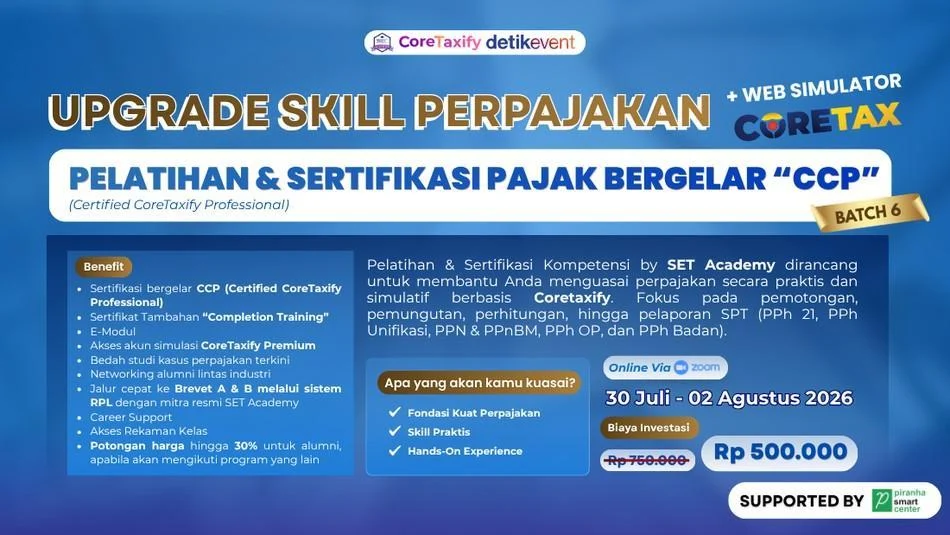
The upcoming intensive online training is scheduled to be held from Thursday, July 30, to Sunday, August 2, 2026. The sessions will be conducted via Zoom Meeting, ensuring accessibility for professionals across the archipelago.
Who should attend?
- Finance/Accounting Staff: To ensure daily operations remain compliant.
- Tax Consultants: To provide expert guidance to clients who are struggling with the system.
- Students & Academics: To bridge the gap between academic theory and the actual requirements of the modern workplace.
- Corporate Leadership: To understand the systemic risks and opportunities that Coretax introduces to their business model.
Benefits of Certification:
- Official CCP A professional credential recognized within the industry.
- CoreTaxify Premium Access: Hands-on experience with the simulation account.
- E-Modules: Comprehensive resources for ongoing reference.
- RPL Pathway: Fast-track opportunities for Brevet A and B certifications through the SET Academy’s Recognition of Prior Learning (RPL) program.
Conclusion: Securing Your Future in the Coretax Era
The implementation of the Coretax system is an irreversible step toward the digitalization of Indonesia’s fiscal infrastructure. While the transition presents challenges, it also offers a unique opportunity for professionals to reinvent their value proposition.
By mastering the system today, practitioners move from a position of anxiety to a position of authority. The Piranha Smart Center and SET Academy have provided the roadmap; the rest is up to the individual. As the professional landscape evolves, those who choose to adapt will lead. Those who rely on outdated methods risk being left behind in a system that demands precision, speed, and digital fluency.
Slots for the upcoming CCP cohort are limited to ensure the quality of the interactive sessions. Professionals are encouraged to secure their participation via detikevent immediately. Don’t wait until the compliance deadline—ensure your firm is ready for the future of tax, today.