Mixed Fortunes for Indonesia: Amri/Nita Advance to Asian Games 2026 Quarterfinals as Joaquin/Fadia Exit
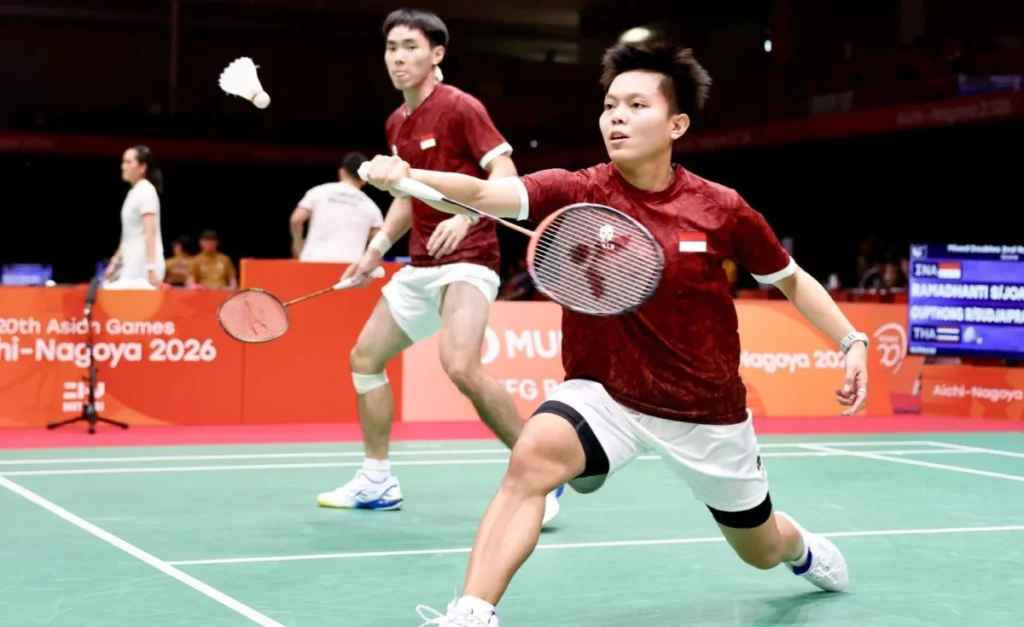
ICHINOMIYA – The atmosphere at the Ichinomiya City Municipal Gymnasium in Japan was nothing short of electric this Friday, September 25, 2026. As the Asian Games 2026 badminton individual events reached the pivotal Round of 16, the Indonesian contingent experienced a day of stark contrasts. While the resilient pair of Amri Syahnawi and Nita Violina Marwah demonstrated exceptional tactical maturity to secure a quarterfinal berth, the campaign for Nikolaus Joaquin and Siti Fadia Silva Ramadhanti came to a heartbreaking conclusion.
The results from today’s matches have significantly shifted the landscape for the Indonesian badminton team as they vie for podium finishes in the prestigious multi-sport event.
The Resilience of Amri Syahnawi and Nita Violina Marwah
The narrative for Amri Syahnawi and Nita Violina Marwah was one of profound perseverance. Facing the daunting task of playing against the home favorites, Japan’s Yuta Watanabe and Maya Taguchi, the Indonesian duo found themselves in immediate trouble.
A Disastrous Start
The opening game saw the Japanese pair dictate the tempo from the first rally. Watanabe’s renowned court coverage and Taguchi’s precise net play left the Indonesian pair scrambling. Amri and Nita struggled to find their rhythm, falling behind early and failing to counter the aggressive offensive strategy deployed by the hosts. The opening game concluded in a lopsided 9-21 scoreline, a result that would have rattled many athletes on the international stage.
The Tactical Pivot
However, what transpired in the second and third games served as a testament to the pair’s mental fortitude. Instead of succumbing to the pressure of the hostile crowd and the deficit, Amri and Nita recalibrated their approach. They tightened their defense, reduced unforced errors, and began targeting the gaps in the Japanese duo’s defensive formation.
In the second game, the momentum began to swing. Amri began to dominate the front court, setting up Nita for powerful smashes that forced errors from the Japanese side. They claimed the second game 21-18, effectively pushing the match into a decider.
The third game was a masterclass in composure. With the crowd roaring, Amri and Nita remained focused, maintaining a steady lead throughout the latter half of the game. They eventually closed out the match 21-15, securing their spot in the quarterfinals and proving their status as genuine contenders for an Asian Games medal.

The Heartbreak of Joaquin and Fadia
In parallel, the court adjacent to the main arena witnessed a grueling battle for Nikolaus Joaquin and Siti Fadia Silva Ramadhanti. Their path to the quarterfinals was blocked by Thailand’s formidable duo, Ruttanapak Oupthong and Jhenicha Sudjaipraparat.
The match was characterized by high-octane rallies and long exchanges that pushed both pairs to their physical limits. The first game was a nail-biter, with neither side able to pull away by more than two points. Every serve was contested, and every point was fought for with desperate intensity. Ultimately, the Thai pair edged out the Indonesians in a marathon opener, taking it 26-24.
The emotional toll of losing such a closely contested first game appeared to hinder the Indonesian pair in the subsequent stages. Despite their technical proficiency, Joaquin and Fadia struggled to maintain the necessary consistency to break down the Thai defense, leading to their exit in the 16th round.
Chronology of the 16th Round Matches
The events of September 25th in Ichinomiya unfolded as follows:
- 14:00 WIB: The atmosphere builds as fans pack the Ichinomiya City Municipal Gymnasium.
- 14:30 WIB: Amri/Nita take the court against the Japanese pair of Watanabe/Taguchi.
- 15:05 WIB: The first game concludes with a disappointing 9-21 loss for Indonesia.
- 15:30 WIB: A dramatic shift in strategy sees Amri/Nita win the second game 21-18.
- 16:00 WIB: Amri/Nita seal their comeback with a 21-15 victory in the third game, officially punching their ticket to the quarterfinals.
- 16:15 WIB: Nikolaus Joaquin and Siti Fadia take the stage against Oupthong/Sudjaipraparat.
- 17:00 WIB: The grueling first game ends 24-26, placing immense pressure on the Indonesian pair.
- 17:20 WIB: Despite their best efforts, the Indonesian pair concedes the match, marking their exit from the tournament.
Supporting Data: The Road to the Quarterfinals
To understand the weight of these results, one must look at the competitive landscape of Asian badminton. The Asian Games is often considered more difficult than the World Championships due to the sheer density of world-class talent from China, Japan, South Korea, and Indonesia.
For Amri and Nita, this victory marks a significant milestone in their partnership. Having shown inconsistency in the BWF World Tour throughout the early months of 2026, this performance suggests they have peaked at the right time. Statistics from their victory today highlight an improvement in their "win-conversion" rate during long rallies—a key indicator of a pair ready to challenge for the podium.
Conversely, the exit of Joaquin and Fadia highlights the volatility of the mixed doubles discipline. At this level, the margin for error is razor-thin. Their loss in the first game by a two-point margin (24-26) suggests that the technical gap between them and the top-tier Thai pair is virtually non-existent; it was purely a matter of who held their nerve during the critical "deuce" points.

Official Responses and Strategic Implications
Following the matches, the Indonesian Badminton Association (PBSI) released a brief statement acknowledging the mixed results.
"We are incredibly proud of the mental strength shown by Amri and Nita. Coming back from a 9-21 loss in the opening game to win the match is the hallmark of a champion," said a team spokesperson. Regarding the exit of Joaquin and Fadia, the association emphasized the need for a comprehensive post-match analysis. "It is a tough pill to swallow for Nikolaus and Fadia, but they showed immense heart. We will review the tactical decisions made in the closing stages of the first game to ensure they return stronger for future tournaments."
What This Means for Indonesia
The advancement of Amri/Nita is vital for Indonesia’s gold medal hopes. With many of the top-seeded pairs from other nations also facing fierce competition, the bracket has opened up significantly. For the coaching staff, the focus now shifts entirely to the quarterfinal preparation. Recovery protocols, video analysis of their next opponents, and mental conditioning will be the priority for the next 24 hours.
For the Indonesian badminton fans, the exit of one of their pairs is a reminder of the unforgiving nature of elite sports. However, the success of Amri and Nita serves as a rallying point. The nation remains hopeful that the spirit displayed on the courts of Ichinomiya today will carry through to the final rounds.
Looking Ahead: The Quarterfinal Challenge
As the tournament progresses, the pressure will only intensify. The Asian Games 2026 is not merely a test of physical ability; it is a war of attrition. Amri and Nita will need to replicate their second-game resilience from today if they hope to progress to the semifinals.
The fans in Indonesia continue to watch with bated breath. With the competition reaching its climax, every rally, every point, and every match is a story of national pride and individual aspiration. As the dust settles in Ichinomiya, one thing is certain: the journey of the remaining Indonesian representatives is far from over, and the entire nation stands behind them as they step back onto the court.
The badminton community will now look toward the upcoming matches with renewed anticipation, wondering if the momentum gained by Amri and Nita will be enough to bring home the gold.