Golden Triumph: Leo Rolly Carnando and Daniel Marthin Conquer Asian Games 2026
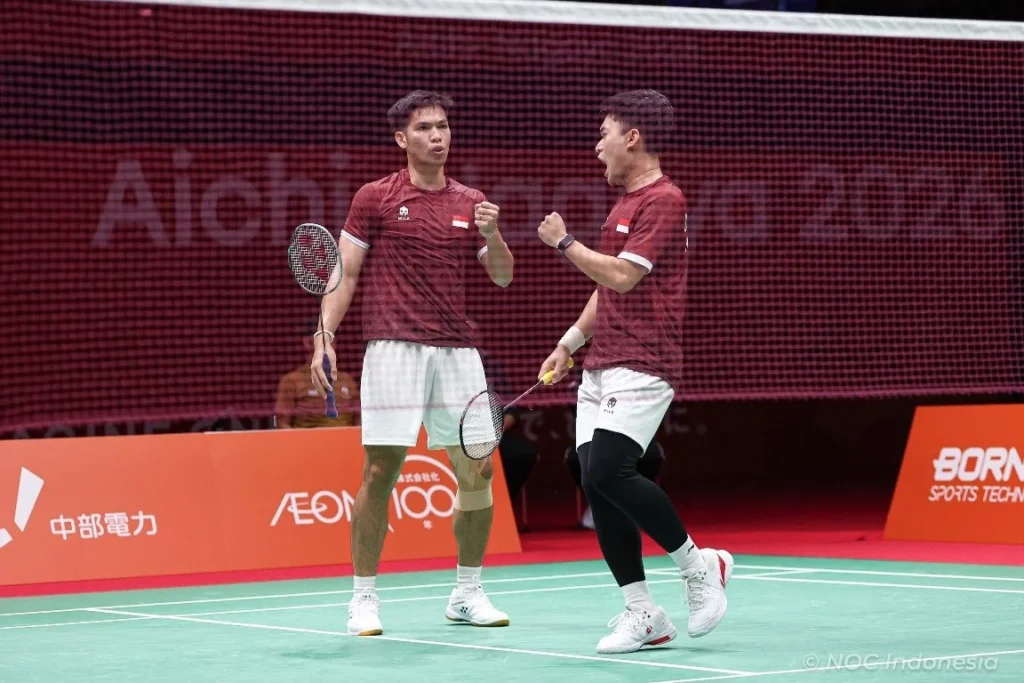
ICHINOMIYA – The Indonesian badminton contingent has etched a historic chapter at the 2026 Asian Games. In a dramatic display of resilience and tactical brilliance, the men’s doubles pair, Leo Rolly Carnando and Daniel Marthin, secured the gold medal in the individual event. Facing formidable opponents from China, the duo showcased the hallmark grit of Indonesian badminton, turning a precarious situation into a moment of national pride at the Ichinomiya City Municipal Gymnasium on Tuesday, September 29, 2026.
A Hard-Fought Battle for Supremacy
The final match was a classic showdown between two of the world’s most aggressive pairs. Leo Rolly Carnando and Daniel Marthin stood across the net from China’s Liang Wei Keng and Wang Chang. The atmosphere in the Ichinomiya City Municipal Gymnasium was electric, with fans witnessing a high-octane tactical battle that stretched across three grueling games.
The match began with the Chinese pair setting a rapid pace. Liang and Wang utilized their explosive power to dictate the net play, catching the Indonesian duo off guard. Despite a valiant defensive effort, Leo and Daniel struggled to find their rhythm early on, conceding the first game 19-21. For many, the momentum seemed to be shifting firmly in favor of the Chinese representatives, who appeared to have neutralized the "Baby Giants’" signature offensive prowess.
However, the second game marked a turning point. Recognizing the need for a tactical shift, Leo and Daniel began to vary their shot selection, forcing their opponents into uncharacteristic errors. The Indonesian pair stormed back with a commanding 21-13 victory, leveling the match and pushing the final into a decisive third game.
Chronology: The Road to the Podium
The path to the gold medal was paved with intense physical and mental conditioning. Throughout the tournament, Leo and Daniel had demonstrated steady growth, overcoming seasoned opponents from South Korea and Malaysia in the earlier rounds. Their performance in the final served as the culmination of months of rigorous preparation under the guidance of the national coaching staff.
- The Opening Gambit: The first game saw China seize the initiative. Liang and Wang’s precise smashes created early gaps in the Indonesian defense. Leo and Daniel, known for their powerful attack, found themselves pinned back, struggling to launch their own counter-attacks.
- The Tactical Reset: Between the first and second games, the Indonesian camp emphasized composure. The focus shifted from raw power to defensive stability. By narrowing the court coverage and forcing the Chinese duo to play from the back of the court, Leo and Daniel regained control.
- The Decisive Finale: The third game was a masterclass in nerves. Locked in a tight contest, the score remained neck-and-neck until the final exchanges. It was here that Leo and Daniel’s partnership truly shone, as they combined for a series of lethal interceptions at the net, ultimately closing out the match 21-18.
As the final shuttlecock landed, the relief and euphoria were palpable. Both players collapsed onto the court, embracing in a moment of pure emotion—a testament to the weight of expectation they had carried throughout the games.
The Power of Mindset: "If Not Now, When?"
Following the victory, Daniel Marthin revealed the internal dialogue that fueled their comeback. In a post-match statement released by PBSI (Badminton Association of Indonesia), Daniel spoke candidly about the pressure of the moment.

"We thank God for this result. We are incredibly grateful," Daniel stated. "During the match, especially when we were trailing, we constantly reminded each other. We told ourselves, ‘If not now, when?’ We knew we had to maximize this opportunity, as chances like this do not come around often."
This mantra—kalau enggak sekarang, kapan lagi (if not now, when)—has become a rallying cry for the pair, reflecting a maturation in their approach to professional badminton. Having already tasted success earlier this year at the Thailand Open 2026, the duo arrived in Japan with a clear objective: to cement their status as the premier men’s doubles pair in Asia.
Analyzing the Statistical Dominance
The victory of Leo and Daniel is not merely a result of luck; it is a statistical validation of their aggressive playstyle. Throughout the 2026 Asian Games, the duo maintained one of the highest "kill" percentages in the tournament. Their ability to transition from defense to offense in under two seconds remains their greatest asset.
Compared to their performance in the 2025 BWF World Tour, their efficiency in the third game of the final match showed significant improvement. While they previously struggled with unforced errors during high-pressure situations, their performance in Ichinomiya was marked by a disciplined reduction in service errors and a higher conversion rate on overhead smashes.
Official Responses and National Pride
The Indonesian sports ministry and the PBSI have lauded the pair for their tenacity. The gold medal is considered a crucial milestone for the "Regeneration Project" of Indonesian men’s doubles, a category that has historically been the nation’s stronghold.
"Leo and Daniel have proven that they are ready to carry the torch," said a representative from the coaching team. "Their victory over a top-tier Chinese pair on such a massive stage shows that they have the mental fortitude required to dominate the global circuit."
Social media platforms in Indonesia erupted with celebratory messages, with #LeoDanielGold trending for several hours. The victory serves as a massive morale booster for the Indonesian contingent, who have faced stiff competition from regional rivals throughout the duration of the 2026 Asian Games.

Implications for the Future of Indonesian Badminton
This gold medal carries significant weight as the badminton world shifts its focus toward the next World Championships and the qualification cycles for future international tournaments. For Leo and Daniel, this win is a catalyst. It provides the necessary ranking points to solidify their position among the world’s top five, effectively guaranteeing them easier draws in upcoming BWF Super 1000 events.
Furthermore, this triumph sends a clear message to their rivals: the Indonesian men’s doubles pair is no longer just a "dangerous outsider." They have evolved into a championship-caliber duo capable of adapting to any style of play.
The challenge moving forward will be consistency. Maintaining this level of performance requires not only physical endurance but also the ability to handle the increased scouting and scrutiny from other nations. With this gold medal around their necks, Leo and Daniel have set a new benchmark for their careers.
Conclusion
The 2026 Asian Games will be remembered as the tournament where Leo Rolly Carnando and Daniel Marthin truly came of age. By overcoming a deficit against a world-class Chinese pair, they proved that their potential is limited only by their own ambition. As they stood on the podium, medals reflecting the lights of the Ichinomiya gymnasium, the world saw not just two talented athletes, but a cohesive unit that understands the value of the present.
For Indonesia, the victory is a reminder of the enduring strength of its badminton culture. As the echoes of the national anthem fade, the journey for Leo and Daniel continues—but for now, they stand tall as the kings of Asia, having answered the question of "when" with an emphatic, resounding "now."