Mastering Financial Efficiency: Bridging the Gap Between Basic Excel and Advanced Accounting Analytics
JAKARTA – In the modern corporate landscape, Microsoft Excel remains the undisputed backbone of the accounting and finance professions. From small startups to multinational conglomerates, the spreadsheet software is ubiquitous. However, a growing trend of "functional deficiency" has emerged: while many professionals claim proficiency in Excel, a significant gap exists between creating basic tables and executing the complex, high-stakes data modeling required in professional financial management.
For many accountants, the daily workflow remains burdened by manual data entry and disjointed spreadsheets, largely because they lack a deep understanding of the specialized functions that can automate their tasks. Recognizing this bottleneck, industry experts are shifting the focus from general Excel training to context-specific "Accounting Accelerators."
The Professional Divide: Why Basic Skills Are No Longer Enough
The reality of modern accounting is that data volume is increasing at an exponential rate. An accountant who can perform simple arithmetic or create basic lists is no longer "tech-ready" in the eyes of most financial departments. The true challenge lies in the complexity of financial data: reconciling thousands of transactions, performing variance analysis, forecasting cash flows, and generating real-time dashboards for executive decision-making.
The Cost of Manual Processing
When professionals rely on manual workarounds rather than leveraging the full power of Excel’s logic—such as nested IF statements, VLOOKUP/XLOOKUP, and INDEX-MATCH—the margin for error increases significantly. Manual processes are not only time-consuming but also carry a high risk of human error, which can lead to significant financial discrepancies.
Furthermore, the inability to utilize advanced tools like Pivot Tables or Power Query often means that an accountant spends 80% of their time "cleaning" data and only 20% actually analyzing it. This inverse ratio is a critical issue that organizations are now seeking to rectify through targeted professional development.
The Evolution of Specialized Training: The Excel Accounting Accelerator
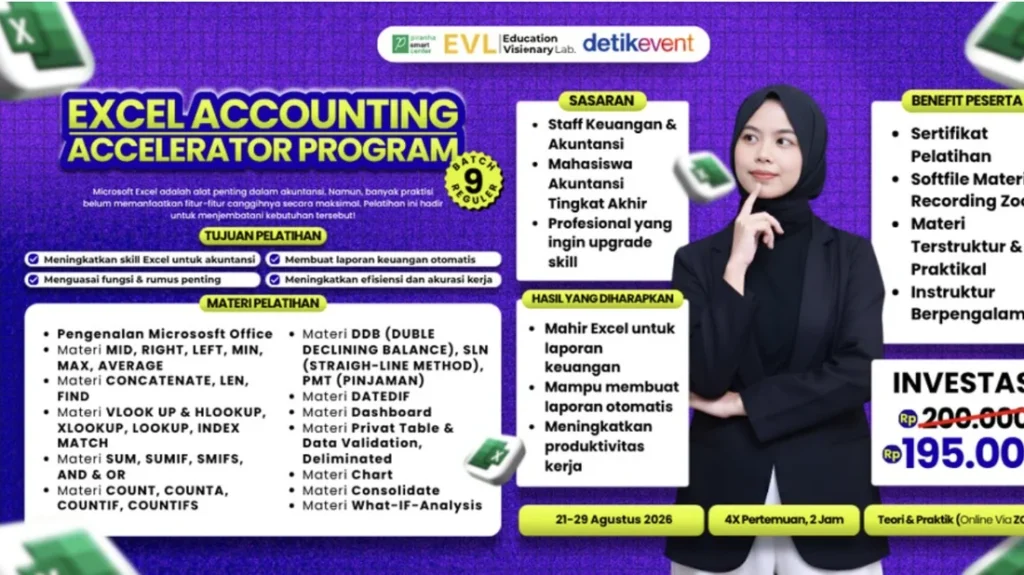
To address this skills gap, training initiatives have moved away from generalized "Excel for Beginners" courses toward highly curated programs. The Excel Accounting Accelerator Program (Reguler Batch 10) is a primary example of this shift. By centering the curriculum on real-world accounting cases, the program ensures that participants are not just memorizing formulas, but applying them to the specific challenges they face in the workplace.
Program Core Objectives
The accelerator is designed to transform how finance professionals interact with their data. The curriculum covers a comprehensive spectrum of essential accounting functions:
- Advanced Data Processing: Techniques for cleaning, organizing, and validating large financial datasets.
- Lookup and Reference Functions: Mastering the tools necessary for cross-referencing ledgers and reconciling bank statements.
- Dynamic Pivot Tables: Using Pivot Tables to summarize financial data, create pivot charts, and perform year-over-year comparisons.
- Financial Modeling and Analysis: Building templates for cash flow projections and budget vs. actual reports.
- Dashboarding: Developing visual representations of financial health that are both intuitive and professional for stakeholders.
Chronology and Program Structure
The upcoming Batch 10 of the Excel Accounting Accelerator is scheduled for a late-September 2026 rollout, structured to accommodate the schedules of working professionals.
- Session 1 (Sept 21, 2026): Foundation of Financial Data Integrity – Focusing on data cleaning and advanced formulas for accounting logic.
- Session 2 (Sept 22, 2026): Advanced Analysis – Deep dive into Pivot Tables, Slicers, and Data Visualization.
- Session 3 (Sept 28, 2026): Automating Financial Reports – Introduction to macros (if applicable) and complex lookup functions to streamline monthly closings.
- Session 4 (Sept 29, 2026): Strategic Financial Dashboarding – Synthesizing data into actionable insights for management review.
All sessions are held in a virtual, online format from 18:30 to 20:30 WIB, ensuring that participants can integrate professional development into their evenings without disrupting their standard working hours.
Supporting Data: The Impact of Excel Mastery on Career Progression
Studies within the financial services sector have consistently shown a direct correlation between advanced technical proficiency and career advancement. According to recent industry surveys, finance professionals who can demonstrate mastery in financial modeling and data automation are 40% more likely to be promoted to senior management roles within their first five years.
Moreover, the "Automation Dividend" is substantial. Firms that adopt advanced Excel reporting workflows report a reduction in month-end closing cycles by an average of 3 to 5 days. This efficiency allows finance departments to pivot from being "scorekeepers" (who report what happened) to "strategic partners" (who analyze why it happened and provide forecasts for the future).
Expert Perspectives: Bridging the Theory-Practice Gap
Industry analysts argue that the problem is not a lack of intelligence, but a lack of contextual learning.
"Traditional Excel training often fails because it teaches the ‘what’ without the ‘why,’" says a lead instructor associated with the Accelerator program. "In a general course, you learn how to use a SUMIFS formula on a list of fruit prices. In an accounting context, you learn to use SUMIFS to reconcile an entire General Ledger by date, category, and cost center. The logic is the same, but the relevance is vastly different."
The pedagogical approach of the Batch 10 program relies heavily on Studi Kasus (Case Studies). By utilizing actual financial statements and raw accounting data, students are forced to troubleshoot the types of messy, fragmented, or incomplete data sets they encounter in their daily jobs.
Implications: The Future of the Accounting Profession
As Artificial Intelligence and Robotic Process Automation (RPA) begin to take over repetitive, low-level accounting tasks, the role of the human accountant is shifting toward higher-level analysis. However, even with AI, Excel remains the primary interface for financial decision-making.
The implication for professionals is clear: Adapt or risk obsolescence.
1. The Shift to Advisory Roles
By automating the mundane parts of the job, accountants are finding more time to act as business advisors. They are moving from data entry to data storytelling—presenting findings in a way that helps business owners make informed, data-driven decisions.
2. Standardization of Best Practices
The adoption of structured training programs like the Excel Accounting Accelerator also helps companies standardize their reporting. When an entire department is trained using the same advanced methodologies, collaboration becomes easier, handovers are more seamless, and the overall reliability of the company’s financial reporting improves.
3. Increased Professional Confidence
Perhaps the most overlooked benefit is the psychological impact on the employee. When a professional stops struggling with Excel and starts commanding it, their confidence in their work increases. This leads to higher job satisfaction and lower turnover rates, as employees feel better equipped to handle the demands of their roles.
Conclusion: Taking the Next Step
The transition from a basic Excel user to an advanced financial analyst is not an overnight process, but it is a necessary evolution. Whether you are a student preparing to enter the workforce, a junior accountant looking to accelerate your career, or a seasoned professional needing to refresh your toolkit, the importance of specialized training cannot be overstated.
The Excel Accounting Accelerator Program (Reguler Batch 10) offers a structured, efficient, and highly relevant path to mastery. By focusing on the specific needs of the accounting function, the program provides the exact tools needed to navigate the complexities of modern finance.
For those ready to move beyond the limitations of manual spreadsheets and harness the full potential of their data, enrollment is now open. Interested participants can register and find further details via detikevent.
Investing in these skills is more than just a professional development goal; it is a commitment to precision, efficiency, and excellence in the field of accounting. As the fiscal year progresses and data demands grow, being equipped with the right formulas and the right analytical mindset will distinguish the leaders in the finance industry from the rest.