
Thirst Amidst the Digital Frontier: Batam’s Water Crisis and the Hidden Costs of AI Infrastructure
By Investigative Desk
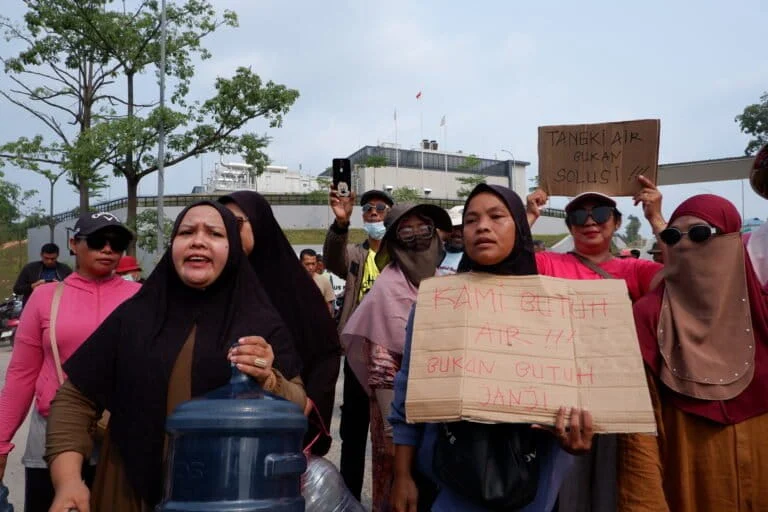
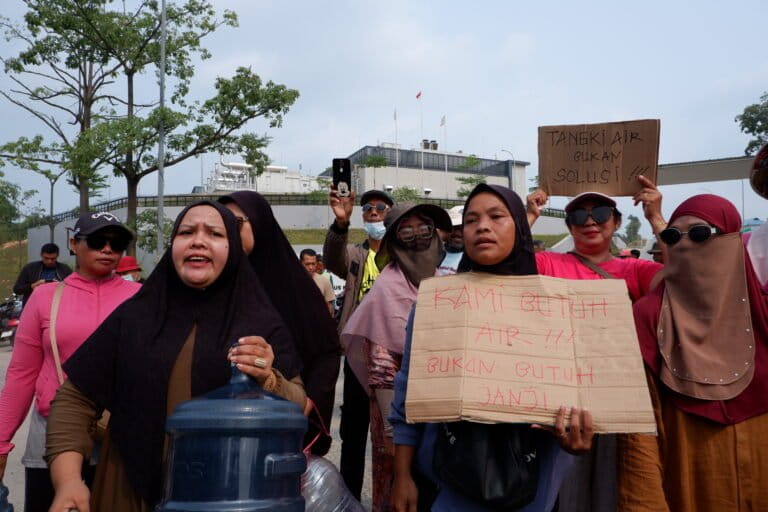
On October 5, 2026, the gates of the Nongsa Digital Park (NDP) in Batam, Indonesia, became the stage for a desperate display of human necessity. Dozens of women from the Sambau district, clutching empty gallon jugs, plastic dippers, and various household containers, gathered not to protest for political reform, but to highlight a fundamental survival crisis: the total absence of clean water.
For three grueling months, the residents of Sambau have been trapped in a cycle of scarcity. As the digital infrastructure within the park expands, the kitchen taps in nearby homes have run dry. The protest, marked by the clatter of empty plastic, served as a grim symbol of a community forced to choose between the high-tech aspirations of a global economic hub and their most basic human right.
The Chronology of a Slow-Motion Crisis
The water crisis in Sambau did not happen overnight, but its intensification has been stark. Residents report that for the past 90 days, the intermittent water supply—which had previously been reliable—has become a luxury.
As the situation deteriorated, the local utility’s emergency measures proved inadequate. Mobile water tanker trucks, dispatched as a stop-gap solution, have failed to meet the community’s daily requirements. For the residents, the struggle has become a daily ritual of desperation. Many are forced to queue before dawn, engaging in what some describe as a "water scramble," waiting hours for a truck that may or may not arrive with enough supply for the neighborhood.
This is not merely a logistical failure; it is a financial burden that has upended the lives of working-class families. For residents like Dewi Susanti, a participant in the October 5 protest, the cost of water has begun to cannibalize the household budget. "I am forced to spend Rp125,000 for two drums of water just to survive a single day," she explains. "That is money that should have been spent on rice and basic nutrition. We are effectively choosing between eating and washing."
Compounding the frustration is the irony of the billing system. Despite the near-total lack of water flowing through their pipes, residents report that their monthly utility bills remain unchanged—high and unforgiving.
The Point of Contention: Data Centers vs. Domestic Need
The proximity of the Nongsa Digital Park to the Sambau residential area has led to a natural, if not officially contested, correlation in the minds of the locals. "Before the data centers were built, our water supply was consistent," says Dewi. "Since the construction began, the flow has dwindled to a trickle. It is hard to ignore the timing."
The residents’ suspicion is rooted in the known thirst of modern digital infrastructure. Data centers—the physical backbone of the Artificial Intelligence (AI) boom—require massive amounts of water for cooling their servers, which generate immense heat.
However, the utility provider, PT Air Batam Hilir (ABH), has vehemently denied any link between the industrial expansion and the domestic shortage. According to ABH, the primary culprit is meteorological. They point to a prolonged drought cycle and the effects of the El Niño climate phenomenon, which have significantly reduced the water levels in the Nongsa Reservoir.
Current operational data from ABH confirms a drastic reduction in capacity. Production has plummeted to 30 liters per second, a staggering drop from the usual capacity of 80 liters per second. In an attempt to address the fallout, ABH claims to have deployed eight tanker trucks to the affected areas and initiated a fleet overhaul, removing older, rusted tanks that had previously led to complaints about the quality and cleanliness of the distributed water.
Official Responses and the Mitigation Strategy
The Batam Indonesia Free Zone Authority (BP Batam) has stepped in to defend the current industrial trajectory, dismissing the public outcry as a misunderstanding of the park’s water management systems.
Denny Tondano, Deputy for Business Development at BP Batam, argues that the cooling systems at the Nongsa Digital Park do not draw from the same municipal source used by the local populace. "The cooling water for the Nongsa Digital Park facilities is sourced from the Kabil Industrial Estate, which operates its own independent water treatment facility," Tondano stated.
Furthermore, BP Batam suggests that the full impact of the data centers has yet to be felt, as many are still under construction or have not yet reached full operational capacity. Looking toward the future, the authority is pinning its hopes on technological intervention: desalination. A new system capable of processing 1,200 liters of seawater per second is currently under construction. BP Batam estimates this project will be completed within a year, potentially alleviating the pressure on the island’s freshwater reservoirs.
When asked about the residents’ demand for a moratorium on new data center permits, Tondano remained non-committal, noting that such a policy is still under internal review.
The Walhi Critique: A Flawed Development Paradigm
While local authorities emphasize technical solutions, environmental advocacy groups are sounding a broader alarm. The Indonesian Forum for the Environment (Walhi) argues that the Batam crisis is a symptom of a national policy failure.
Wahyu Eka Setyawan, an urban justice campaigner for Walhi, contends that the current regulatory framework is dangerously ill-equipped to handle the rapid rise of AI-driven infrastructure. "The government continues to rely on general instruments like the AMDAL (Environmental Impact Assessment) and basic risk-based licensing," Setyawan explains. "There is no specialized regulation that forces these high-intensity facilities to be water-autonomous or energy-efficient."
Walhi’s critique is not an anti-technology stance, but a call for accountability. "AI is an inevitable part of our technological future," Setyawan notes. "But the development of AI infrastructure must not come at the cost of the public’s right to water and a healthy environment. We are seeing a pattern where corporate expansion takes precedence over the basic metabolic needs of the community."
Implications: The High Cost of the Digital Transformation
The situation in Batam highlights an emerging global conflict: the clash between the physical resource demands of the "cloud" and the finite realities of local ecosystems.
1. The Ecological Debt
As governments rush to position their countries as leaders in the AI race, they often prioritize the rapid construction of data centers to attract foreign investment. However, these centers are essentially "water-heavy" industries. In regions already susceptible to climate change-induced drought, this creates a zero-sum game between local residents and industrial nodes.
2. The Gap in Regulatory Oversight
The Walhi intervention points to a critical blind spot in governance. If a data center is built under a general commercial permit, it may not be legally required to recycle its water, capture rainwater, or utilize non-potable sources for cooling. Without a mandatory mandate for self-sufficiency, these facilities act as a "drain" on the existing public utility grid, creating an artificial scarcity that hits the most vulnerable populations first.
3. The Social Contract
The protest on October 5 represents a breakdown of the social contract. When the state facilitates infrastructure that leaves citizens without access to basic water, it loses its mandate to govern effectively. The residents of Sambau are not merely complaining about a lack of water; they are questioning the logic of a development model that treats the fundamental lifeblood of a community as an expendable resource.
Conclusion: A Call for Moratorium and Reform
Walhi has formally urged the Indonesian government to implement a moratorium on the construction of new data centers until a more robust regulatory framework is established. This framework, they argue, must include:
- Zoning and Carrying Capacity: A scientific assessment of how much water and energy the local environment can sustain before new projects are approved.
- Mandatory Circularity: Requirements for data centers to utilize water recycling systems and, where possible, desalinized water, to ensure they do not compete with household supply.
- Transparency and Participation: Greater public disclosure regarding the resource consumption of industrial projects and active, meaningful participation of affected communities in the licensing process.
As the sun set on the Nongsa Digital Park on October 5, the protesters dispersed, but the buckets remained empty. For the people of Sambau, the "digital revolution" currently unfolding in their backyard has brought no progress—only a thirst that threatens to define their future. The challenge for the government now is clear: either regulate the insatiable appetite of the digital economy or risk a deepening social crisis that will prove far costlier than any lost investment.
The story of Batam is a warning. As the world pivots toward AI, the physical, environmental, and human foundations of that transition must be secured. Without them, the future is not just digital—it is hollow.







