The AI Revolution in Web Development: How Modern Tools are Redefining Digital Creation
Jakarta – In the rapidly evolving landscape of the digital economy, the barrier to entry for professional web development has historically been steep. For decades, aspiring developers were required to master complex programming languages—HTML, CSS, JavaScript, and various backend frameworks—before they could see their creative visions come to life on the screen. However, a seismic shift is currently underway. With the advent of advanced Artificial Intelligence (AI) tools, the era of "no-code" or "low-code" development has moved from a niche concept to a mainstream professional standard.
Today, building a sophisticated, functional website no longer requires years of coding experience. Instead, it requires a new set of skills: proficiency in AI orchestration, logical prompt engineering, and an understanding of modern deployment pipelines.
The Paradigm Shift: From Syntax to Strategy
The traditional approach to web development was defined by syntax—the rigid, unforgiving grammar of code where a missing semicolon could crash an entire interface. The new paradigm, fueled by generative AI, shifts the focus from writing code to defining intent. By leveraging Large Language Models (LLMs) and specialized AI coding assistants, users can describe their website’s architecture, visual design, and functional requirements in natural language.
However, the misconception that "AI does everything" is a significant hurdle for beginners. While AI handles the heavy lifting of generating syntax, the human element remains paramount. Success in this new landscape depends on the ability to provide precise, structured instructions—or "prompts"—that guide the AI toward a professional, secure, and responsive result.
Bridging the Skill Gap: The Rise of Website Mastery
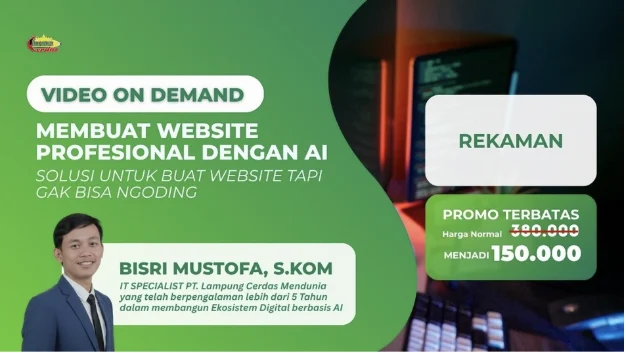
Recognizing the need for a structured bridge between raw AI potential and professional application, educational platforms are stepping in to formalize this workflow. A prime example is the Website Mastery Video-on-Demand (VOD) course, an initiative designed to transition individuals from AI-curious to AI-enabled web developers.
The curriculum is designed to move beyond the "surface level" of AI generators. Instead, it provides a comprehensive roadmap for the modern web professional, focusing on the integration of a specialized AI toolkit. Key tools covered in these professional environments include:
- Lovable: A sophisticated platform that translates user requirements into functional web components.
- v0 by Vercel: A generative UI system that allows developers to create complex, high-fidelity interfaces using text-to-code capabilities.
- Bolt.new: An AI-powered full-stack development environment that streamlines the creation and deployment of web applications.
Chronology of an AI-Driven Workflow
To understand how these tools transform the development lifecycle, one must look at the standard workflow taught in modern masterclasses:
Phase 1: Environment Preparation and Infrastructure
Before a single line of code is generated, the professional workflow mandates a stable foundation. This includes setting up a GitHub repository. GitHub is not merely a storage site; it is the industry standard for version control. Understanding how to manage code, track changes, and collaborate via Git is a non-negotiable skill for any web developer, regardless of whether they use AI or write code manually.
Phase 2: Ideation and Prompt Engineering
The process begins with "Prompt Engineering." This involves breaking down a website project into its core components: navigation, hero section, call-to-action (CTA), and footer. Participants learn to articulate design systems—specifying color palettes, typography, and responsive layouts—so the AI understands the "look and feel" desired for the brand.
Phase 3: Iterative Development and Refinement
The initial output from an AI is rarely the finished product. The "Mastery" phase involves teaching students how to read the generated code, identify potential flaws, and provide iterative feedback to the AI. This is where the human developer acts as an editor or an architect rather than a manual laborer.
Phase 4: Deployment and Global Accessibility
The final step is moving the project from a local development environment to the live internet. Through platforms like Vercel, which integrates seamlessly with GitHub, the website is pushed to global servers. This phase ensures that the website is not just a mockup, but a live, secure, and performant web asset accessible to users worldwide.
Supporting Data: The Impact of AI on Productivity
Industry reports from platforms like GitHub and Stack Overflow suggest that developers using AI-assisted tools experience a significant increase in productivity. Studies have shown that AI can reduce the time taken to build boilerplate code by up to 50–70%.
However, the real value lies in the "Time-to-Market" metric. For entrepreneurs and small businesses, the ability to launch a professional-grade MVP (Minimum Viable Product) in days rather than months is a game-changer. By lowering the cost of development, AI is democratizing the internet, allowing creators, small business owners, and non-technical founders to compete on a level playing field with larger, well-funded organizations.
Expert Perspectives: The Human-in-the-Loop Requirement
Industry experts emphasize that while AI is an incredible force multiplier, it is not a replacement for fundamental digital literacy.
"The danger is not that AI will replace developers," says one industry analyst. "The danger is that developers who refuse to learn these new tools will be replaced by those who embrace them."
The consensus among educators is that the "Human-in-the-Loop" (HITL) model is essential. AI often lacks the nuanced understanding of business logic, user experience (UX) psychology, and security vulnerabilities. Therefore, the "Website Mastery" approach focuses on teaching participants to supervise the AI. They learn to audit the code for security gaps, ensure the site is optimized for SEO, and confirm that the site architecture aligns with the user’s ultimate conversion goals.
Implications for the Future of Work
The rise of these tools has profound implications for the labor market and the educational sector.
1. The Democratization of Tech
The "coding barrier" has historically acted as a gatekeeper. By removing this barrier, the web development industry will likely see a surge in diversity. Individuals from non-STEM backgrounds—designers, marketers, writers, and small business owners—can now translate their ideas into functional digital reality.
2. The Shift toward "Full-Stack" Generalists
As AI handles the heavy lifting of backend logic and frontend styling, the role of the developer is shifting. We are moving toward a future where a single individual can function as a full-stack developer, designer, and DevOps engineer. This "Generalist" model is becoming increasingly valuable in the startup ecosystem.
3. Focus on High-Level Problem Solving
When the focus shifts away from the mechanics of coding, the educational system must pivot toward teaching high-level concepts: System Design, Cybersecurity, Data Privacy, and User Behavior. These are the areas where human intuition and ethical judgment still outperform the most advanced algorithms.
Conclusion: Taking the First Step
The journey into modern web development is no longer about learning the syntax of a specific language, but about learning the language of digital creation. The tools are available, the workflows are established, and the barrier to entry has never been lower.
For those looking to gain a competitive edge in this new landscape, practical application is key. Theory provides the map, but practice provides the destination. By utilizing platforms like the Website Mastery VOD course, aspiring developers can move beyond the theory and begin building the digital infrastructure of tomorrow.
Whether you are an entrepreneur looking to launch your first brand, a professional looking to upskill, or a creative eager to build your portfolio, the tools at your disposal are unprecedented. The digital future is being written in code, but today, that code is being written by anyone with the vision to prompt it into existence.
For those ready to embark on this journey and master the art of AI-assisted web development, the Website Mastery VOD course via detikevent provides the professional guidance and hands-on practice necessary to succeed in the modern digital age.