Ancient Roots of Habitual Use: Sulawesi Discovery Rewrites History of Human Addiction and Pain Management
JAKARTA – A groundbreaking archaeological discovery in the karst landscapes of Sulawesi, Indonesia, has fundamentally altered our understanding of human history and the antiquity of substance use. New research, published in the prestigious journal Science Advances on September 9, 2026, reveals that human ancestors were consuming the areca nut—commonly known as the betel nut—as early as 25,000 years ago.
The study, titled "Betel nut sucking is the earliest recorded evidence for the habitual use of a neuroactive plant drug," provides the oldest known evidence of human reliance on a psychoactive plant. By examining the skeletal remains of two hunter-gatherers, researchers have uncovered a complex, millennium-spanning history of dental pain, medicinal self-medication, and the potential for ancient physiological dependency.
The Discovery: A Shift in Prehistoric Timelines
For decades, the prevailing archaeological consensus held that the practice of chewing or sucking on betel nuts was a relatively recent cultural development, likely emerging during the early Neolithic or Bronze Age, roughly 3,500 years ago. This assumption was rooted in the appearance of specific cultural artifacts—such as specialized lime containers and evidence of agricultural trade—that facilitated the modern practice of "betel quid" chewing.
However, the findings from Sulawesi push this timeline back by over 20,000 years. "With the oldest food gatherers dating back to 25,000 to 16,000 years ago, our findings indicate that the use of betel nut as a medicinal or psychoactive substance has much more ancient origins than previously estimated," the research team noted in their publication.
The study was a collaborative international effort led by Professor Adam Brumm from the Australian Research Centre for Human Evolution (ARCHE) at Griffith University, in partnership with distinguished Indonesian archaeologists from Hasanuddin University (Unhas) and the National Research and Innovation Agency (BRIN).
Chronology of the Subjects
The evidence for this ancient habit was pulled from the remains of two specific individuals found in the limestone caves of South Sulawesi:
- Maros-LBB-1a (25,000–16,000 years ago): Excavated from the Late Pleistocene deposits of Leang Bulu Bettue, this individual represents one of the earliest known examples of sustained plant-drug use in human history.
- CPL-R2a (7,600–6,300 years ago): Discovered in the Holocene site of Leang Cappalombo 1, this individual is associated with the Toalean culture, a unique group of hunter-gatherers with roots in the pre-Neolithic era of South Sulawesi.
Biochemical analysis of the dental calculus—the hardened plaque found on the teeth of these remains—confirmed the presence of arecoline, the primary neuroactive alkaloid found in the Areca genus of plants. This provided definitive, molecular proof that these individuals were not merely incidental consumers, but habitual users of the plant.
The Science of Self-Medication
While the modern practice of "chewing betel" involves mixing the Areca catechu seed with slaked lime (calcium hydroxide) and wrapping it in betel leaves, the prehistoric Sulawesi hunter-gatherers consumed the nut in its raw, whole form.
The Mechanism of Arecoline
When the raw nut is held in the mouth and mixed with saliva, it releases arecoline. In the human body, arecoline acts as a powerful stimulant and, crucially, as an analgesic (painkiller). The research team posits that this was not a recreational indulgence, but a functional necessity.
The skeletal analysis revealed that these hunter-gatherers suffered from severe dental pathology. Their teeth were riddled with cavities, infections, and structural damage. In an era long before modern dentistry, the arecoline in the betel nut served as a pharmacological remedy, effectively dulling the chronic, agonizing pain caused by rotting teeth and exposed nerves.
Dental Erosion and the Cost of Relief
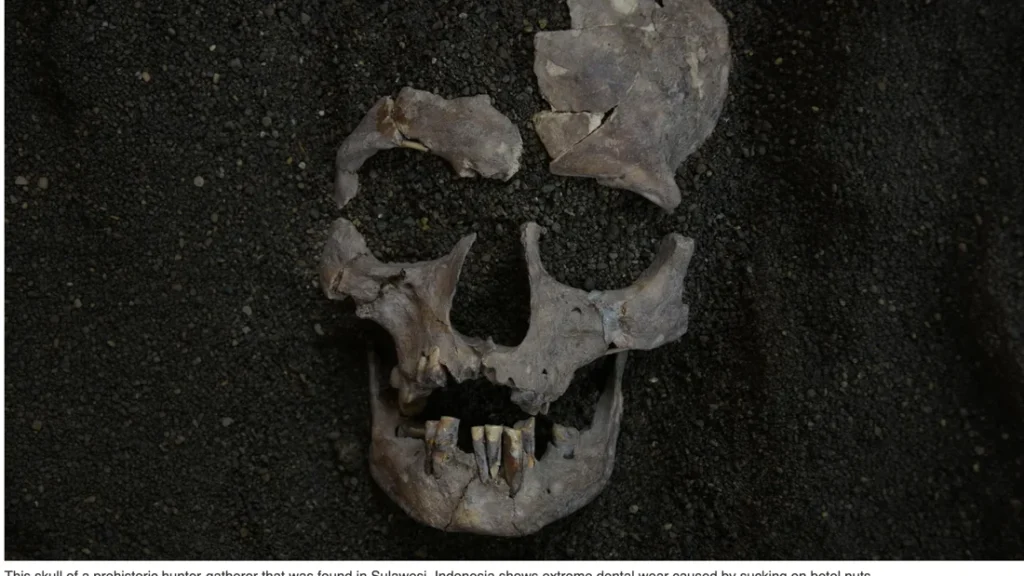
The habit of sucking on hard, fibrous betel nuts came at a steep physical price. The researchers observed a specific, highly unusual pattern of wear on the teeth of both Maros-LBB-1a and CPL-R2a.
"Seiring waktu (Over time), sucking on these hard and abrasive seeds eroded the foragers’ teeth so severely that, in some cases, the inner pulp chamber became completely exposed," explained Professor Adam Brumm.
The pulp of a tooth is the soft, living tissue at the center, containing nerves, blood vessels, and connective tissue. When this is exposed—as it was in these prehistoric specimens—it leads to extreme pain, an inability to eat properly, and a significantly heightened risk of chronic systemic infection. The circular, deep, and rounded grooves observed in their teeth were consistent with the consistent suction of small, wild varieties of betel, likely Areca triandra, a plant native to South Sulawesi.
This presents a tragic irony: the very substance used to treat the pain of dental decay was also the primary driver of the wear that led to the exposure of the tooth’s pulp, thereby exacerbating the very infections the users were trying to mitigate.
Implications: The Earliest Recorded Dependency?
The research team suggests that these individuals were trapped in a vicious cycle. They were likely caught in a feedback loop where the ingestion of the nut provided relief for the pain caused by the nut’s own abrasive properties.
While the concept of "drug addiction" is often associated with modern society, the findings suggest that the biological mechanisms of dependency are as old as the human experience. The report notes that, while underappreciated in Western contexts, the betel nut is the fourth most popular psychoactive substance in the world, following only alcohol, caffeine, and nicotine.
Because arecoline acts upon the central nervous system, it produces changes in thought processes, emotions, and perception. It is highly probable that for these ancient foragers, the habit transcended basic medicine and became a source of psychological comfort or dependence. The researchers conclude that for these individuals, the practice likely evolved into a "pathological dependence" as their dental health deteriorated further, making the cessation of the habit impossible due to the onset of severe withdrawal and untreated dental agony.
Official Responses and Scientific Context
The collaboration between Griffith University, Unhas, and BRIN underscores the importance of Indonesia as a focal point for understanding human evolution. By integrating biochemical analysis with traditional osteological examination, the team has provided a blueprint for how future archaeologists can track the deep history of human interactions with the natural world.
"This discovery changes the narrative of the ‘primitive’ hunter-gatherer," said a representative from the research team during a press briefing in Jakarta. "It shows a level of botanical knowledge and an attempt to control the human biological state—specifically pain—that we previously reserved for much later, more ‘civilized’ societies."
The implications of this study extend beyond just the history of betel nut. It challenges researchers to look closer at the dental remains of other prehistoric populations. If human ancestors 25,000 years ago were already utilizing complex neuroactive plants to manage their physical ailments, it is highly likely that this practice was widespread across various global populations, representing a fundamental aspect of human survival strategy.
Conclusion: A Window into the Past
The story of Maros-LBB-1a and CPL-R2a is a sobering reminder of the harsh realities of prehistoric life. It paints a vivid picture of a human ancestor living in the lush, unforgiving caves of Sulawesi, struggling with the pain of chronic infection, and finding a temporary, if damaging, respite in the chemical properties of a local plant.
As the scientific community continues to analyze these findings, the study stands as a testament to human ingenuity in the face of suffering. The "Betel nut sucking" phenomenon, now confirmed to be 25,000 years old, serves as the earliest chapter in the long, complex, and often painful history of human pharmacological self-regulation. This research not only illuminates the origins of a cultural practice still seen in parts of Asia today but also highlights the enduring, and often perilous, human pursuit of relief from the pains of existence.