Beyond the Vows: The Academic Journey of a Power Couple Achieving Doctoral Degrees Together
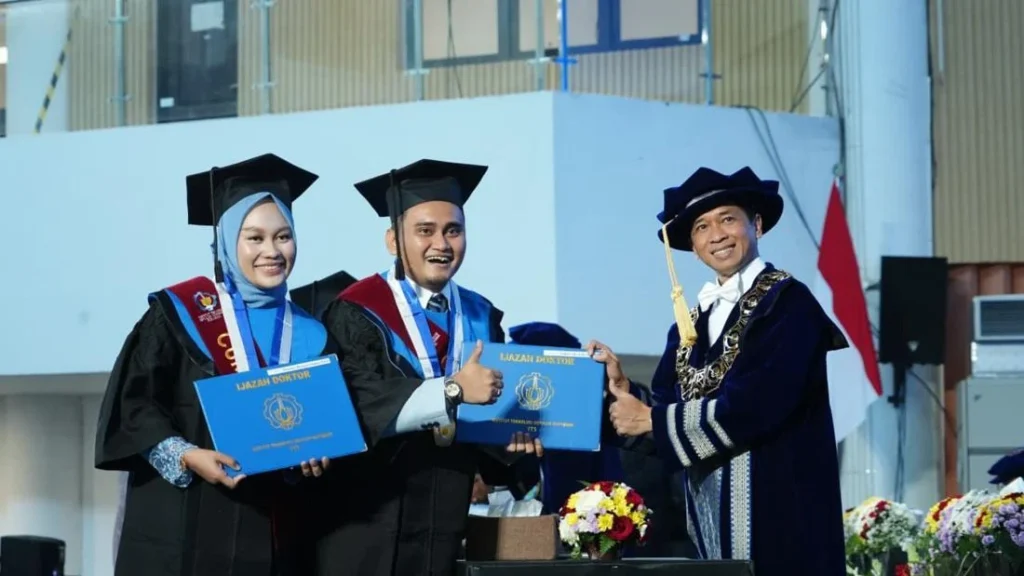
JAKARTA – Marriage is often described as a partnership, but for Andika Ade Indra Saputra and Rossana Margaret Kadar Yanti, that partnership has transcended the domestic sphere, evolving into a lifelong academic collaboration. In a remarkable display of intellectual synergy and perseverance, the couple recently celebrated a milestone that few achieve: they were conferred their doctoral degrees simultaneously during the graduation ceremony at the Institut Teknologi Sepuluh Nopember (ITS).
The duo, both faculty members at the Institut Teknologi Kalimantan (ITK), navigated the rigorous demands of a PhD program in Civil Engineering while balancing the complexities of marriage, parenting, and professional teaching responsibilities. Their story serves as an inspiring testament to the idea that personal growth and marital harmony are not mutually exclusive, but rather, can be mutually reinforcing.
The Genesis: A Shared Academic Pedigree
To understand the magnitude of their achievement, one must look at the foundation of their relationship with their alma mater. Both Andika and Rossa are what the academic community often refers to as "pure-blooded" ITS alumni. Their connection to the institution spans over a decade, encompassing every stage of their higher education.
"We both pursued our bachelor’s, master’s, and doctoral degrees at the ITS Department of Civil Engineering. You could say we are truly ‘pure-blooded’ ITS," Rossa stated during an interview on Sunday (October 11).
The chronology of their academic journey is fascinating. While their paths crossed during their undergraduate years, it was not a classic campus romance that blossomed in the lecture halls of their youth. During those early years, Andika was simply a senior in the department—a face in the crowd, a peer in the field, but not yet a life partner. It was only after both had stepped into the professional world as lecturers at the Institut Teknologi Kalimantan that their relationship evolved.
The transition from professional colleagues to life partners occurred in the halls of academia. As junior lecturers, they found themselves collaborating on teaching strategies, research, and department management. It was in the crucible of academic discourse that their personal connection deepened.
"As a junior lecturer at the time, I learned a lot and frequently discussed teaching methods with Mr. Andika," Rossa recalled. "It was through those professional exchanges that our love grew. Furthermore, it was Mr. Andika who encouraged and pushed me to pursue our doctoral studies together."
Navigating the Triad: Marriage, Parenting, and Research
Since their marriage in 2017, the couple has navigated the traditional milestones of life—building a home, establishing careers, and welcoming two daughters into the world. Integrating a PhD program into this existing ecosystem of responsibilities was, by any measure, a monumental challenge.
The doctoral journey is famously isolating and grueling. It requires an immense amount of cognitive labor, deep research, and emotional resilience. When two people in a marriage undertake this journey simultaneously, the challenges multiply, but so do the support systems.
The Balancing Act
The couple describes their daily life as a meticulously managed routine. With two young daughters, the primary hurdle was time management. They had to divide their energy between:
- Professional Duties: Developing curricula, grading, and lecturing at ITK.
- Parental Responsibilities: Ensuring the well-being and upbringing of their two children.
- Academic Research: Conducting the field studies and data analysis required for their respective dissertations.
"The most exciting part of pursuing a doctoral degree as a married couple is the process of balancing the challenges of household life, academics, and work," Rossa explained. "However, we always had the best place to share our stories and frustrations—our own partner."
This level of mutual understanding is perhaps the secret to their success. In a typical academic pursuit, a partner might feel neglected by the hours spent in the laboratory or library. In this case, the partner was in the same library, facing the same deadlines, and experiencing the same intellectual fatigue. This shared experience transformed their home into an intellectual sanctuary rather than a source of stress.
Implications of Dual-Career Academic Partnerships
The success of Andika and Rossa brings to light the importance of supportive domestic environments in the pursuit of higher education. Sociological studies on dual-career academic couples often highlight the "two-body problem," where one partner’s career advancement is limited by the other’s. In this instance, the couple inverted that dynamic, turning their partnership into a catalyst for advancement.
Empowering Growth
Rossa emphasized that her success was heavily contingent on having a partner who did not view her growth as a threat or a burden. "I am grateful because I have a husband who does not hinder my space to grow," she noted.
This perspective is crucial in modern academia, where women are often statistically more likely to interrupt or delay their doctoral progress due to family responsibilities. By choosing a partner who prioritized their joint advancement, the couple ensured that both individuals reached their maximum potential without sacrificing their family structure.
The Legacy of Learning
The couple’s commitment to education extends beyond their personal achievements. They are already fostering an environment of intellectual curiosity for their two daughters. In a lighthearted comment, Andika mentioned that they have been "indoctrinating" their children from a young age with the goal of having them attend ITS as well.
While said in jest, the sentiment underscores a deeper commitment to the value of education. By demonstrating that continuous learning is a lifelong pursuit—one that can be navigated even while managing a household—they are setting a powerful precedent for their children.
Official Perspectives and Academic Impact
The Faculty of Civil Engineering at ITS has noted that the graduation of such a couple is a point of pride. It reflects the department’s rigorous standards and its ability to foster an environment where students can thrive not just individually, but as part of a supportive community.
The implications of their achievement are two-fold:
- Institutional Loyalty: Their trajectory from S1 to S3 within the same department highlights the strength of the ITS Civil Engineering program and the loyalty it inspires in its alumni.
- The "Academic Couple" Model: Their success provides a blueprint for universities on how to support faculty who are also partners. As more couples enter academia, institutions are increasingly looking at ways to accommodate the specific needs of dual-career households.
Conclusion: A Future of Shared Aspirations
As Andika and Rossa look toward the future, their focus remains on maintaining the harmony that carried them through the last several years. Their doctoral degrees are not the end of the journey, but rather a new chapter in their professional lives.
"Our hope is that we remain harmonious, continue to reach for our dreams together, and stay happy with our partner, children, and those around us," Rossa concluded.
The story of Andika and Rossa is more than just a tale of two degrees. It is a story about the redefinition of "partnership." It proves that the traditional model of a "supportive spouse" can be upgraded to an "academic teammate." By aligning their visions, respecting each other’s intellectual capacity, and refusing to let domestic life stifle their professional ambition, they have successfully navigated one of the most challenging paths in higher education.
As they return to their teaching roles at the Institut Teknologi Kalimantan, they do so not just as doctors in their field, but as a unit that has proven that when two people row in the same direction, the destination is not only reachable—it is a shared victory. Their journey stands as a beacon for all academics navigating the delicate balance between the head and the heart, proving that with mutual support, the pursuit of knowledge can be a truly collaborative endeavor.