The Golden Dominance: Rahmat Erwin Abdullah’s Historic Back-to-Back Triumph at the 2026 Asian Games
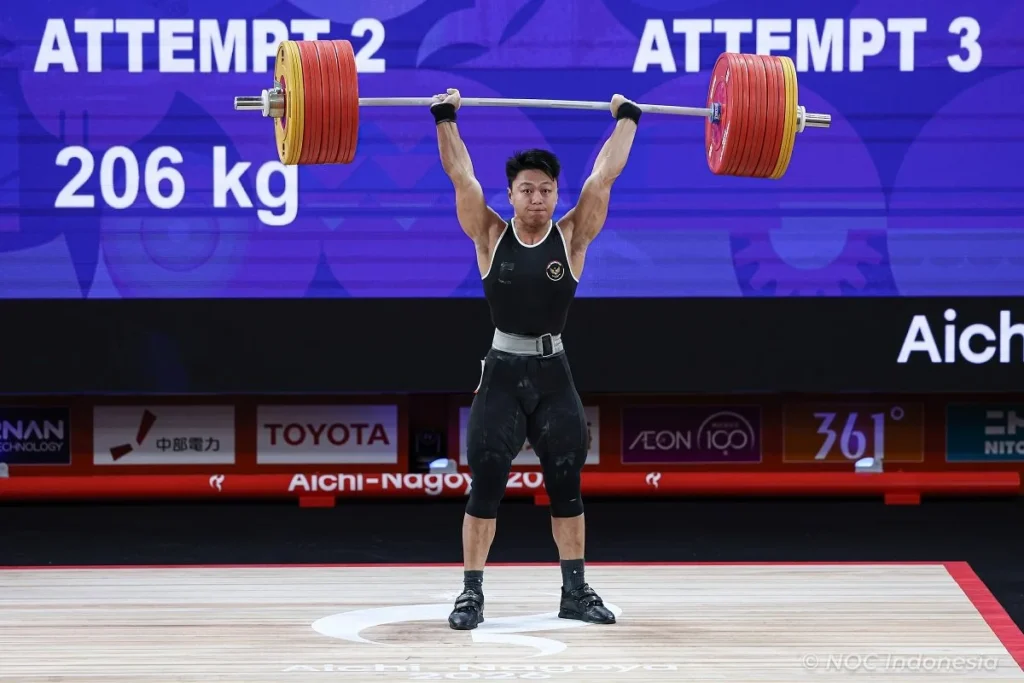
NAGOYA, JAPAN – In a display of sheer physical prowess and unwavering mental fortitude, Indonesian weightlifting sensation Rahmat Erwin Abdullah has once again etched his name into the annals of sporting history. Competing at the Nagoya City Trade and Industry Center on Saturday, September 26, 2026, the 25-year-old athlete secured a gold medal in the men’s 75kg category at the Asian Games, successfully defending the title he first claimed in 2022. This “back-to-back” gold medal achievement marks a defining moment for Indonesian sports, solidifying Rahmat’s status as a global icon in the world of competitive weightlifting.
The Performance of a Lifetime: A Chronology of Glory
The atmosphere in Nagoya was electric. As the marquee event of the evening, the 75kg weightlifting final attracted thousands of spectators and millions of viewers worldwide. Rahmat Erwin Abdullah entered the competition not just as a favorite, but as a man on a mission to prove that his previous gold in the 2022 Asian Games was merely the beginning of an era.
The competition began with the snatch discipline. Rahmat’s opening movements were calculated and precise. With each attempt, he maintained a steely focus that silenced the arena. He successfully locked out 160kg, setting a strong foundation for the clean and jerk—his specialty.
As the session shifted to the clean and jerk, the tension reached a fever pitch. Rahmat’s primary rival, Thailand’s Weeraphon Wichuma, had pushed the limits, finishing with a formidable total of 365kg. The path to gold for Rahmat required nothing short of perfection. Summoning his trademark explosive power, Rahmat successfully hoisted 206kg, bringing his grand total to a staggering 366kg. The arena erupted as the referee’s white lights flashed—Rahmat Erwin had done it again.
Technical Brilliance: Breaking World Records
Beyond the gold medal, the magnitude of Rahmat’s performance is defined by the statistics he rewrote. In the world of elite weightlifting, the margin between victory and defeat is often measured in grams. Rahmat, however, operated on a different plane of existence during the 2026 Asian Games.
By achieving a total of 366kg, Rahmat did more than just win; he established two new world records. The first record was shattered in the clean and jerk portion, where his 206kg lift surpassed the previous global standard. The second record was the total aggregate weight, a testament to his consistency across both disciplines.
Sports analysts have pointed out that Rahmat’s technique is a masterclass in biomechanical efficiency. His ability to recover from a deep squat, combined with a lightning-fast transition in the clean and jerk, allows him to lift weights that appear physically impossible for his body weight. At only 25, his physical maturity coupled with his tactical experience makes him a daunting opponent for any lifter in the world.
The Weight of Expectation: Official Responses
Following the victory ceremony, the Indonesian contingent was overwhelmed with emotion. The Indonesian Olympic Committee (NOC Indonesia) issued an official statement praising Rahmat’s discipline, dedication, and the immense pride he has brought to the nation.
In a rare moment of vulnerability, Rahmat spoke to the media about the internal battle he faced throughout the tournament. Despite his composed exterior, the pressure of being a defending champion was significant.
"Alhamdulillah, I am extremely grateful," Rahmat said, his voice reflecting the exhaustion and relief of the moment. "It wasn’t necessarily a sense of calm that I felt, but rather a profound sense of focus. I was nervous, of course—any athlete who says they aren’t nervous before a performance like this is not being honest. But that nervousness is what kept me sharp. It kept me grounded and focused on the bar."

His coach and support staff highlighted that Rahmat’s preparation for the 2026 Games was grueling. Having dealt with the rigors of international travel and the high-intensity training cycles required to remain at the top of his game, Rahmat’s success is a triumph of scientific training and mental conditioning.
The Competitive Landscape: A Rivalry for the Ages
The rivalry between Rahmat Erwin Abdullah and Weeraphon Wichuma of Thailand has become one of the most compelling narratives in Asian weightlifting. The 1kg margin that separated them in Nagoya is indicative of the fierce competition within the continent.
Weightlifting in Asia has historically been dominated by a few nations, but the rise of Southeast Asian athletes like Rahmat and Wichuma signals a shift in the power balance. Their performance in Nagoya serves as a benchmark for the sport globally. Observers noted that the caliber of lifting witnessed at the 2026 Asian Games was arguably higher than in many previous Olympic cycles, suggesting that the sport is evolving at an unprecedented rate.
Implications for the Future: Road to the Olympics
Rahmat’s victory in Nagoya serves as a critical milestone on his path toward the next Olympic cycle. By consistently breaking world records, he has effectively painted a target on his back. However, for a lifter of his caliber, this pressure acts as fuel.
The implications of his success are twofold:
- National Inspiration: Rahmat has become a beacon of hope for the younger generation of Indonesian athletes. His journey, from a local lifter to a two-time Asian Games champion, provides a blueprint for success in a country that is increasingly investing in high-performance sports infrastructure.
- Global Dominance: With these world records now firmly in his possession, Rahmat is widely considered the man to beat in the upcoming international championships. His ability to maintain peak performance during multi-event games is a rare trait that separates legends from champions.
The Human Side of a Champion
Behind the 366kg total and the shiny gold medal lies a human story of sacrifice. The life of an elite lifter is one of strict nutrition, grueling sleep schedules, and repetitive training that would break most individuals. Rahmat’s ability to remain humble and grounded, despite the fame that follows such a historic victory, has endeared him to millions of fans.
Throughout the tournament, fans observed Rahmat’s interactions with his rivals—a display of the "spirit of sport" that is often lost in the intensity of competition. Even in the heat of the moment, when the weight of a nation rested on his shoulders, he maintained a sense of dignity and respect for his peers.
Conclusion: A Legacy in the Making
As the dust settles in Nagoya, the sporting world looks back at the 2026 Asian Games as the moment Rahmat Erwin Abdullah cemented his legacy. He has proven that he is not merely a product of talent, but a product of relentless, uncompromising work.
As he returns to Indonesia, he does so as a hero. But for Rahmat, the work is never truly finished. With his eyes likely already set on the next record to break and the next platform to conquer, the world waits with bated breath to see what this extraordinary athlete will achieve next. For now, he stands alone—a two-time Asian Games champion, a world record holder, and a symbol of Indonesian strength on the global stage.
For more updates on the performance of Indonesian athletes at the 2026 Asian Games and comprehensive coverage of international sporting events, follow our ongoing reports and sign up for our digital newsletters.