Beyond the Red and White: Understanding the Crucial Differences Between Paskibra and Paskibraka
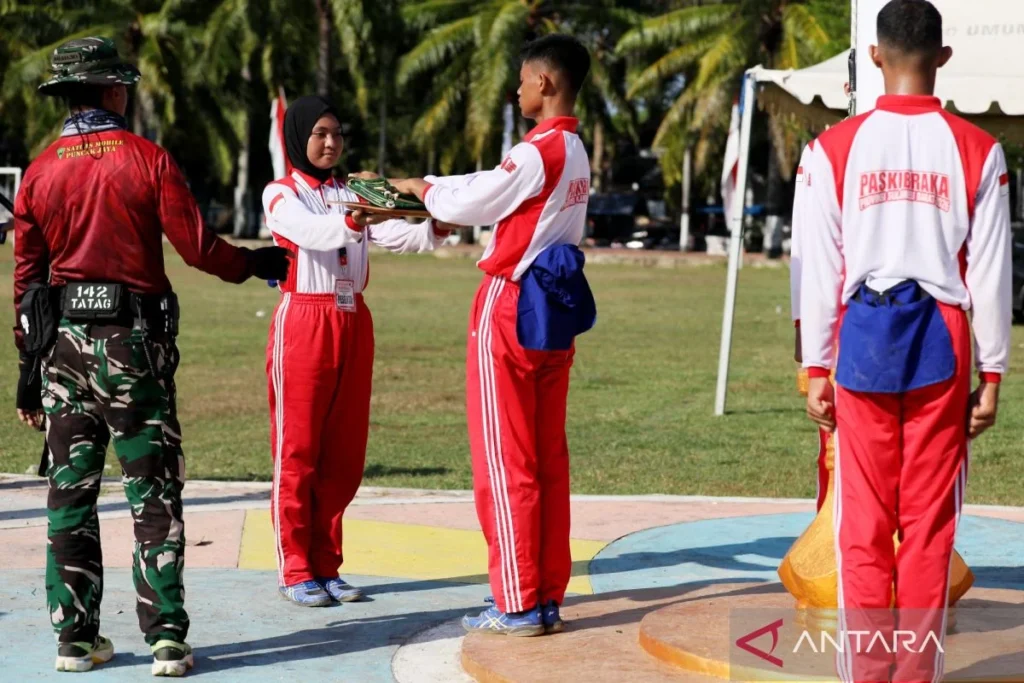
JAKARTA — As the calendar pages turn toward the golden heat of August, the streets of Indonesia begin to bloom with the vibrant colors of the national flag. Red-and-white banners flutter from electric poles, schoolyards echo with the sharp, synchronized cadence of marching boots, and an undeniable sense of national pride fills the air. It is a season intimately tied to two ubiquitous terms: Paskibra and Paskibraka.
Often used interchangeably in casual conversation, these two acronyms are frequently treated as synonyms by the general public, especially in the weeks leading up to Indonesia’s Independence Day celebrations on August 17. However, to those well-versed in the nation’s ceremonial traditions and youth development programs, the two terms represent distinct entities. While both share a sacred duty—the hoisting of Indonesia’s sacred emblem, the Sang Merah Putih (the Red and White)—they diverge significantly in their scope of duties, institutional status, selection processes, and historical evolution.
Understanding this distinction is more than a mere exercise in semantics; it is an appreciation of a deeply rooted national institution designed to forge character, discipline, and leadership among the nation’s youth.
Main Facts: Defining the Pillars of the Flag-Hoisting Tradition
To understand the core differences between Paskibra and Paskibraka, one must first examine their definitions, jurisdictions, and foundational frameworks.
What is Paskibra?
Paskibra is an acronym for Pasukan Pengibar Bendera (Flag-Hoisting Troop). It is a general term applied to any team tasked with raising the national flag during ceremonies held within schools, government offices, private organizations, and various civic events.
In the educational sphere, Paskibra typically operates as an extracurricular activity (known in Indonesia as Ekstrakurikuler). It serves as a rigorous training ground where students learn the fundamentals of military-style marching (Peraturan Baris-Berbaris or PBB), physical endurance, discipline, teamwork, leadership, and personal responsibility. Because of its localized and adaptable nature, Paskibra possesses a broad scope. Its existence is not tethered exclusively to national independence commemorations at high levels of government; rather, a Paskibra unit can be formed by any institution wishing to conduct a disciplined, formal flag-raising ceremony.
What is Paskibraka?
In stark contrast, Paskibraka—an acronym for Pasukan Pengibar Bendera Pusaka (Heritage Flag-Hoisting Troop)—is an elite, highly structured national program orchestrated directly by the Indonesian government. Its existence is anchored by robust legal frameworks, most notably Presidential Regulation (Perpres) Number 51 of 2022 concerning the Pasukan Pengibar Bendera Pusaka Program.
According to this regulation, Paskibraka is far more than a ceremonial troupe; it is officially designated as a formal cadre-building program aimed at producing future national leaders imbued with Pancasila character—the foundational philosophical principles of the Indonesian state. Paskibraka members carry the solemn responsibility of performing flag-raising and lowering duties during the official commemoration of the Proclamation of Indonesian Independence at the State Palace, as well as during the annual commemoration of the Birth of Pancasila on June 1st.
The recruitment of Paskibraka members is a rigorous, multi-tiered process supervised by the state, stretching from the district and municipal levels up to provincial and national stages. Once members complete their tenure at the state ceremony, they graduate into an organized alumni network known as Purna Paskibraka.
Chronology: The Historical Evolution of Paskibraka
The majestic formations seen at the State Palace today did not emerge overnight. They are the product of a deliberate historical evolution born out of crisis, ingenuity, and a vision for youth empowerment.
[1946: Yogyakarta] ──► [1967: Jakarta] ──► [1973: Naming] ──► [Modern Era: State Program]
  Husein Mutahar      Three-Tier Formation   Idik Sulaeman     Perpres No. 51/2022
  (First Ceremony)     (17-8-45 Symbolism)   coins "Paskibraka" Ideological Cadreing
The Genesis in Yogyakarta (1946)
The history of Paskibraka traces back to the turbulent era of the Indonesian National Revolution. In 1946, the young republic’s capital was temporarily moved to Yogyakarta due to security threats in Jakarta. President Sukarno personally commanded Major (Navy) Husein Mutahar to prepare the ceremonial hoisting of the sacred Bendera Pusaka (the original flag sewn by First Lady Fatmawati) for Indonesia’s first Independence Day anniversary at the Gedung Agung presidential palace in Yogyakarta.
Faced with the profound significance of the occasion, Mutahar conceived a visionary idea: the sacred flag should be raised by young representatives hailing from various regions of the archipelago, symbolizing national unity. However, the chaotic security situation and logistical limitations of the ongoing revolution made it impossible to summon youths from across the islands. Consequently, Mutahar selected five extraordinary youths—three girls and two boys—representing the local youth of Yogyakarta to carry out the historic task.
The Birth of the Three-Tier Formation (1967)
Decades later, in 1967, Husein Mutahar—by then a high-ranking official—was once again entrusted with handling the sacred flag ceremony. Recognizing the need for a more structured and symbolic approach, Mutahar expanded the troop layout into a sophisticated three-tier formation.
This formation was deliberately engineered to mirror the sacred date of Indonesia’s independence:
- The 17 Troop (Pasukan 17): Acting as the vanguard or escort.
- The 8 Troop (Pasukan 8): Acting as the core color guard tasked with carrying and raising the flag.
- The 45 Troop (Pasukan 45): Acting as the security detail equipped with ceremonial arms.
Together, the numbers 17, 8, and 45 formed the date 17-08-1945. This iconic formation layout remains the standard template for state flag-raising ceremonies across the country to this day.
Codification and the Birth of the Term "Paskibraka" (1973)
By the early 1970s, the troop needed a standardized, official moniker. In 1973, Idik Sulaeman—a prominent figure in youth development—officially coined the term Paskibraka as an amalgamation of PASukan (troop), KIBar (to wave/hoist), bendeRA (flag), and PusaKA (heirloom).
Concurrently, the practice of using the original, fragile Bendera Pusaka was eventually phased out to preserve the historical artifact, replaced by a pristine replica (duplikat bendera pusaka) for annual ceremonies, while the original was retired to a climate-controlled vault in the National Monument (Monas) museum.
Supporting Data: Comparative Breakdown of Paskibra vs. Paskibraka
To clearly delineate the differences between the two entities, a side-by-side comparison reveals distinct operational and legal boundaries:
| Comparative Aspect | Paskibra (Flag-Hoisting Troop) | Paskibraka (Heritage Flag-Hoisting Troop) |
|---|---|---|
| Primary Scope & Jurisdiction | General; operates in schools, universities, private companies, and local institutions. | State-sanctioned; operates at municipal, provincial, and national (State Palace) levels. |
| Institutional Status & Legal Basis | Functions as a school club or organizational unit without specific national statutory mandates. | Governed strictly by state law, specifically Presidential Regulation No. 51 of 2022. |
| Selection Mechanism | Handled internally by individual schools, local teachers, or institutional committees. | Highly rigorous, multi-layered, competitive selection process managed by state bodies (BPIP). |
| Core Responsibilities | Routine school ceremonies, local office flag-raisings, and community events. | State ceremonies on August 17 (Independence Day) and June 1 (Birth of Pancasila). |
| Post-Service Designation | Alumni of school/institutional flag-hoisting squads. | Purna Paskibraka (an organized civic alumni network with ideological mandates). |
| Primary Objectives | Discipline, physical fitness, teamwork, and school representation. | State cadre-building, ideological cultivation of Pancasila, and national leadership training. |
Official Responses and Institutional Perspectives
As the governance of youth programs has evolved in Indonesia, the oversight of Paskibraka has shifted to ensure it fulfills its mandate as a vehicle for national unity and ideological preservation.
The Agency for the Implementation of State Ideology Pancasila (BPIP)—the state body currently holding jurisdiction over the Paskibraka program—has consistently emphasized that Paskibraka is not merely a marching drill squad. During national briefings for regional candidate selections, BPIP officials have stressed that candidates undergo rigorous psychological, physical, and ideological testing.
"Paskibraka members are selected not just for their posture or marching precision, but for their mental fortitude, national insight, and deep understanding of Pancasila values," a BPIP representative noted during a national coordination meeting. "They are being prepared to inherit the future leadership of this nation with integrity."
Educational authorities share a complementary perspective regarding the grassroots counterpart, Paskibra. The Ministry of Primary and Secondary Education frequently highlights school-level Paskibra units as vital crucibles for character building. In statements surrounding national educational milestones, education officials note that the dedication seen in school-level Paskibra squads mirrors the deep-seated patriotic spirit embedded within the national education system. Whether braving the morning sun on a muddy school field or executing crisp maneuvers on an asphalt courtyard, student members of Paskibra embody the grassroots dedication to national pride.
Furthermore, civil society organizations and alumni associations—such as local chapters of Purna Paskibraka Indonesia (PPI)—regularly organize community service initiatives, leadership camps, and civic education workshops. These organizations ensure that the discipline learned on the parade ground translates into meaningful contributions to society long after the ceremonial banners have been lowered.
Implications: The Societal and Educational Impact
The distinction between Paskibra and Paskibraka carries profound implications for how Indonesia manages youth development, civic education, and national memory.
1. Elevating Standards of Youth Leadership
By codifying Paskibraka under Presidential Regulation No. 51 of 2022, the Indonesian government elevated the program from an ad-hoc military-style drill to an institutionalized state cadet pipeline. This formal recognition ensures standardized training across all 38 provinces, bridging regional divides and bringing together youths from diverse ethnic, religious, and socioeconomic backgrounds into a unified national team at the State Palace.
2. Safeguarding Ideological Continuity
Through the integration of Pancasila ideological training within the Paskibraka curriculum, the state utilizes the allure of the flag-hoisting tradition as a vehicle for national resilience. In an era marked by globalization and rapid digital transformation, embedding foundational state values into the country’s brightest youth serves as a bulwark against radicalism, disunity, and apathy.
3. Fostering Grassroots Patriotism Through Paskibra
While Paskibraka commands the spotlight at the national level, Paskibra remains the indispensable foundation of everyday Indonesian civic life. By operating within thousands of junior and senior high schools across the archipelago, Paskibra ensures that millions of students experience the values of discipline, punctuality, and mutual respect (gotong royong). It democratizes patriotism, proving that love for the country is not restricted to an elite few chosen for the national stage, but is practiced daily in every corner of the republic.
Conclusion
As Indonesia continues to march forward into its future, the twin pillars of Paskibra and Paskibraka stand as powerful testaments to the enduring spirit of the nation. While Paskibra provides the broad, accessible foundation of discipline and teamwork in schools and local institutions, Paskibraka represents the pinnacle of state ceremonial duty and ideological cadre formation. Recognizing the unique contributions of both ensures that every flutter of the Red and White—whether in a remote village schoolyard or before the gaze of the nation at the State Palace—remains deeply anchored in history, respect, and national pride.