The Gentle Titan of the Deep: Understanding and Protecting the Whale Shark (Rhincodon typus)
In the vast, mysterious expanse of the world’s oceans, few creatures command as much awe and fascination as the whale shark (Rhincodon typus). Despite a name that conjures images of predatory menace, this colossal inhabitant of the tropical seas is a gentle giant, a filter-feeding nomad that defies the common perception that size is synonymous with aggression. As the largest fish in the world, the whale shark serves as a vital indicator of ocean health and a cornerstone of marine biodiversity, particularly within the archipelago of Indonesia.
Main Facts: Anatomy of a Gentle Giant
The whale shark is a biological marvel. Measuring up to 12 meters or more in length, its physical stature is intimidating to the uninitiated. However, its temperament is remarkably docile, often allowing divers and researchers to swim alongside it with little more than a passing glance.
The Mechanism of Feeding
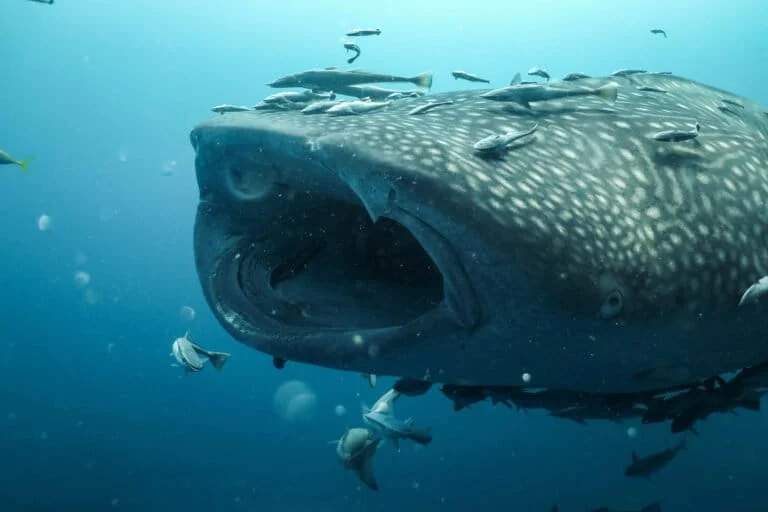
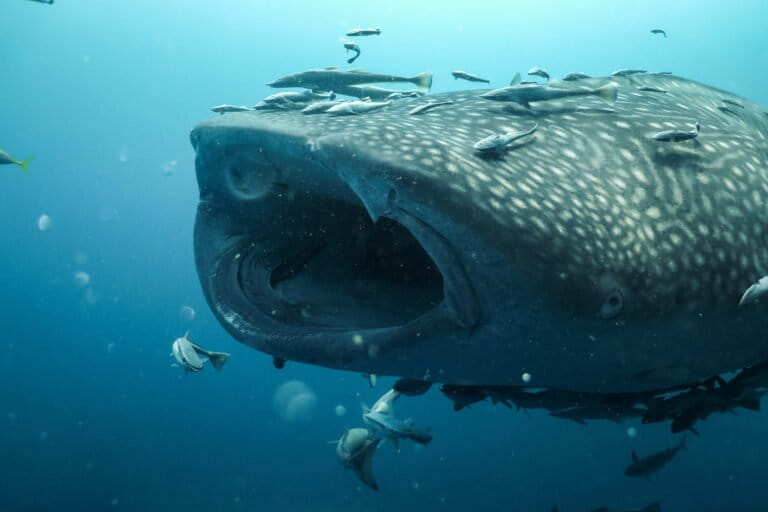
Perhaps the most striking feature of the whale shark is its expansive mouth, which can stretch to a width of approximately 1.5 meters. Within this cavernous maw, one might expect rows of razor-sharp teeth designed to tear through prey. Instead, the whale shark possesses 300 to 350 rows of vestigial, tiny teeth, each measuring a mere six millimeters. These teeth play no part in hunting; rather, the whale shark is a passive filter feeder. It relies on a sophisticated system of gill rakers that act as a sieve, trapping microscopic organisms such as plankton, krill, and small baitfish—known locally in Eastern Indonesia as ikan furi—as the shark cruises through the water with its mouth agape.
Biological Identification
The aesthetic profile of the whale shark is unmistakable. Its dorsal surface is a canvas of dark, slate-grey, punctuated by a constellation of white and pale-yellow spots and horizontal stripes. This unique pattern creates a grid-like appearance, earning it the moniker "whale-spotted shark" or gurano bintang (star shark) in Indonesian coastal communities.
Marine biologists have discovered that these patterns are as unique to each individual as human fingerprints. This "photo-identification" technique has revolutionized marine research, allowing scientists to track individual sharks across vast distances and over many years, providing deep insights into their migration patterns and social behavior without the need for invasive tagging.
Chronology of Scientific and Conservation Discovery
The scientific understanding of the whale shark has evolved significantly over the last century. Historically viewed as a mysterious monster of the deep, it was not until the mid-20th century that global marine biology began to decode its life history.
- 1828: The first scientific description of the species was recorded by Andrew Smith after a specimen was harpooned in Table Bay, South Africa.
- Late 20th Century: As scuba diving technology advanced, the "myth" of the man-eating shark was debunked. Encounter data began to accumulate, revealing that these creatures are highly migratory, often traversing entire ocean basins.
- 2013: A pivotal year for the species in Indonesia. Recognizing the extreme vulnerability of the whale shark due to its slow reproductive rate and susceptibility to anthropogenic threats, the Indonesian government granted it full protected status.
- 2015–Present: Integration of community-based tourism and scientific monitoring programs across sites like Cendrawasih Bay, Nabire, and Gorontalo. These initiatives have transitioned from seeing the shark as a target for traditional fisheries to viewing it as a long-term asset for sustainable ecotourism.
Supporting Data: Habits and Habitat
While the whale shark is an imposing presence, it is a creature of slow, deliberate movements. Its cruising speed is a modest five kilometers per hour—a pace that makes it remarkably vulnerable to maritime traffic. Collisions with large shipping vessels remain one of the leading causes of non-natural mortality for the species.
Deep-Diving Capabilities
Despite its leisurely surface behavior, the whale shark is a formidable deep-sea explorer. Research has tracked these giants diving to depths of up to 1,000 meters. These deep dives are often undertaken to forage in cooler, nutrient-rich waters, though they spend the majority of their time in the upper 50 meters of the water column, where temperatures are warmer and light is more abundant.
The Indonesian Archipelago as a Sanctuary
Indonesia sits at the heart of the "Coral Triangle," the global epicenter of marine biodiversity. For the whale shark, Indonesia provides essential nursery grounds and migratory corridors. Documented sightings occur regularly in:
- Nabire and Cendrawasih Bay: Known for their stable, year-round populations.
- Kaimana and Maluku: Vital transit points for migratory pods.
- Gorontalo and Sabang: Sites where whale sharks often interact with local artisanal fisheries.
- Situbondo and Nusa Tenggara: Critical regions for understanding the seasonal shifts in population distribution.
The presence of these sharks is not merely a tourist attraction; it is a vital component of the marine ecosystem. By consuming vast quantities of plankton and small fish, they help regulate the lower tiers of the oceanic food web, effectively acting as "gardeners" of the sea.
Official Responses and Conservation Policy
The Indonesian government’s 2013 mandate, formalized under the Ministry of Marine Affairs and Fisheries, was a watershed moment. The status of "Full Protection" implies that the catching, trading, and distribution of whale shark products are strictly prohibited by law.
The Balancing Act
Government officials have faced the difficult challenge of balancing the economic needs of local fishing communities with the imperative of conservation. Historically, whale sharks were sometimes caught incidentally or targeted for their fins and meat. Through the Rencana Aksi Nasional (National Action Plan), the government has sought to:
- Enforce Strict Maritime Zoning: Limiting boat traffic in known aggregation areas.
- Community Empowerment: Transitioning former hunters into tour guides and conservation monitors.
- Educational Outreach: Changing the cultural perception of the shark from a "monster" to a "natural treasure."
These policies are reinforced by international frameworks, including the Convention on International Trade in Endangered Species of Wild Fauna and Flora (CITES), which lists the whale shark under Appendix II, regulating international trade to ensure it does not threaten the species’ survival.
Implications: The Future of the Whale Shark
The life expectancy of a whale shark is estimated to be around 70 years, yet their slow maturation and low reproductive rates mean that even minor population losses can have catastrophic impacts on their recovery.
Economic and Ecological Stakes
The ecological implication of losing the whale shark is profound. A decline in their population could trigger a trophic cascade, disrupting the delicate balance of the marine food web. Economically, the whale shark represents a sustainable "blue economy" model. In regions like Nabire, the whale shark has become a symbol of regional pride and a major driver of ecotourism, proving that a live shark is significantly more valuable to the local economy than a dead one.
The Path Forward
The road ahead requires rigorous, data-driven management. As the climate changes and ocean temperatures rise, the migratory patterns of these giants may shift, requiring international cooperation across the Indian and Pacific Oceans.
Conservationists emphasize that the protection of the whale shark is synonymous with the protection of the ocean itself. If the largest fish in the sea cannot find a safe haven in the waters of the archipelago, it serves as a grim warning for the health of all marine life.
As we look toward the future, the integration of technology—such as satellite tracking and AI-driven image recognition—will be essential. However, the most effective tool remains the commitment of the people of Indonesia to coexist with these ancient travelers. The whale shark is not just a specimen to be studied; it is a fellow inhabitant of our planet, a silent wanderer that reminds us of the fragility and the grandeur of the blue heart of our world.
This article was synthesized from marine biology reports and conservation updates provided by Konservasi Indonesia and the Ministry of Marine Affairs and Fisheries. Photo credit: Ismail Syakurachman, Teluk Saleh.