Indonesia Falls to South Korea in Exhibition Match: A Strategic Assessment Without Megawati Hangestri
By Cikal Bintang | Thursday, July 23, 2026 | 16:13 WIB
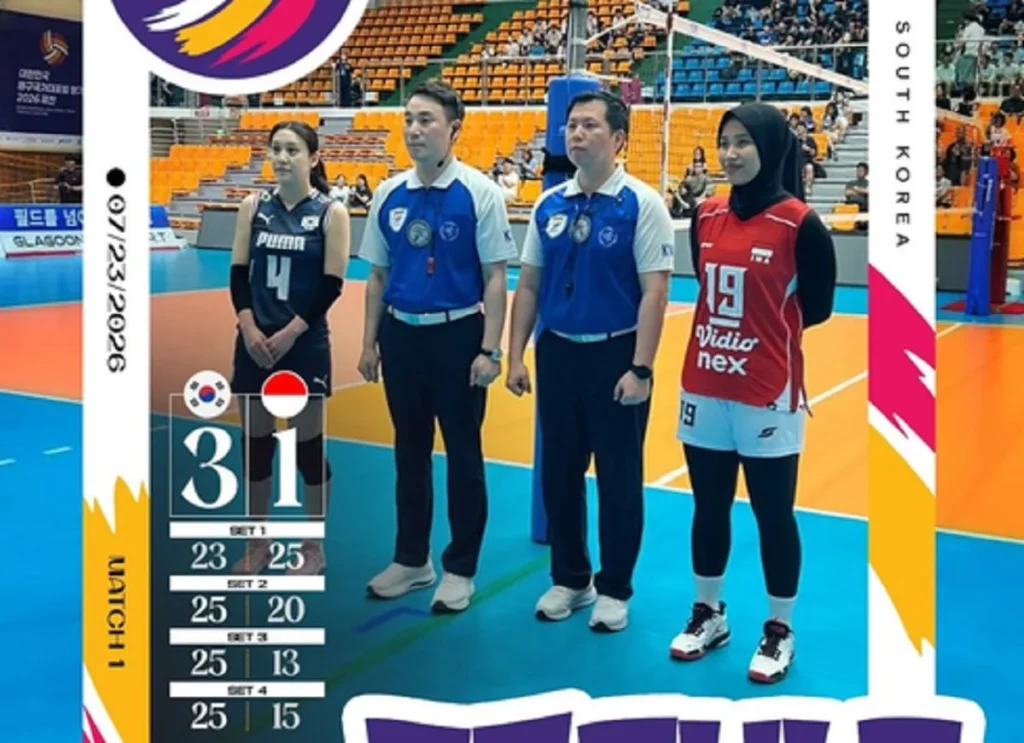
The Jecheon Gymnasium in South Korea became the stage for a compelling international exhibition match on Thursday, July 23, 2026, as the Indonesian Women’s National Volleyball team faced off against the formidable South Korean national squad. In a contest that served as both a litmus test for the Garuda Pertiwi and a tactical scouting mission for the hosts, the visitors ultimately succumbed to a 1-3 defeat (25-23, 20-25, 13-25, 15-25).
The match was particularly notable for the conspicuous absence of Indonesia’s international superstar, Megawati Hangestri. Her unavailability forced head coach and technical staff to experiment with new rotations and tactical configurations, providing a rare glimpse into the depth—or lack thereof—within the current national setup.
The Chronology: A Tale of Two Halves
The Opening Gambit: A Surge of Hope
The match commenced with a palpable tension. Korea, historically a titan in Asian volleyball, entered the court as the heavy favorites. However, the initial exchanges were characterized by a lack of rhythm from both sides. Indonesia, initially struggling to find their footing, appeared hesitant against the imposing presence of the Korean blockers.
As the first set progressed, the Garuda Pertiwi began to settle into a rhythm. They tightened their defensive transition, allowing them to capitalize on a series of unforced errors from the Korean side. The highlight of the opening frame was the offensive brilliance of Mediol Yoku, whose precision attacking dismantled the Korean defense. With the score locked in a deadlock, a pivotal service error by the Koreans coupled with Yoku’s aggressive front-row play allowed Indonesia to clinch a narrow 25-23 victory. It was a statement of intent, proving that Indonesia could compete at a high level even without their primary offensive weapon.
The Turning Point: Korea’s Tactical Adjustment
The second set marked a definitive shift in the match’s momentum. The South Korean coaching staff, clearly unimpressed by their team’s lackadaisical start, implemented a more aggressive service pressure strategy. By forcing the Indonesian receivers off balance, the hosts were able to set up a dominant block-and-defend system.
Korea surged to an early 8-3 lead, signaling a change in intensity. While the Garuda Pertiwi attempted to claw their way back through tactical substitutions and improved back-row play, the consistency of the South Korean attack proved insurmountable. The second set concluded 25-20 in favor of the hosts, leveling the match at 1-1.

The Finality of the Third and Fourth Sets
The confidence gained by South Korea in the second set carried over into the remainder of the match. The third set saw an unfortunate collapse in the Indonesian defensive structure. The hosts exploited gaps in the middle of the court, racking up points with alarming speed. The scoreline of 25-13 reflected the growing disparity in court coverage and physical conditioning as the match reached its mid-point.
In the fourth and final set, Indonesia attempted to regain the form that had served them so well in the opener. However, fatigue appeared to set in, and the tactical discipline wavered. South Korea maintained their high-octane offensive, eventually closing out the set 25-15 and the match 3-1.
Tactical Analysis: Life Without Megawati
The absence of Megawati Hangestri served as a double-edged sword for the Indonesian team. On one hand, it stripped the team of their most reliable point-scorer and a player who draws significant defensive attention, often opening up lanes for her teammates. Without her, the team was forced to play a more distributed, team-oriented game.
Mediol Yoku emerged as the focal point of the offense, showcasing a level of maturity and technical prowess that will be vital in future tournaments. However, the match also exposed a critical vulnerability: the reliance on individual brilliance rather than a cohesive, multi-faceted offensive system. When the opposition successfully neutralized the primary attacker, the transition from defense to offense became labored, leading to the lopsided scores in the latter two sets.
Statistical Breakdown and Performance Metrics
A deep dive into the match statistics reveals why the momentum shifted so drastically:
- Service Errors: Indonesia committed 12 service errors throughout the match, a figure that the coaching staff will likely address as a priority. In contrast, Korea’s aggressive serve-receive strategy limited their own errors to just 6.
- Block Points: South Korea recorded 14 blocks, compared to Indonesia’s 5. This defensive discrepancy was the deciding factor, particularly in the third and fourth sets where the Indonesian attack was consistently stifled at the net.
- Attack Efficiency: While Indonesia outperformed Korea in the first set (42% vs 38%), their efficiency plummeted to 24% by the fourth set, while Korea maintained a consistent 45-50% efficiency throughout the contest.
Official Responses and Stakeholder Perspectives
In the post-match press conference, the Indonesian head coach expressed mixed feelings. "We played with heart, especially in that first set," the coach stated. "We wanted to see how the team functioned without relying on a single star player. We saw some excellent individual efforts, but we also saw the gaps in our endurance and systemic consistency. This loss is a valuable lesson."
Conversely, the South Korean head coach praised the intensity of the visiting squad. "Indonesia showed that their technical skill is evolving. That first set was a wake-up call for us. They forced us to look at our own rotations and defensive shifts, which is exactly why we hold these exhibition matches."

Strategic Implications for the Future
The implications of this exhibition match are far-reaching. For the Indonesian Women’s National Team, the path forward involves a critical assessment of their bench depth.
1. Developing a Secondary Offensive Core
The reliance on a single superstar is a common hurdle for emerging volleyball nations. This match demonstrated that when the primary option is removed, the team must be able to pivot to a "middle-heavy" or "wing-rotation" style of play that is equally effective.
2. Conditioning and Tactical Discipline
The drop-off in performance after the second set highlights a need for better physical conditioning. Maintaining peak performance over a five-set match requires not just stamina, but the mental fortitude to execute technical instructions under extreme pressure.
3. Strengthening the International Schedule
Exposure to high-level opponents like South Korea is essential for the growth of the Garuda Pertiwi. The ability to experience the speed and tactical sophistication of a world-class team is something that cannot be replicated in domestic leagues. Moving forward, the federation should prioritize a more rigorous international friendly circuit to ensure the players are accustomed to the tempo of top-tier global volleyball.
Conclusion: A Step in the Right Direction
While the final scoreline of 1-3 may appear discouraging, the match provided a crucial foundation for development. By taking a set off a superior opponent and demonstrating moments of tactical brilliance, the Indonesian squad proved that they are on an upward trajectory.
The lessons learned in Jecheon will be integrated into the upcoming training camps. With the goal of becoming a regional powerhouse, the Garuda Pertiwi must now synthesize the grit displayed in the opening set with the consistency required to compete against the best in the world. As the team looks toward the next international window, the focus will undoubtedly shift to building a more resilient, well-rounded roster that can thrive under any circumstance—with or without their star power.