Unveiling the Depths: The Profound Meanings of Dreaming of Drawing Well Water for Ablution
Published: July 23, 2026, 04:41 WIB
Dreams often serve as enigmatic windows into our subconscious, reflecting our deepest anxieties, desires, and spiritual states. For many, particularly within Muslim communities, dreams involving purification rituals leave an indelible mark upon waking. Among these, the imagery of drawing water from a well specifically for wudhu (ablution) stands out as particularly potent, intertwining symbols of self-purification with the profound mystery of hidden springs.
This intricate dreamscape, where the act of accessing a subterranean water source converges with a sacred ritual, is widely perceived as bearing significant spiritual and emotional messages. The well itself frequently symbolizes the profound, often untapped, potential within one’s inner being, while wudhu represents a state of readiness and purity for communion with the Divine. The synthesis of these two powerful symbols renders the dream of drawing well water for wudhu rich with multilayered interpretations, necessitating a comprehensive examination from various cultural, spiritual, and psychological perspectives.
Expert dream interpreters consistently emphasize that the meaning of such a dream is rarely monolithic. Instead, it is profoundly influenced by crucial details such as the condition of the water (clear or murky), the ease or difficulty of the drawing process, and the dreamer’s prevailing emotional state during the experience. As observed by the Centre of Excellence, "a well full of water in a dream can represent abundance, wisdom, and emotional sustenance," often signaling a period of significant personal growth and fulfillment. This article delves into the diverse interpretations of this compelling dream, offering a holistic understanding of its potential implications.
1. Main Facts: The Core Significance of a Sacred Dream
The dream of drawing well water for wudhu is not merely a fleeting nocturnal image but a complex narrative brimming with symbolic weight. At its heart, it depicts an individual actively retrieving water from a well and subsequently using it for ritual purification. This convergence of wudhu, a universal symbol of cleansing and spiritual preparedness, with the well, representing a hidden yet abundant source of life, forms the foundational meaning of this dream.
Unlike the simple act of performing wudhu with tap water, the use of well water introduces an additional layer of meaning: the implication of deeper effort and introspection required to access one’s inner resources. The physical act of drawing water from a well signifies that the dreamer is not merely a passive recipient but an active participant in their own spiritual or emotional journey, actively seeking and retrieving something vital from the depths of their own being. This active engagement underscores a conscious effort towards self-improvement and spiritual alignment.
Renowned dream interpreter Gustavus Hindman Miller, in his seminal work 10,000 Dreams Interpreted, cited by Psychologist World, posits that "drawing water from a well signifies the fulfillment of ardent desires." When applied to the context of wudhu, this interpretation suggests that the dream may be an auspicious harbinger, indicating that deep-seated aspirations, particularly those related to spiritual purity, emotional peace, or personal growth, are beginning to manifest.
However, the interpretation is never absolute without considering the nuances. The clarity of the water, the smoothness of the drawing process, and the emotions experienced by the dreamer—be it serenity, struggle, or joy—all contribute significantly to the dream’s ultimate message. These details act as crucial modifiers, fine-tuning the broad symbolism into a more personalized and pertinent insight.
2. Chronology of Interpretation: Tracing the Wisdom Through Ages
The practice of interpreting dreams is as ancient as humanity itself, with various cultures and belief systems developing intricate frameworks to decode nocturnal visions. The dream of drawing well water for wudhu finds its roots in these enduring traditions, with interpretations evolving yet retaining core symbolic meanings across different historical and cultural contexts.
Ancient Roots and Universal Symbolism:
From prehistoric times, wells have been revered as vital sources of life, especially in arid regions. Their depths often led to associations with the underworld, the subconscious, and hidden knowledge. Water itself, universally, symbolizes life, purity, emotion, and transformation. The act of purification through water rituals is similarly ancient, predating many organized religions and found in various forms across diverse cultures. The convergence of these powerful symbols in a dream, therefore, taps into a collective human unconscious understanding.
Islamic Interpretive Tradition:
With the advent of Islam in the 7th century CE, dream interpretation gained a structured and spiritual dimension. Islamic scholars categorized dreams into ru’ya shadiqah (true dreams, often from Allah), hadith al-nafs (self-talk, reflections of daily thoughts), and adghath ahlam (confused dreams, from Shaytan). Dreams involving wudhu and purification are typically viewed within the context of ru’ya shadiqah or hadith al-nafs, reflecting the dreamer’s spiritual state. Early Islamic dream interpreters, drawing from Quranic verses and Hadith (sayings of Prophet Muhammad), began associating clear water with purity, knowledge, and lawful sustenance, while murky water often signified doubt, sin, or worldly troubles. The well, in this context, could represent the source of one’s faith or sustenance, requiring effort to draw from it.
Javanese Primbon: Indigenous Wisdom:
In the Indonesian archipelago, particularly Java, the Primbon system emerged as a complex indigenous body of knowledge, blending ancient Javanese cosmology, astrology, numerology, and divination. Dating back centuries, Primbon interprets dreams as direct omens or subtle guidance from the universe. For the Javanese, wells are not just water sources but sacred points, often believed to be portals or places of power. The act of drawing water, therefore, becomes a ritualistic engagement with these energies. Primbon interpretations are highly contextual, considering not just the water’s clarity but also the specific time of the dream, the dreamer’s weton (birth calendar), and other environmental cues. This system emphasizes harmony with nature and self-introspection as key to understanding dream messages.
Modern Psychological Approaches:
The late 19th and early 20th centuries saw the rise of modern psychology, with figures like Sigmund Freud and Carl Jung revolutionizing dream analysis. Freud viewed dreams as "the royal road to the unconscious," primarily serving as wish fulfillment or expressions of repressed desires. Jung, on the other hand, proposed the concept of the "collective unconscious" and "archetypes," seeing dreams as messages from deeper, universal layers of the psyche aiming for individuation (self-realization). For psychology, the well symbolizes the deep unconscious, and water represents emotions. The act of drawing and purifying speaks to the processing of emotional content, resolving internal conflicts, and achieving psychological integration.
Thus, the interpretation of dreaming about drawing well water for wudhu is a confluence of ancient reverence for life’s essentials, structured spiritual teachings, nuanced indigenous wisdom, and modern scientific inquiry into the human mind. Each tradition, while unique, universally acknowledges the dream’s profound connection to the dreamer’s inner state and external journey.
3. Supporting Data: Detailed Interpretations Across Disciplines
To fully grasp the multifaceted meanings of this dream, it’s essential to delve deeper into the specific interpretations offered by each framework. These "supporting data" points flesh out the core symbolism with practical implications and nuanced readings.
3.1. The Islamic Perspective: Purity, Piety, and Divine Grace
In Islamic tradition, dreams of purification are intimately linked to the dreamer’s spiritual health and readiness. Wudhu is a prerequisite for prayer (salat) and other acts of worship, making its appearance in a dream often symbolic of spiritual preparedness and self-cleansing.
-
Perfect Wudhu, Clear Water: As quoted by NU Online, performing wudhu perfectly in a dream with clear, pure water is universally considered a highly auspicious sign.
- For the Grieved: It promises relief from sorrow and the onset of happiness.
- For the Fearful: It signifies divine protection (hifz) and security from harm.
- For the Indebted: It portends the swift repayment of debts and financial relief.
- For the Ailing: It signals recovery from illness and renewed health.
- Purity of Heart: Drawing clear water from a well for wudhu specifically emphasizes a deep, internal purification, signifying a sincere intention to cleanse oneself of sins and negative traits, leading to a state of spiritual clarity (safa’ al-qalb) and lawful sustenance (rizq halal).
- Seeking Knowledge: The well can also symbolize a source of profound religious knowledge, and drawing from it for wudhu suggests an active pursuit of spiritual wisdom and its application in one’s life.
-
Imperfect Wudhu, Murky Water: Conversely, dreaming of wudhu with impure or insufficient water, or from a well that is murky, often serves as a spiritual warning.
- Spiritual Imperfections: It may indicate a need for introspection regarding one’s intentions, actions, or faith. It could point to hypocrisy, unresolved sins, or a lack of sincerity in worship.
- Worldly Distractions: Murky water from a well might symbolize a source of sustenance or knowledge that is tainted or leads to spiritual confusion, urging the dreamer to re-evaluate their sources and priorities.
- Call to Repentance (Tawbah): Such a dream is often interpreted as an urgent call to repent, seek forgiveness from Allah, and rectify one’s path.
It is crucial to remember, as Islamic teachings emphasize, that not all dreams carry specific divine messages. Many are merely reflections of daily thoughts or external influences. Therefore, such dreams should be approached with wisdom, used as a catalyst for self-improvement rather than a source of undue anxiety.
3.2. The Primbon Jawa Perspective: Omens, Introspection, and Life’s Journey
In the rich tapestry of Javanese local wisdom, every dream is believed to hold clues or warnings for waking life. The interpretation of purification dreams, especially involving well water, is deeply contextualized by the specifics of the dream. The book Kitab Primbon Jawa Serbaguna (2021) by R. Gunasasmita broadly states that wudhu-related dreams generally signify positive omens for one’s life and endeavors.
-
Drawing Clear Water from a Full Well:
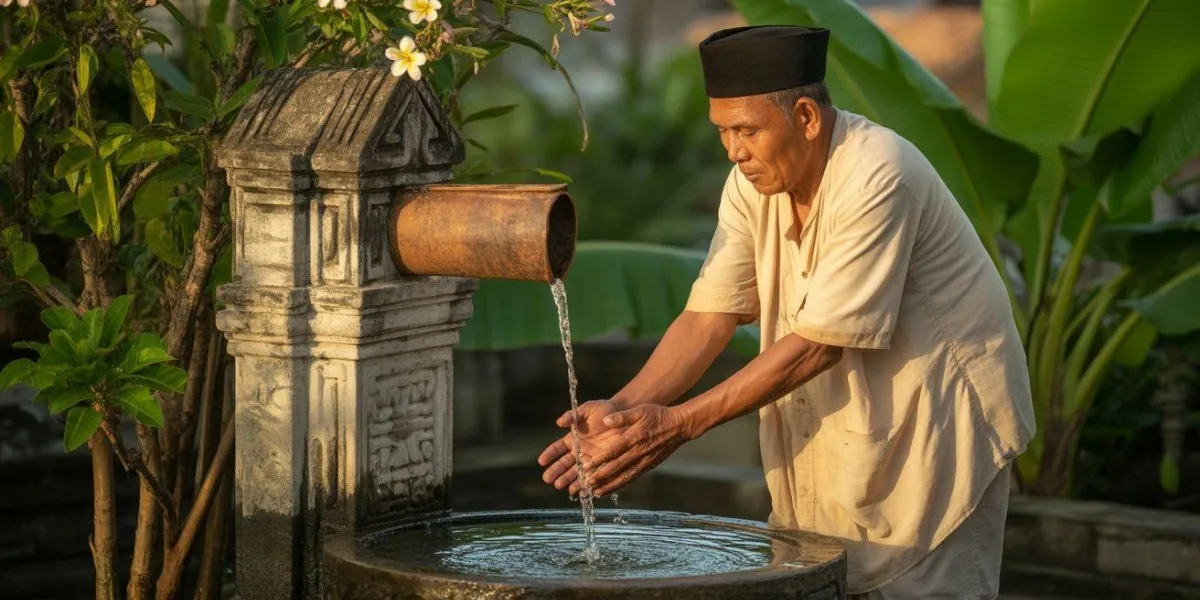
- Prosperity and Blessings: This is a strong indicator of impending good fortune, abundant rezeki (sustenance), and blessings in personal life and professional ventures. It suggests that the dreamer’s efforts will bear fruit, and their path will be smoothed.
- Inner Peace and Clarity: The clear water reflects a peaceful inner state, a clear mind, and a sense of harmony with one’s surroundings.
- Health and Vitality: It can also be a sign of good health and renewed vitality, symbolizing the cleansing of ailments or negative energies.
-
Drawing Murky or Scanty Water:
- Challenges and Obstacles: This serves as a warning of potential difficulties, obstacles in work or relationships, or periods of confusion.
- Emotional Turmoil: Murky water directly reflects internal emotional distress, unresolved conflicts, or spiritual impurities that need addressing.
- Need for Caution: The dream urges the dreamer to be cautious in their actions and decisions, to practice eling (mindfulness) and waspada (vigilance). It may also suggest the need for introspection and self-correction to avoid future pitfalls.
-
Difficulty in Drawing Water:
- Struggle and Effort: If the dreamer struggles to draw water, it indicates that their desired outcomes will require significant effort and perseverance. It’s a reminder that success is earned through hard work.
- Hidden Blockages: This could also point to internal or external blockages hindering progress, urging the dreamer to identify and resolve them.
Primbon Jawa emphasizes that these interpretations are not immutable decrees but rather guides for introspection and proactive adjustment. They encourage individuals to reflect on their current life situation and make conscious choices to align with positive omens or avert negative ones.
3.3. The Psychological Perspective: Emotions, the Unconscious, and Self-Actualization
From a modern psychological standpoint, water is a primal and powerful symbol for emotions and the unconscious mind. As Psychology Today highlights, water is "the most common element to appear in dreams among the four classical elements" due to its universal association with life, emotion, and the subconscious.
-
Water as Emotion and the Unconscious:
- Clear Water: Represents emotional clarity, peace, tranquility, and a healthy flow of emotional energy. It suggests that the dreamer is in touch with their feelings and can navigate them effectively.
- Murky Water: Symbolizes emotional confusion, turmoil, unresolved issues, or repressed feelings. It indicates a need to address inner conflicts and seek emotional purification.
-
The Well as the Deep Self:
- Jungian Archetype: In Jungian psychology, the well can be seen as an archetype representing the "collective unconscious," a repository of universal wisdom, primal instincts, and ancient knowledge. Drawing water from it signifies the process of accessing these deep, often hidden, layers of the psyche. It aligns with the concept of "individuation," the journey towards psychological wholeness and self-realization, where unconscious contents are integrated into consciousness.
- Freudian Symbolism: For Freud, the well might symbolize the unconscious mind itself, containing repressed desires, memories, and conflicts. The act of drawing water and performing wudhu could be interpreted as a psychological mechanism to confront, process, and ultimately purify oneself of these internal burdens, such as guilt, shame, or unresolved trauma. It represents a conscious effort to bring unconscious material to the surface for healing and transformation.
-
The Act of Drawing and Wudhu as Psychological Processing:
- Emotional Cleansing: The entire dream sequence—drawing water and performing wudhu—can be interpreted as the mind’s attempt to engage in emotional self-cleansing. It suggests a desire or an active process of releasing stress, guilt, anxiety, or other negative emotional baggage.
- Transformation: It signifies a powerful drive for personal transformation, a shedding of old patterns or identities that no longer serve the dreamer, and an embrace of a more authentic, purified self. This mirrors the spiritual aim of wudhu but on a psychological plane.
-
Cognitive Processing: From a cognitive perspective, dreams are often seen as the brain’s way of processing daily experiences, consolidating memories, and even problem-solving. This dream could be the mind’s metaphorical representation of working through a challenge that requires inner strength and a clear approach.
Psychological interpretations emphasize the personal narrative of the dreamer, encouraging them to explore what specific emotions or unconscious contents the well and its water might represent in their unique life context.
4. Official Responses: Authoritative Interpretations and Consensus
While "official responses" in the governmental sense are not applicable to dream interpretation, there exist authoritative interpretations from established religious institutions, traditional spiritual guides, and widely recognized psychological theorists. These form the "official" consensus within their respective domains.
Islamic Scholarly Consensus (as seen in NU Online and other sources):
Within mainstream Islamic scholarship, as reflected in reputable sources like NU Online, the interpretation of dreams involving wudhu is generally consistent. The emphasis is on the spiritual state of the dreamer (hal al-ra’i) and the purity of the water.
- Positive Connotation: The overarching consensus is that wudhu in a dream, particularly with clear water, is a positive sign, indicating purity, sincerity in faith, removal of worries, protection, and fulfillment of needs.
- Warning and Repentance: If the water is dirty or the wudhu is incomplete, it serves as a clear warning, urging the dreamer to reflect on their sins, purify their intentions, and seek repentance (istighfar).
- Contextual Relevance: Scholars consistently advise that such dreams should lead to positive action and self-reflection, rather than mere superstition. The dream acts as a mirror to one’s spiritual journey.
Primbon Jawa Expert Consensus (as seen in Kitab Primbon Jawa Serbaguna):
The Kitab Primbon Jawa Serbaguna and similar traditional texts represent the accumulated wisdom and "official" interpretations within the Javanese Primbon system.
- Nature’s Omens: Primbon experts agree that dreams are signals from the natural and spiritual world. The condition of the water (clear, murky, flowing, stagnant) is paramount.
- Holistic Well-being: Interpretations generally link the dream to one’s overall well-being, encompassing health, relationships, career, and spiritual harmony.
- Guidance for Action: The "official" Primbon stance is that these dreams are not deterministic but provide guidance. They empower the dreamer to take conscious steps to either reinforce positive outcomes or mitigate negative ones through rituals, introspection, or changes in behavior.
Psychological Theoretical Frameworks (Freud, Jung, and Modern Psychology):
From a scientific perspective, the "official" responses come from the established theories of psychology:
- Unconscious Exploration: Sigmund Freud’s work established the dream as a manifest content concealing latent desires, with interpretation aiming to uncover these unconscious elements. For Freud, such a dream could be a symbolic wish for purification from guilt or a desire to achieve a state of inner cleanliness.
- Individuation and Archetypes: Carl Jung’s school emphasizes the dream as a compensatory mechanism, aiming to balance conscious attitudes and integrate unconscious material. The well and wudhu would be seen as archetypal symbols pointing towards the journey of individuation, the quest for wholeness, and the integration of one’s spiritual and emotional self.
- Modern Cognitive Neuroscience: While not offering direct "interpretations" in the same way, modern psychology views dreams as products of brain activity during sleep, involved in memory consolidation, emotional regulation, and problem-solving. Thus, such a dream is the brain’s symbolic way of processing experiences related to self-purification, emotional clarity, or overcoming internal obstacles.
In essence, the "official responses" across these diverse fields converge on the idea that this dream is significant. It is rarely dismissed as meaningless but is seen as a profound reflection of the dreamer’s inner world, spiritual journey, and emotional landscape, offering insights that can be harnessed for personal growth.
5. Implications: Navigating the Dream’s Message for Daily Life
Understanding the diverse interpretations of dreaming of drawing well water for wudhu is merely the first step. The true value lies in how one integrates these insights into daily life, transforming a nocturnal vision into a catalyst for conscious improvement. The condition of the water in the dream serves as a crucial compass for this journey of self-reflection.
As Dreams.co.uk aptly states, "clear, calm water generally signifies peace and clarity, while dark or murky water can indicate stress and emotional pressure." Building upon this foundational understanding, here are wise and actionable implications for those who experience this powerful dream:
5.1. For Dreams with Clear, Flowing Water: Embrace and Cultivate
If the dream featured clear, pristine water drawn effortlessly from a full well for a perfect wudhu, the implications are overwhelmingly positive:
- Affirmation of Inner Purity: This dream often affirms that you are on a righteous path, your intentions are pure, and your spiritual state is sound. Embrace this sense of inner peace and continue to nurture it through sincere worship, ethical conduct, and positive relationships.
- Expect Blessings and Fulfillment: Take this as a sign that your efforts are recognized, and blessings, whether in the form of lawful sustenance, emotional tranquility, or opportunities for growth, are on their way. Be open to receiving these gifts and utilize them wisely.
- Strengthen Your Resolve: The dream encourages you to strengthen your resolve in pursuing your spiritual and personal goals. It’s a reaffirmation of your inner resources and wisdom.
- Share Your Blessings: In many traditions, abundance is meant to be shared. Consider how you can use your blessings to benefit others, further enhancing your spiritual merit.
5.2. For Dreams with Murky, Stagnant, or Difficult-to-Draw Water: Introspection and Action
When the dream presents murky, stagnant water, or if drawing it was a struggle, it functions as a powerful call for introspection and corrective action:
- Identify Emotional Blockages: The murky water symbolizes emotional or psychological clutter. Take time to identify sources of stress, unresolved conflicts, guilt, or negative emotions that might be clouding your inner landscape. Journaling, meditation, or seeking trusted counsel can be beneficial.
- Spiritual Rectification: From an Islamic perspective, this is a clear invitation for tawbah (repentance) and istighfar (seeking forgiveness). Reflect on your actions, make amends where necessary, and strive to improve your relationship with the Divine.
- Re-evaluate Life Choices: In the context of Primbon Jawa, such a dream urges a re-evaluation of current life choices, relationships, or professional paths. Are there decisions that are leading you away from your true self or causing disharmony?
- Seek Purity in Sources: Consider the "wells" from which you draw in waking life—your sources of information, sustenance, and companionship. Are they pure and beneficial, or are they contributing to inner turmoil?
- Proactive Problem Solving: Do not succumb to anxiety. Instead, view this dream as a constructive warning. It empowers you to proactively address underlying issues, seek clarity, and work towards a cleaner, more harmonious inner and outer environment. This might involve setting boundaries, seeking professional help for emotional distress, or making difficult but necessary changes.
5.3. General Wisdom for All Dream Types:
- Self-Reflection is Key: Regardless of the dream’s specifics, use it as a prompt for deep self-reflection. What aspects of your life are you seeking to purify? What inner resources do you need to tap into?
- Not Deterministic, but Guiding: Understand that dreams are not absolute predictions but symbolic guides. They highlight aspects of your subconscious or spiritual state that require attention. Your conscious actions can always influence your reality.
- Seek Further Guidance (If Needed): If the dream is particularly vivid, disturbing, or recurring, consider seeking guidance from a knowledgeable spiritual mentor, a trusted elder, or a mental health professional, especially if it points to significant emotional distress.
- Maintain Spiritual Practices: For those of faith, continue or strengthen your spiritual practices. Prayer, meditation, and acts of kindness help maintain inner purity and resilience.
In conclusion, the dream of drawing well water for wudhu is a profound symbolic narrative, offering rich insights into our spiritual journey and emotional landscape. By approaching it with curiosity, discernment, and a commitment to self-improvement, this powerful dream can serve as a potent catalyst for growth, guiding us towards greater inner peace, purity, and alignment with our highest selves. It reminds us that just as we draw water from the earth, we must also draw wisdom and clarity from the depths of our own being, purifying ourselves continually in the sacred journey of life.
Daftar Referensi (References):
- Kapanlagi.com (Original Source)
- Centre of Excellence (as cited by Kapanlagi.com)
- Psychologist World (as cited by Kapanlagi.com, referencing Gustavus Hindman Miller)
- NU Online (as cited by Kapanlagi.com)
- Kitab Primbon Jawa Serbaguna (2021) by R. Gunasasmita (as cited by Kapanlagi.com)
- Psychology Today (as cited by Kapanlagi.com)
- The Interpretation of Dreams by Sigmund Freud (as cited by Kapanlagi.com)
- Dreams.co.uk (as cited by Kapanlagi.com)