The Digital Transformation of Academia: Bridging the AI Gap in Modern Research
Jakarta – The landscape of academic research is undergoing a seismic shift. For decades, the standard for empirical analysis was confined to traditional statistical software such as SPSS or manual calculations performed in quiet university offices. However, the paradigm has shifted. Today, the world’s most prestigious, high-impact journals are increasingly prioritizing research that leverages Artificial Intelligence (AI) and Machine Learning (ML) to process large-scale digital datasets. From sentiment analysis on social media platforms to predictive modeling of public discourse, the ability to synthesize digital data has become the new frontier of scholarly inquiry.
Yet, this rapid evolution has created a significant "technical divide." A vast number of undergraduate students, doctoral candidates, and even seasoned faculty members find themselves struggling to keep pace. The primary barrier is not a lack of intellectual curiosity, but a lack of technical fluency. For many, the prospect of mastering programming languages like Python or navigating complex environments like Google Colab—often self-taught through fragmented and overwhelming online tutorials—feels like an insurmountable hurdle.
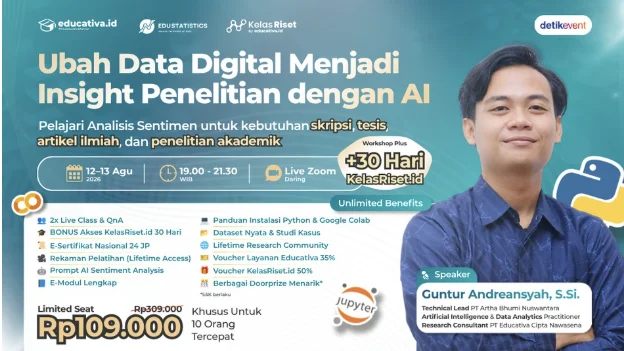
To address this critical gap, the EXCLUSIVE Workshop: Transforming Digital Data into Research Insights with AI has been launched. This initiative is designed to democratize access to advanced research methodologies, allowing academics from all levels to transition from theoretical understanding to practical application without requiring prior coding experience.
The Evolution of Scholarly Inquiry: Why AI Matters
Moving Beyond Traditional Statistics
Historically, social science and humanities research relied on primary data collection methods: surveys, focus groups, and semi-structured interviews. While these remain foundational, they are limited by scale and speed. In the digital age, human behavior is archived in real-time across the internet. Social media platforms, news aggregators, and digital forums act as massive, untapped reservoirs of qualitative data.
However, manually analyzing thousands of tweets or millions of comments is impossible. This is where AI-driven sentiment analysis becomes transformative. By utilizing Natural Language Processing (NLP), researchers can now categorize public sentiment, identify emotional trends, and track the diffusion of ideas with unprecedented precision.
The Technical Barrier
Despite the obvious benefits, the "coding barrier" remains the single largest obstacle for non-STEM researchers. The academic community is currently bifurcated: those who have the resources to hire data scientists and those who are left to conduct research using outdated methodologies. This gap is not merely a technical issue; it is a matter of academic equity. If only a small percentage of researchers can handle large-scale data, the diversity and scope of academic output suffer.
Chronology: A Structured Approach to Skill Acquisition
The Exclusive Workshop is structured to dismantle the intimidation factor associated with AI. Recognizing that participants have varying levels of experience, the organizers have developed a two-day intensive curriculum that balances conceptual theory with hands-on application.
Session 1: Building the Foundation (Wednesday, August 12, 2026)
The inaugural session focuses on the "Why" and the "How." Participants will be introduced to the architecture of sentiment analysis. Instead of diving into complex syntax immediately, the session covers:
- The Logic of NLP: Understanding how machines "read" human emotion.
- Environment Setup: A guided, step-by-step walkthrough of Google Colab, demystifying the interface for absolute beginners.
- Data Ethics: A crucial discussion on the scraping of digital data, privacy, and the ethical responsibility of researchers in an AI-driven environment.
Session 2: Practical Application and Interpretation (Thursday, August 13, 2026)
The second session transitions from the "Sandbox" to real-world application. Participants will be tasked with:
- Dataset Processing: Working with curated, real-world datasets—specifically focusing on trending socio-political issues—to ensure that the research is not just an abstract exercise but a meaningful contribution to academic discourse.
- Interpretation: Learning how to turn raw machine output into meaningful academic narratives. The goal is not just to generate graphs, but to answer the "So What?" question that defines a high-quality journal submission.
Supporting Data: The Value Proposition
To ensure that the workshop is not a fleeting experience, the organizers have integrated a robust support system designed to foster long-term retention.
- Extended Learning Access: Participants receive a 30-day all-access pass to KelasRiset.id, an online platform where they can revisit specific modules, troubleshoot errors, and practice at their own pace.
- Lifetime Resource Library: Recognizing that AI tools update rapidly, the workshop provides permanent access to class recordings. This serves as a "living document" that students can refer back to whenever they initiate a new research project.
- Community Networking: Perhaps the most significant asset is the inclusion of a lifetime research community. Post-workshop, participants are invited to join an exclusive network where they can discuss challenges, share datasets, and collaborate on interdisciplinary papers.
- Professional Certification: The workshop awards an e-certificate equivalent to 24 JP (Jam Pelajaran), a formal acknowledgment of professional development that carries weight in academic portfolio reviews and tenure applications.
Official Perspective: Bridging the Gap
Experts in the field of digital research have noted that workshops of this nature are not merely "nice-to-have" add-ons, but essential survival skills.
"The methodology of research is changing faster than the curriculum of most universities," says a leading coordinator of the initiative. "We are seeing a trend where traditional researchers are being sidelined simply because they cannot process the volume of data required for modern journals. By providing a bridge—removing the fear of Python and replacing it with functional knowledge—we are empowering a new generation of scholars to remain relevant."
The curriculum design is deliberate. By focusing on "viral issues" and "real-world context," the workshop ensures that participants are not just learning syntax; they are learning how to frame research questions that resonate with contemporary academic editors and reviewers.
Implications for Future Research
A Shift in Academic Output
The long-term implication of this transition is an increase in the quality and quantity of empirical evidence in the humanities and social sciences. When researchers are equipped to handle large datasets, their claims become more robust. Instead of generalizing based on 50 survey responses, a researcher can now validate their findings against a dataset of 50,000 interactions.
The Democratization of AI
By lowering the barrier to entry, this workshop plays a vital role in the democratization of technology. It challenges the assumption that AI is reserved for computer scientists. It posits that any researcher—whether in sociology, communications, political science, or management—can and should utilize these tools to enhance their work.
Preparing for a Competitive Landscape
The academic publishing market is more competitive than ever. As journal editors increasingly demand quantitative rigor, researchers who remain tethered to manual processing methods will find it harder to secure funding and publication space. This workshop acts as a preemptive strike against professional obsolescence. By investing in digital literacy now, researchers are securing their capacity to lead in their respective fields for the next decade.
Conclusion: How to Participate
The window to upgrade one’s research profile is open. The Exclusive Workshop is not designed for the elite few, but for any student or academic who recognizes the necessity of evolving with the digital tide.
The program, scheduled for August 12–13, 2026, offers a rare combination of intensive technical training, long-term access to educational resources, and a community of peers. Given the high demand for digital literacy in academia, prospective participants are encouraged to secure their spots early.
For those ready to move from traditional data processing to AI-driven analysis, full details, registration procedures, and curriculum breakdowns can be found on the official detikEvent page.
In an era where data is the new currency, the ability to interpret that data is the ultimate competitive advantage. This workshop provides the tools to turn that currency into academic excellence.
(Note: This article is intended for informational purposes regarding the workshop. For inquiries or technical support, please refer to the official event registration portal.)