Tragedy on the Rails: At Least 69 Dead in Devastating High-Speed Train Collision South of Madrid
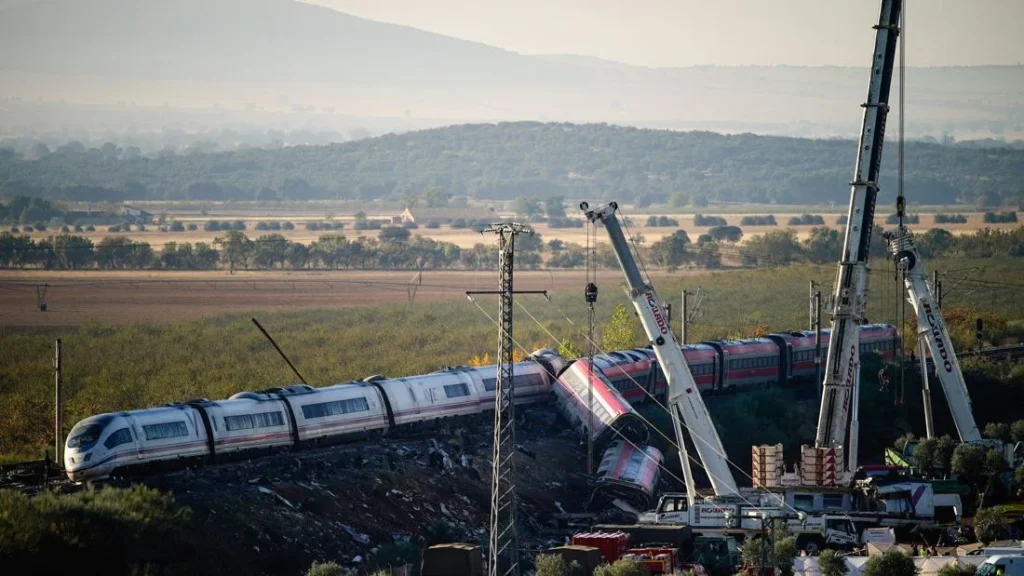
MADRID — In one of the deadliest rail disasters in modern European history, at least 69 people were killed and dozens more sustained severe injuries on Wednesday morning when a high-speed passenger train collided with a stationary train in central Spain. The catastrophic crash occurred on the historic high-speed rail line connecting Madrid to the southern city of Sevilla, plunging the nation into profound grief and raising urgent questions regarding infrastructure reliability, automated safety protocols, and human oversight.
The incident, which marks Spain’s worst railway catastrophe since 2013, has prompted the Spanish government to declare three days of national mourning. Rescue workers, emergency medical teams, and forensic units immediately mobilized at the crash site near the municipality of Urda, working tirelessly through the wreckage to pull survivors from mangled carriages and recover the bodies of the victims.
As investigators descend upon the scene to untangle the sequence of technical failures and operational missteps that led to the tragedy, international experts are closely monitoring the fallout, viewing the disaster as a stark reminder of the vulnerabilities inherent in managing complex high-speed transportation networks.
Main Facts of the Disaster
The collision took place at approximately kilometer 118 of the Madrid-Sevilla high-speed line, situated within the province of Toledo, precisely between the towns of Mora, Orgaz, and Urda.
According to preliminary government reports and transport authorities, a state-operated Renfe high-speed AVE train plowed into the rear of a stationary commercial train operated by the private rail company Iryo. The impact was devastating, causing significant structural damage to the rear cars of the Iryo service and the front locomotive of the Renfe convoy.
While the exact speed of the Renfe train at the moment of impact remains under active investigation, the sheer kinetic force involved resulted in an immense death toll. At least 69 fatalities have been confirmed, with numbers expected to fluctuate as hospital authorities evaluate the conditions of dozens of injured passengers, many of whom are in critical condition.
The route where the disaster struck holds symbolic weight within Spain’s transport history. Opened in April 1992 to coincide with the prestigious Sevilla Universal Exposition (Expo ’92), the Madrid-Sevilla corridor was Spain’s very first high-speed rail line, setting a precedent for the country’s transformation into a global leader in high-speed rail infrastructure. For decades, the corridor maintained an exemplary safety record, making Wednesday’s catastrophe all the more shocking to the public and rail operators alike.
Chronology of Events: From System Failure to Fatal Impact
Piecing together the timeline of Wednesday morning has become the primary focus for investigators from Spain’s railway accident investigation commission. Initial findings suggest that a cascading series of technical malfunctions, compounded by critical manual interventions, laid the groundwork for the disaster.
1. The Initial Technical Malfunction
The chain of events began early Wednesday morning when a critical failure struck the primary signaling and safety architecture governing the Toledo section of the Madrid-Sevilla line. The infrastructure relies heavily on the German-engineered Linienzugbeeinflussung (LZB) system. LZB is an advanced continuous automatic train protection system that monitors train speeds in real-time and transmits vital movement authorities and braking instructions directly into the engineer’s cab.
When the LZB system suffered an unexpected breakdown on Wednesday, protocol dictated that operations must transition away from automated control and fall back to manual management.
2. The Traffic Stall and Manual Override
Due to the sudden failure of the automated safety apparatus, central dispatch ordered a precautionary halt for a total of eight high-speed trains operating within the affected sector. As engineers awaited clearance, the traffic control center attempted to diagnose the issue and subsequently instituted manual operations, issuing instructions for halted trains to cautiously resume their journeys.
However, operational complications arose with one specific Iryo service. For reasons still being verified, the Iryo train was unable to restart its journey immediately and remained immobilized on the tracks near Urda.
3. The Fatal Clearance
Operating under instructions relayed from the main Atocha control center in Madrid, a trailing Renfe AVE high-speed service was given clearance to proceed along the block section. Believing the track ahead was clear or operating under restricted manual guidance, the Renfe train advanced down the line.
Moments later, the AVE train collided directly with the rear of the stationary Iryo service. Because the automated block systems were offline and operations were being managed manually, the safety margins that normally prevent two trains from occupying the same track section failed to halt the oncoming locomotive in time.
Technical Deep-Dive: Understanding Spain’s Rail Safety Infrastructure
To comprehend how a collision could occur on one of the world’s most advanced rail networks, experts must examine the multilayered technological ecosystem designed to prevent precisely this type of accident. Modern high-speed rail safety does not rely on a single mechanism; rather, it is a complex tapestry of redundant systems, electronic sensors, and communication protocols.
The LZB System and the Migration to ERTMS
The Madrid-Sevilla line has long utilized the LZB system, a proven technology that establishes a continuous data link between the track and the train via an inductive cable laid between the rails. However, this infrastructure is currently undergoing a massive modernization program.
Spain is actively replacing LZB with the European Rail Traffic Management System (ERTMS), a standardized European Union initiative designed to ensure seamless interoperability and supreme safety across the continent’s rail networks. Specifically, the corridor is transitioning to ERTMS Level 2.
Unlike older systems, ERTMS Level 2 provides continuous supervision of train speeds and automated braking via digital radio communication (GSM-R), relying less on fixed lineside balises (transponders). The tragedy on Wednesday underscores the immense risks and operational vulnerabilities inherent during transitional phases when legacy systems are being phased out and operational habits shift.
Lineside Protection: The ASFA System
In addition to cab-signaling systems like LZB and ERTMS, Spanish rail lines operated by the state infrastructure manager Adif are equipped with ASFA (Anuncio de Señales y Frenado Automático / Announcement of Signals and Automatic Braking).
ASFA functions via magnetic or electronic beacons placed along the tracks. These beacons transmit signal states to antennas mounted on the bottom of the trains. If a driver fails to acknowledge a restrictive signal or attempts to pass a red stop signal, ASFA automatically triggers emergency brakes. However, the efficacy of such systems can be compromised when operations are forced into manual override modes due to overarching control system failures.
Block Control and Detection Mechanisms
To prevent rear-end collisions, rail networks utilize block control systems that divide tracks into distinct physical or logical segments. Under standard automated conditions, no two trains are permitted to occupy the same block simultaneously.
Adif’s technical standards (such as NAS 811) incorporate advanced track-circuit and axle-counter technologies designed to continuously detect the presence of rolling stock within a specific block. Furthermore, secure communication between trains and command centers is maintained via GSM-R (Global System for Mobile Communications – Railway), a dedicated digital radio frequency standard that replaced older analog systems to ensure zero interference.
Investigators must now determine precisely where this multi-tiered safety net failed—whether through a breakdown in track-occupancy detection, a miscommunication over the GSM-R network, or an error in human judgment during the manual override phase.
Official Responses and National Mourning
The magnitude of the disaster has elicited immediate responses from Spain’s highest political offices, international leaders, and emergency services.
Prime Minister Pedro Sánchez expressed his profound devastation, cutting short official engagements to travel directly to the disaster site in Toledo. In a televised address to the nation, Sánchez declared three official days of mourning, stating, "Spain is united in grief today. We mourn the lives lost in this unimaginable tragedy, and our absolute priority is providing solace to the families and ensuring every injured survivor receives the highest standard of medical care."
King Felipe VI and Queen Letizia issued a joint statement conveying their deep sorrow and solidarity with the victims’ families, praising the heroic efforts of firefighters, medical personnel, and civil guard units who worked through harrowing conditions in the immediate aftermath of the crash.
Transport Minister Óscar Puente held an emergency press conference, pledging full transparency and absolute cooperation with judicial investigators. "We owe the victims, their families, and the Spanish public the complete truth," Puente said. "Every log, every radio transmission, and every digital record from the Atocha control center and the trains involved will be scrutinized without exception to understand how this catastrophe was allowed to happen."
International leaders, including the President of the European Commission and heads of state from across Europe, dispatched messages of condolence, offering technical assistance and forensic support from EU rail safety agencies.
Implications for Global High-Speed Rail
As the shockwaves of the Urda disaster reverberate internationally, the implications for the future of high-speed rail management are profound.
1. Re-Evaluating Manual Override Protocols
The foremost implication centers on the procedures invoked when automated signaling systems fail. Rail networks worldwide increasingly rely on automation to eliminate the margin of human error. However, when those digital systems crash, operators are frequently forced to revert to manual command structures that rely heavily on human situational awareness. The Madrid-Sevilla disaster highlights the critical danger point during this technological handover, suggesting that global rail authorities must institute stricter, more conservative speed restrictions and spacing mandates whenever automated safety nets go offline.
2. Scrutiny on Infrastructure Upgrades
With the Madrid-Sevilla line actively undergoing modernization from LZB to ERTMS Level 2, the incident will spark rigorous safety audits regarding how infrastructure projects are managed on active, high-density corridors. Transport analysts point out that transitional phases—where old and new technologies temporarily overlap or interface—represent periods of elevated systemic risk.
3. Public Trust and Economic Impact
Spain has long prided itself on exporting high-speed rail technology to Latin America, the Middle East, and other parts of Europe. This disaster poses a significant psychological blow to public confidence in rail travel safety. Restoring that trust will require an exhaustive, transparent judicial inquiry, clear accountability, and immediate engineering adjustments to ensure that a tragedy of this scale can never happen again.
As forensic teams continue their meticulous work at kilometer 118, Spain and the global rail community wait anxiously for answers, bound together in mourning for the lives abruptly cut short on a historic railway line.