The Silent Crisis: How Indonesia’s Non-ASN Lecturers Are Pushed to the Brink of Poverty
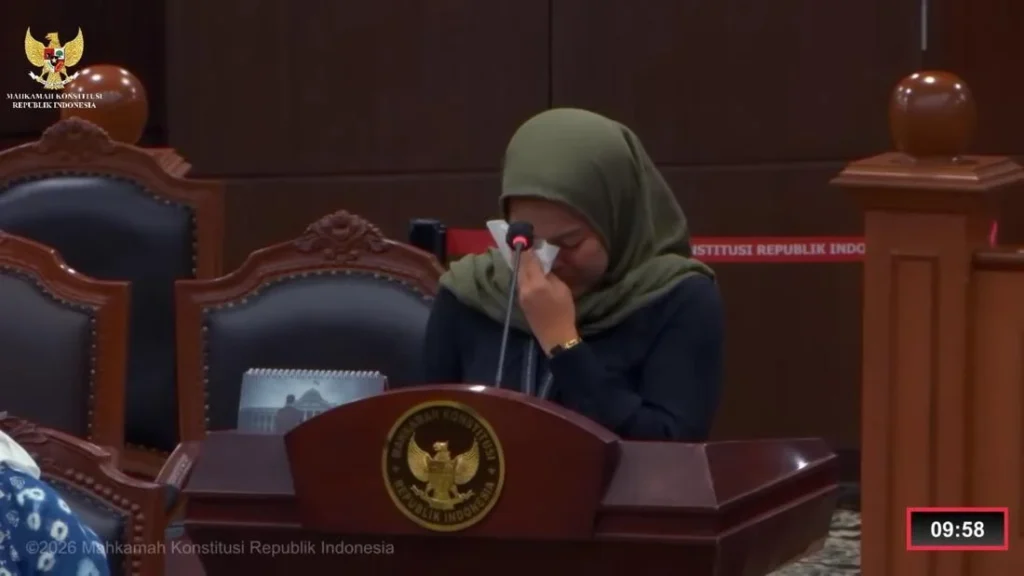
JAKARTA – The ivory tower of academia in Indonesia is facing a harsh, hidden reality. Behind the prestige of university rankings and the rigorous pursuit of scientific advancement, a significant segment of the teaching workforce is grappling with profound financial instability. On June 30, 2026, during a Constitutional Court hearing regarding the judicial review of Law No. 14 of 2005 on Teachers and Lecturers, the systemic struggles of non-State Civil Apparatus (non-ASN) lecturers were laid bare, revealing a landscape of "financial violence," job insecurity, and shattered professional dignity.
The Human Face of Financial Hardship
The courtroom was filled with palpable emotion as Dinda Dinanti, a permanent non-ASN lecturer at UPN Veteran Jakarta (UPNVJ), broke down while testifying. Her testimony highlighted a harrowing contradiction: while she is responsible for the intellectual development of 290 students across three subjects, her own livelihood remains precarious.
"In this month of 2026, my net take-home pay is exactly Rp 3,171,443," Dinda revealed, her voice trembling. "This figure encompasses my base salary, functional position allowance, and a rice allowance."
For context, this amount falls below the Minimum Wage (UMK) for Jakarta and its satellite city, Depok—areas where the cost of living for a professional is significantly higher. Dinda, who holds a heavy load of 14 credit hours (SKS) per week, argued that the exhaustion from her academic responsibilities—which include research, community service, and thesis supervision—is not commensurate with the compensation provided.
The struggle is not hers alone. The court heard that many of her colleagues, driven by the inability to meet basic living costs, have resorted to "side hustles" that would be considered unimaginable for educators of their caliber. Some have turned to selling homemade cakes to make ends meet, while others are forced to work as ride-hailing drivers (ojek online) after hours to put food on the table.
A Chronology of Institutional Neglect
The plight of these lecturers is not a sudden phenomenon but a result of years of shifting administrative statuses and regulatory gaps.
Dinda’s journey began in 2011 as a student at UPNVJ. She transitioned into an assistant lecturer role in 2017 and eventually became a permanent lecturer in 2018. However, eight years later, she remains without the crucial "Sertifikasi Dosen" (Serdos)—a government-recognized lecturer certification that serves as a gateway to higher income and professional validation.
"I have been perpetually stalled at the Pekerti (Basic Instructional Technique Skills) requirement," Dinda explained. Despite her efforts to fulfill the changing administrative criteria set by the Ministry, her name consistently fails to enter the certification pipeline. The absence of this certification traps her in a cycle where she receives only the base salary, denying her access to the professional allowances that would bring her income closer to a livable wage.
Furthermore, she highlighted the "administrative violence" involving unpaid 13th-month salaries, holiday allowances (THR), and other performance-based payments (P1 and P2). When she and her peers inquired about these missing payments, the institution cited their non-ASN status as the primary barrier. Her employment status itself has been a moving target: "Calon Dosen" in 2018, "Permanent Non-PNS Lecturer" in 2019, and finally re-categorized as a "BLU (Public Service Agency) Lecturer" in 2025.
Supporting Data: The Case of the PhD Holder
The testimony provided by Cenuk Widiyastrisna Sayekti, a lecturer at Universitas Airlangga (Unair), further underscored that academic excellence offers no immunity from financial precarity.
Cenuk, who earned a PhD from Macquarie University in 2016, began her career in 2010 with a monthly salary of just Rp 1.2 million. By 2022, after years of dedicated service and obtaining her Serdos, she joined Unair. Yet, even with a doctorate, her reality remained bleak. "My base salary is approximately Rp 2.6 million. With allowances, it totals around Rp 3.3 million," she testified.
Cenuk’s testimony pointed to a critical structural flaw: the reliance on volatile income components. Because the livelihood of these lecturers is built on a "house of cards" made of performance-based allowances, any administrative glitch—such as a "not met" status in the Workload of Lecturers (BKD) report—can result in an immediate, devastating salary cut.
Cenuk recounted how she was denied funding for community service and research projects simply because her employment status was deemed "unclear" by the university administration. This creates a vicious cycle: if a lecturer cannot get official tasks recognized due to administrative hurdles, they cannot fulfill their BKD requirements, which in turn leads to the revocation of their professional allowances.
The Institutional Defense: UPN Veteran Jakarta Responds
In the wake of the testimonies, UPN Veteran Jakarta (UPNVJ) issued a formal response, emphasizing its commitment to "Good University Governance."
Rector Prof. Dr. Anter Venus stated that the university respects the judicial process and is currently conducting a comprehensive internal review. The university identified seven key points to address, ranging from employment status and career development to welfare and BLU (Public Service Agency) policy mechanisms.
"As a public institution, we are obligated to provide a complete, factual, and transparent explanation," Prof. Venus noted. The university maintains that its actions are based on national regulations and that the goal of the current restructuring is to align the institution with government standards for PTN-BLU status.
However, the university’s stance remains under scrutiny. Critics argue that regardless of the legal classification of "BLU," the human element—the fact that educators are working for poverty-level wages—remains an ethical failure that administrative jargon cannot fully justify. The university asserts that it is not looking for a polemic, but rather seeking to clarify the boundaries of its authority and its ongoing efforts to reform human resource management.
Broader Implications: The Future of Higher Education
The ongoing litigation at the Constitutional Court highlights a critical conflict between the spirit of Law No. 14 of 2005 and the reality of university management in the 2020s. Article 3 of the law clearly defines lecturers as "professional staff" who deserve recognition and protection. Yet, as Dinda and Cenuk argued, the interpretation of these laws by universities—often prioritizing administrative convenience over the welfare of the individual—has effectively degraded the status of the teaching profession.
The implications of this crisis are far-reaching:
- Academic Quality: If lecturers are forced to focus on survival—selling goods or driving transport—the quality of research, teaching, and mentorship inevitably suffers. The "transfer of knowledge" becomes secondary to the "transfer of stress."
- Brain Drain: The disparity in compensation and the lack of professional security act as a deterrent for young, brilliant minds to pursue careers in academia, potentially leading to a talent crisis in the next generation of Indonesian educators.
- Institutional Trust: The "intimidatory" tactics described by witnesses—such as the threat to reduce status to hourly-wage earners if they do not sign new contracts—have severely eroded the trust between faculty members and university leadership.
As the Constitutional Court continues its deliberation on these petitions, the academic community across Indonesia is watching closely. The core of the matter is not just about salary scales; it is about the definition of a "professional" in the Indonesian education system. Until the government and university leaders move beyond viewing lecturers as disposable administrative variables, the ivory tower will continue to house individuals who are, quite literally, struggling to survive the very institutions they are tasked to build.