Navigating the Academic Frontier: How Students Can Master AI Without Compromising Research Integrity
Jakarta – In the rapidly evolving landscape of higher education, the integration of Artificial Intelligence (AI) has shifted from a novel experiment to an indispensable reality. For university students across Indonesia, AI tools have become the new "digital research assistants," promising to slash hours of tedious data gathering and formatting. However, this convenience has introduced a perilous paradox: while students are producing work faster than ever, the quality, veracity, and ethical standing of their research are increasingly under fire.
As the academic community grapples with the rise of AI-generated content, a critical discourse has emerged regarding the fine line between "intelligent assistance" and "academic negligence." With the threat of AI hallucinations—instances where algorithms confidently present fabricated facts as truth—looming over skripsi (undergraduate thesis) and dissertation projects, the need for a standardized approach to AI literacy has never been more urgent.
The Illusion of Knowledge: Understanding AI Hallucinations
The most insidious threat currently facing student researchers is the phenomenon of "AI hallucination." In the context of large language models (LLMs), a hallucination occurs when the AI predicts the next word in a sequence so convincingly that the resulting sentence sounds authoritative and scholarly, despite being completely devoid of factual basis.
For a student working on a complex literature review, this can be catastrophic. An AI might generate a citation for a non-existent study, attribute a quote to the wrong researcher, or invent a statistical trend that simply does not exist in the real world. When these fabricated references slip into a draft, they don’t just violate academic integrity; they threaten the student’s reputation and the credibility of their entire academic institution.
The Chronology of an AI-Driven Academic Shift
The adoption of AI in Indonesian universities has followed a distinct trajectory over the past three years:
- 2023: The Unregulated Boom. Following the public release of ChatGPT, students began using AI as a primary content generator. Universities were caught off-guard, leading to widespread confusion regarding plagiarism policies.
- 2024: The Era of Detection. Institutions scrambled to implement AI-detection software. However, as detection tools evolved, so did the ability of students to prompt-engineer their way around them, creating a digital "cat-and-mouse" game.
- 2025: The Critical Juncture. Educators began to realize that banning AI was a futile endeavor. The focus shifted from prohibition to "AI-literacy," acknowledging that graduates entering the workforce will be expected to use these tools professionally.
- 2026: The Professionalization of Research. The current landscape is defined by a shift toward "Human-in-the-Loop" (HITL) research. The focus is no longer on whether to use AI, but how to use it as a scaffold for human critical thinking rather than a replacement for it.
Bridging the Knowledge Gap: Expert Perspectives
To address the mounting challenges of academic rigor in the AI age, industry experts and Academic AI Consultants are advocating for a fundamental change in how students approach their research workflow.
"The issue isn’t the technology; it’s the lack of methodology," says a lead consultant in the field. "Students are treating AI like a ‘search engine that talks back,’ but it is actually a probabilistic engine. It doesn’t ‘know’ facts; it calculates the likelihood of words appearing together. Without a structured workflow, the risk of error is almost 100%."
Experts suggest that the role of AI should be relegated to:
- Ideation and Structuring: Using AI to brainstorm potential research gaps.
- Synthesis: Summarizing complex, verified papers.
- Language Refinement: Polishing academic tone and grammar.
Conversely, the "No-Go Zones" include using AI for primary data generation, literature sourcing (without verifying against a primary database), and drafting core arguments without human verification of the underlying evidence.
Empowering the Next Generation: A Specialized Intervention
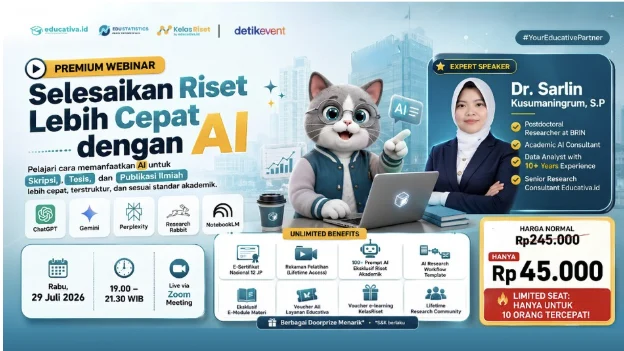
To mitigate the risks associated with AI-driven research, a strategic educational initiative has been launched. A comprehensive webinar, specifically designed for university students and researchers, aims to demystify the technology and provide a "safety-first" framework for academic writing.
The session will focus on the practical application of tools such as:
- ChatGPT & Gemini: Mastering prompt engineering to avoid bias and hallucination.
- Perplexity: Utilizing AI as a citation-verified search tool.
- Research Rabbit & NotebookLM: Leveraging advanced tools for mapping literature and synthesizing large datasets.
What Participants Will Learn
The curriculum is designed to move students beyond basic prompting. Key modules include:
- Verification Protocols: Techniques to cross-reference every AI-generated claim against legitimate academic databases (e.g., Scopus, Google Scholar).
- Advanced Prompt Engineering: Moving from "Give me an essay on X" to "Act as a research assistant, analyze these documents, and identify the research gap in Y."
- Workflow Optimization: Integrating AI into the research lifecycle—from the first literature review to the final citation map—without losing the "human touch" required for original academic inquiry.
Implications for Academic Integrity
The implications of this shift are profound. If universities fail to teach students how to use AI responsibly, they risk graduating a generation of researchers who are technically proficient but theoretically shallow. Conversely, those who master the ethical use of AI will possess a significant competitive advantage.
Academic integrity is no longer just about avoiding plagiarism; it is about "intellectual provenance"—the ability to track and verify the origin of every piece of data in a thesis. The use of AI, if managed correctly, can actually lead to higher quality research by allowing students to spend less time on formatting and data cleaning, and more time on the deep, qualitative analysis that AI cannot replicate.
Event Details: Investing in Research Excellence
For students who recognize that their thesis is too important to leave to the unpredictability of a chatbot, this webinar serves as a necessary intervention.
- Date: Wednesday, July 29, 2026
- Time: 19:00 – 21:30 WIB
- Format: Online via Zoom
- Early Bird Enrollment: Rp45,000 (Available until July 28, 2026, at 23:30 WIB)
In an era where "garbage in, garbage out" has become the mantra of the digital age, learning the nuances of AI research is an investment in one’s academic future. As the competition for academic and professional recognition intensifies, those who can demonstrate both technological fluency and rigorous ethical standards will inevitably stand out.
Registration: Students and researchers are encouraged to secure their spot early to ensure they are equipped with the skills necessary to navigate the complexities of modern academia. Registration is currently open at detikevent.
Conclusion: The Future of Research is Collaborative
AI is not a substitute for the human mind; it is an amplifier. Just as the invention of the calculator did not eliminate the need for mathematicians, the rise of AI will not eliminate the need for researchers. However, it will eliminate those who refuse to adapt.
By shifting the narrative from "AI as a threat" to "AI as a tool," students can regain control over their research process. The goal is to produce work that is not only faster to write but more rigorous, better cited, and truly original. In the end, the value of a degree is not found in the final document itself, but in the critical thinking skills developed during the process of creating it—skills that AI can assist, but never replace.