The Long-Nosed Guardian of the Borneo Wetlands: Understanding the Bekantan
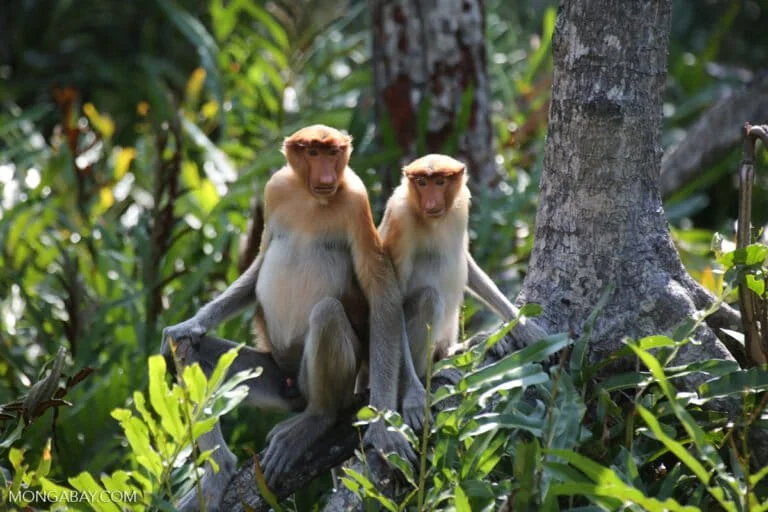
In the dense, emerald labyrinth of Borneo’s mangrove forests and peat swamps, one creature stands out not only for its peculiar silhouette but for its critical role in the island’s ecological tapestry. The Bekantan (Nasalis larvatus), known globally as the Proboscis monkey, is an iconic primate endemic to the island of Borneo. Renowned for its oversized, pendulous nose and distinctive social structure, the Bekantan is more than a biological curiosity—it is a barometer for the health of Indonesia’s coastal ecosystems. However, as human encroachment accelerates, this "Dutch Monkey" finds its future increasingly hanging by a thread.
I. Main Facts: Anatomy of an Icon
The Bekantan is a masterpiece of evolutionary adaptation. Scientifically classified as Nasalis larvatus, the species is immediately recognizable by the male’s bulbous, elongated nose, which can grow to over 10 centimeters in length.
The "Dutch Monkey" Moniker
The popular local nickname, "Monyet Belanda" (Dutch Monkey), originated during the colonial era. Local populations observed that the physical traits of the male Bekantan—specifically their oversized, reddish noses and potbellies—bore a striking, satirical resemblance to the Dutch colonial administrators of the 17th and 18th centuries. While the name is a cultural artifact, it persists as a testament to the primate’s deeply ingrained presence in the folklore of Kalimantan.
Specialized Physiology
The Bekantan’s anatomy is uniquely suited to its riparian lifestyle. Beyond the nose, which serves as a sexual ornament and a sound amplifier for mating calls, the primate possesses a specialized, multi-chambered stomach. This "ruminant-like" digestive system allows the Bekantan to ferment tough, fibrous leaves and plant materials that would be indigestible to many other primates.
Their physical build is equally remarkable. Males are significantly larger than females, often displaying a reddish-brown dorsal coat contrasted against a cream-colored underbelly and limbs. Furthermore, their fingers and toes are equipped with partial webbing, transforming these arboreal creatures into surprisingly adept swimmers. They are known to leap from towering trees directly into river currents, navigating the waterways of Borneo with surprising grace.
II. Chronology: A History of Habitat Fragmentation
The history of the Bekantan is inextricably linked to the history of Borneo’s land-use patterns.
- Pre-Colonial Era: Historically, the Bekantan flourished throughout the vast mangrove forests and riverine systems of Borneo, living in stable, cohesive social groups. Their range was vast, undisturbed by large-scale industrialization.
- 19th and 20th Century Expansion: As colonial resource extraction began, the first ripples of habitat loss appeared. However, the most severe pressure began in the late 20th century, as industrial logging and the rapid expansion of palm oil plantations began to carve through the mangrove fringes.
- The 21st Century Crisis: Over the past two decades, the acceleration of deforestation and illegal mining has fragmented the Bekantan’s territory. Recent observational data has recorded a behavioral shift: populations previously strictly arboreal are increasingly descending to the forest floor, crossing open palm oil plantations and abandoned mining sites to find fragmented food sources.
- Current Status: Today, the species is classified as Endangered on the IUCN Red List. With each passing year, the proximity of the Bekantan to human-dominated landscapes increases, leading to a rise in human-wildlife conflict and higher predation rates from opportunistic hunters and natural predators alike.
III. Supporting Data: The Biological and Ecological Cost
Research into the behavior of Nasalis larvatus reveals a delicate social structure currently under immense stress.
Social Dynamics
Bekantans live in complex, tiered societies. Typically, these groups consist of a "harem"—one dominant male accompanied by several females and their offspring. Additionally, there are "bachelor groups" comprised solely of adult males. Their activity patterns are highly synchronized with the canopy, where they spend the majority of their time.
The Terrestrial Shift
The most alarming data point in recent years is the shift toward terrestrial living. When forests are fragmented, Bekantans are forced to travel across open ground. This exposes them to ground-based predators such as clouded leopards, pythons, and wild cats. Furthermore, the lack of canopy cover reduces their ability to forage for their preferred diet of leaves, fruits, and seeds, forcing them into lower-nutrient agricultural areas.
Population Estimates
While precise counting is difficult due to the dense nature of their habitat, conservationists estimate that the population has declined by more than 50% over the last 30 to 40 years. The reliance on specific mangrove and riparian corridors means that if these corridors are blocked by infrastructure, entire groups can become isolated, leading to genetic bottlenecks.
IV. Official Responses and Conservation Efforts
The government of Indonesia and various non-governmental organizations (NGOs) have categorized the Bekantan as a fully protected species under national law.
Protection and Policy
Under the Indonesian Wildlife Protection Act, it is illegal to kill, capture, or trade in Bekantans. Efforts are currently being channeled into:
- Corridor Restoration: Creating "wildlife bridges" and replanting mangrove corridors to reconnect fragmented patches of forest.
- Monitoring Programs: Utilizing camera traps and drone technology to track population movements and identify "hotspots" where human-wildlife conflict is highest.
- Community Engagement: Programs aimed at educating local communities on the importance of the Bekantan to the health of the river systems, which provide essential ecosystem services like water filtration and erosion control.
Academic and Conservation Perspectives
Conservationists argue that policy alone is insufficient. Dr. Rhett A. Butler, a prominent voice in tropical conservation, notes that the Bekantan is a "flagship species." Protecting the Bekantan is not just about saving one monkey; it is about preserving the entire mangrove-peatland complex. If the Bekantan survives, it implies that the water quality, the fisheries, and the carbon storage capacity of the Borneo wetlands remain intact.
V. Implications: Why the Future of the Bekantan Matters
The plight of the Bekantan is a mirror reflecting the broader environmental health of Indonesia. The implications of their continued decline are profound.
Ecological Domino Effect
As a primary consumer of leaves and fruits, the Bekantan plays a vital role in seed dispersal and nutrient cycling within the riparian forest. Their absence would lead to a shift in plant composition, potentially reducing the resilience of the mangroves against rising sea levels and erosion.
The Human Connection
The Bekantan is not merely a biological specimen; it is an economic and cultural asset. As ecotourism grows in Kalimantan, the Bekantan has the potential to provide sustainable livelihoods for local communities who act as stewards of the forest. If the species vanishes, a unique piece of Indonesian identity vanishes with it, and a potential sustainable revenue stream for the local economy is lost forever.
A Call for Integrated Management
The future of the Bekantan requires an integrated approach to land-use planning. This means:
- Enforcing Protected Areas: Moving beyond "paper parks" to active, on-the-ground enforcement against illegal encroachment in protected mangroves.
- Sustainable Agriculture: Requiring palm oil and industrial plantation operators to maintain high-conservation-value (HCV) areas and riparian buffer zones.
- Climate Adaptation: Recognizing that as sea levels rise, the mangrove forests—the Bekantan’s primary home—must be allowed to migrate inland. If urban or industrial development blocks this migration, the habitat will be squeezed out of existence.
Conclusion
The Bekantan, with its comical nose and solemn, human-like gaze, remains one of the most enigmatic residents of Borneo. Its transition from a creature of the high canopy to a traveler of the forest floor is a poignant warning of a habitat in retreat. Protecting this primate is a complex task that pits the immediate needs of economic development against the long-term imperative of ecological survival.
Yet, the survival of the Bekantan is non-negotiable. To lose this species would be to admit defeat in the effort to preserve the ancient, water-logged heart of Borneo. As the sun sets over the Kalimantan rivers, the silhouettes of the Bekantans in the treetops serve as a reminder: we are not just guarding a monkey, we are guarding the very lungs and filters of the Indonesian landscape. The time to ensure their survival is not when they become a memory, but now, while they still leap through the branches of the world’s most vital wetlands.