Strengthening Strategic Ties: King Abdullah II of Jordan’s State Visit to Indonesia
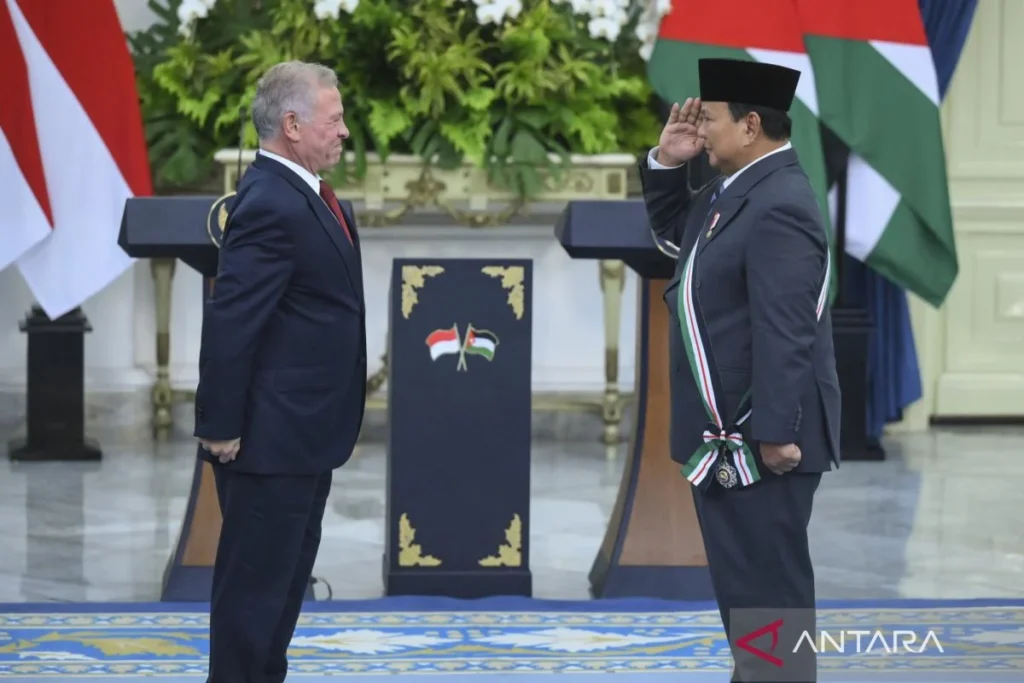
JAKARTA – In a significant move to bolster bilateral relations and economic cooperation, King Abdullah II of Jordan arrived in Jakarta this Friday for a high-level state visit. The arrival of the Hashemite monarch underscores the deepening diplomatic bridge between the Middle East and Southeast Asia, focusing on strategic partnerships that transcend mere formality.
The visit marks a pivotal moment in the administration of President Prabowo Subianto, as the two leaders—who share a long-standing personal bond rooted in their military backgrounds—seek to translate their camaraderie into tangible economic and political outcomes for their respective nations.
The Core Agenda: Diplomatic and Economic Synergy
King Abdullah II’s schedule in Jakarta is packed with high-level engagements designed to solidify ties. Central to the visit is a bilateral meeting with President Prabowo Subianto at the Presidential Palace. The meeting is expected to cover a wide spectrum of issues, including regional stability in the Middle East, humanitarian efforts, and, crucially, economic collaboration.
Beyond the formal tête-à-tête, the King is slated to meet with representatives from Danantara Indonesia (Daya Anagata Nusantara). This meeting is of particular interest to market observers, as discussions are heavily focused on critical resource partnerships, most notably the supply and processing of phosphates—a vital component for Indonesia’s agricultural and industrial sectors.
Following these discussions, the two leaders are scheduled to witness the signing of several memoranda of understanding (MoUs). These documents are expected to lay the groundwork for long-term cooperation in trade, investment, and perhaps defense technology, marking a new chapter in the Indonesia-Jordan relationship.
A Historical Alliance: The "Brothers-in-Arms" Connection
The relationship between President Prabowo Subianto and King Abdullah II is not merely one of state protocol; it is a deep-seated personal friendship that spans decades. The bond was forged in the crucible of military training. Both men are alumni of the prestigious United States Army Infantry School at Fort Benning, Georgia.
Their shared experiences as career military officers provide a unique layer of mutual understanding. This connection was publicly highlighted when President Prabowo visited Amman on April 14, 2025. During that visit, the two held an intimate, private discussion at the Al Husseiniya Palace, reflecting a level of trust and candidness rarely seen in standard diplomatic discourse. Analysts suggest that this personal rapport acts as a catalyst for swift decision-making between the two governments, bypassing the usual bureaucratic inertia.
Chronology of Engagement
The current state visit is part of a wider diplomatic tour by the Jordanian monarch, who has been engaging with key Asian powers including Japan, Vietnam, Singapore, and Pakistan. This tour signals Jordan’s "Look East" policy, seeking to diversify its economic partnerships beyond traditional Western spheres of influence.
- April 14, 2025: President Prabowo Subianto makes an official visit to Jordan, meeting King Abdullah II at Al Husseiniya Palace to discuss regional security and economic synergy.
- May 2025: King Abdullah II conducts a regional tour of Asia to foster deeper ties with emerging economies.
- Friday, Current Date: King Abdullah II arrives in Jakarta for a state visit, focusing on Danantara Indonesia partnerships and bilateral MoUs.
Profile: King Abdullah II, a Modern Monarch
Born in Amman on January 30, 1962, to King Hussein bin Talal and Princess Muna Al Hussein, King Abdullah II occupies a unique position in the global political landscape. As a direct descendant of the Prophet Muhammad (41st generation), his authority carries immense moral and religious weight in the Muslim world.
Educational Foundation
The King’s educational journey was truly global:
- Early Education: Islamic Educational College, Amman.
- Formative Years: St. Edmund’s School, Surrey, England, followed by Deerfield Academy, USA.
- Military and Higher Education: Royal Military Academy Sandhurst (1980); Pembroke College, University of Oxford (1982); and Georgetown University (1987-1989).
Military Career
Before ascending the throne, the King had a distinguished military career. He served in the Royal Jordanian Army from 1981 to 1993 and rose to become the Commander of the Special Forces (1994–1999). His hands-on experience in military strategy, combined with his status as a qualified pilot and expert parachutist, defines his disciplined approach to governance.
Personal Life
King Abdullah II married Queen Rania Al Abdullah on June 10, 1993. The couple has four children: Crown Prince Hussein, Prince Hashem, Princess Iman, and Princess Salma. Outside of his royal duties, the King is known for his diverse interests, including high-speed car racing, scuba diving, and the preservation of antique weaponry.
Strategic Implications: Why This Visit Matters
The visit of King Abdullah II to Indonesia is not just a symbolic gesture. Several strategic implications arise from this meeting:
1. Resource Security and Danantara Indonesia
The focus on phosphates is critical. As Indonesia seeks to optimize its domestic fertilizer production to support food sovereignty, Jordan—one of the world’s leading phosphate exporters—becomes a natural and vital partner. The engagement with Danantara Indonesia suggests that the Indonesian government is looking to secure a stable, long-term supply chain that bypasses volatile global market fluctuations.
2. Regional Stability and Humanitarian Diplomacy
Both Indonesia and Jordan play pivotal roles in their respective regions regarding humanitarian issues. With the ongoing instability in the Middle East, Indonesia—the world’s largest Muslim-majority democracy—seeks to align its foreign policy with Jordan, a stabilizing force in the Levant. Their joint stance on humanitarian aid and peacebuilding efforts is expected to carry significant weight on the international stage.
3. Economic Diversification
For Indonesia, the visit is a chance to court Middle Eastern investment in infrastructure, digital economy, and renewable energy. For Jordan, Indonesia represents a massive, growing market of over 280 million people, offering a gateway into the ASEAN region.
Official Responses and Public Sentiment
The Indonesian Ministry of Foreign Affairs has expressed optimism regarding the visit. In recent briefings, officials noted that the visit is a "natural progression of the growing warmth between the two nations." The Foreign Minister highlighted that the collaboration with Danantara is a flagship initiative, aimed at ensuring that bilateral trade is not just about imports and exports, but about long-term industrial integration.
King Abdullah II has previously praised President Prabowo’s vision for Indonesia, noting that the new administration is steering the country in a "very positive direction." This public endorsement from a leader as respected as the King serves to boost investor confidence in Indonesia’s current economic trajectory.
Conclusion: A Future-Oriented Partnership
The state visit of King Abdullah II to Jakarta serves as a testament to the power of personal diplomacy combined with clear national interest. By leveraging their shared histories and aligned visions for a stable, prosperous future, President Prabowo and King Abdullah II are effectively elevating the Indonesia-Jordan relationship to a strategic partnership.
As the MoUs are signed and the discussions regarding phosphates and investment transition into actionable projects, the world will be watching. For Indonesia, this is a clear signal that the nation is actively diversifying its strategic alliances, moving beyond traditional partners to engage with key global players who share a commitment to sovereignty, security, and economic growth.
The visit concludes with a sense of renewed vigor. Both nations, separated by geography but united by shared values and common goals, stand at the threshold of a new era of cooperation. As the King departs Jakarta, the legacy of this visit will likely be defined by the concrete progress made in the halls of Danantara and the strengthened resolve of two leaders who understand that in a complex global landscape, true strength lies in the depth of one’s alliances.
Copyright © 2025 ANTARA. All rights reserved. This article is for informational purposes only. Unauthorized reproduction, crawling, or automated indexing for AI purposes is strictly prohibited.