Siloam International Hospitals Spearheads Healthcare Transformation in Indonesia Through Artificial Intelligence and Advanced Robotics
JAKARTA — In a bold strategic move to redefine the landscape of national healthcare, PT Siloam International Hospitals Tbk is accelerating its digital transformation by heavily integrating Artificial Intelligence (AI) and robotic-assisted solutions into its operational and medical ecosystems. Amid systemic challenges such as a nationwide shortage of medical specialists, escalating healthcare delivery costs, and fierce competition from neighboring medical hubs, Siloam is betting on a high-tech "leapfrog" strategy to elevate Indonesian healthcare to world-class standards.
The initiative represents a pivotal turning point for Indonesia’s largest private hospital network. By harnessing cutting-edge data architectures and intelligent clinical decision-support systems, Siloam aims not only to optimize hospital workflows and clinical accuracy but also to stanch the massive outflow of capital caused by Indonesian medical tourism abroad.
Main Facts
The core of Siloam’s digital modernization centers around the establishment of its proprietary Enterprise AI Foundation, a centralized data integration infrastructure scheduled for full deployment by November 2026. This foundational architecture underpins three core pillars of application: Patient Digital Twin, Doctor Digital Twin, and Hospital Digital Twin.
According to company leadership, this multi-tiered technological framework is designed to address chronic structural deficits in Indonesia’s healthcare sector:
- Addressing Specialist Shortages: By standardizing clinical practices and augmenting human capabilities via AI, Siloam aims to bridge the gap caused by a low doctor-to-patient ratio and the uneven geographic distribution of medical specialists across the archipelago.
- Capital Retention: The initiative directly targets the estimated Rp 170 trillion ($10+ billion USD) that Indonesian citizens spend annually on medical treatments overseas, a phenomenon driven largely by gaps in domestic trust and perceived service quality.
- Operational Efficiency: Through the Hospital Digital Twin pillar, administrative friction—ranging from nurse rostering and inventory management to predictive equipment maintenance—will be automated, driving down overhead costs and curbing healthcare inflation.
Crucially, Siloam has emphasized that these technologies are designed to act as force multipliers for human medical professionals, rather than replacements. The physician remains firmly at the center of clinical governance, utilizing AI insights to make faster, more accurate diagnoses and treatment plans.
Chronology of Technological Evolution
Siloam’s journey toward becoming a "hospital of the future" did not happen overnight. It is the result of a deliberate, multi-year infrastructural buildup designed to transition legacy medical systems into an agile, cloud-enabled digital environment.
- 2024–2025: Centralization and Cloud Migration: Recognizing that AI is only as good as the data feeding it, Siloam spent the preceding two years centralizing its vast troves of patient data. A major milestone during this phase was the complete centralization of Magnetic Resonance Imaging (MRI) data management, coupled with a transition to enterprise-grade cloud storage solutions. This allowed disparate hospitals within the network to securely share and analyze diagnostic data in real time.
- Early 2026: The Inception of Enterprise AI Foundation: Moving past basic data storage, Siloam officially kicked off the development of its Enterprise AI Foundation in early 2026. This phase focused heavily on data structuring, establishing data governance protocols, and cleaning legacy hospital records to ensure compliance, security, and interoperability across all branches.
- November 2026 (Projected Completion): Finalization of the AI Backbone: Siloam’s leadership has set a hard target of November 2026 to complete the foundational AI architecture. Once finalized, this platform will serve as the launchpad for deploying the three specialized "Digital Twin" pillars across the network’s 41 hospitals.
- Beyond 2026: Scaling the Hospital of the Future: With the foundational pillars operational, the subsequent phases involve deep clinical integration, the refinement of predictive models, and the expanded deployment of robotic process automation and physical robotics to streamline logistics and patient care pathways.
Supporting Data and Economic Realities
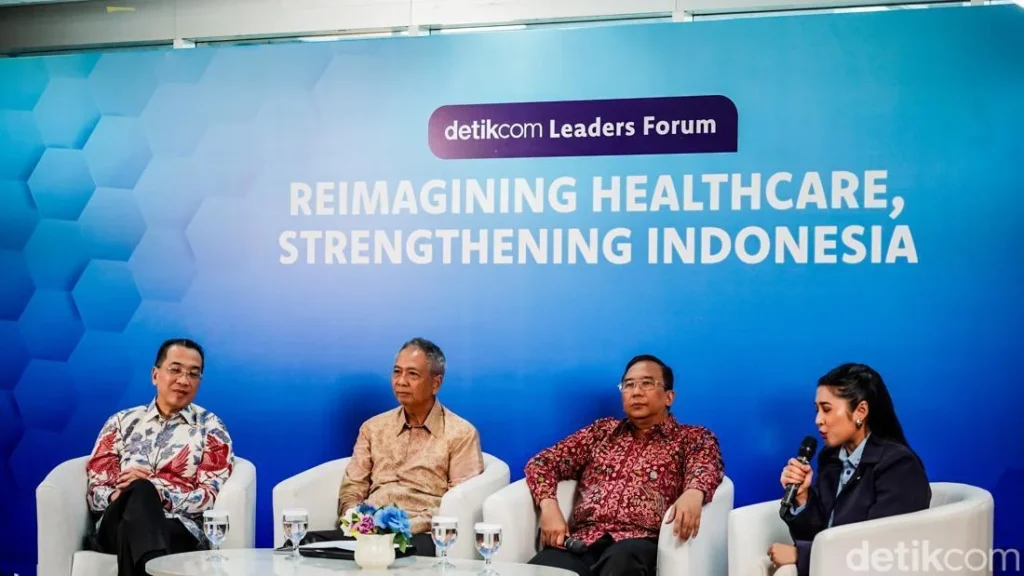
The urgency behind Siloam’s digital overhaul is underscored by stark economic and demographic data. Speaking at the detikcom Leaders Forum on Tuesday, October 27, 2026, President Director of Siloam International Hospitals, David Utama, laid bare the economic leakages plaguing Indonesia’s healthcare sector.
+------------------------------------------------------------------------+
|                      KEY HEALTHCARE METRICS & TARGETS                  |
+-----------------------------------+------------------------------------+
| Annual Indonesian Medical Tourism | ~ Rp 170 Trillion                  |
+-----------------------------------+------------------------------------+
| Siloam Hospital Network Scale     | 41 Hospitals Nationwide            |
+-----------------------------------+------------------------------------+
| Enterprise AI Foundation Target   | Completion by November 2026        |
+-----------------------------------+------------------------------------+
| Core AI Architecture Pillars      | 1. Patient Digital Twin            |
|                                   | 2. Doctor Digital Twin             |
|                                   | 3. Hospital Digital Twin           |
+-----------------------------------+------------------------------------+
“If we do not adapt, we will fall behind our neighboring countries,” David stated during the forum. “Indonesian citizens spend roughly Rp 170 trillion annually to seek medical treatment abroad. This is an enormous figure.”
This massive outflow of capital is not merely a reflection of affluent citizens seeking luxury care; it highlights structural deficits in domestic confidence, diagnostic speed, and patient-experience consistency. In a country spanning thousands of islands, ensuring that a patient in a tier-two city receives the same standard of diagnostic rigor as someone in Jakarta is an immense logistical challenge—one that traditional expansion models cannot solve quickly enough.
By leveraging cloud computing, standardized data pipelines, and AI processing, Siloam can theoretically scale clinical excellence horizontally across its 41-hospital footprint without needing to physically relocate scarce medical specialists to every corner of the archipelago.
Official Responses and Strategic Vision
Detailing the architecture of the company’s digital transformation, David Utama elaborated on the tripartite framework that forms the backbone of Siloam’s strategy. Rather than purchasing off-the-shelf, generic wellness apps, Siloam chose to build custom infrastructure tailored specifically to the unique operational realities of the Indonesian healthcare market.
1. The Patient Digital Twin
The first pillar focuses on reimagining the patient journey. Designed as an integrated digital ecosystem tailored exclusively for Siloam’s network, this pillar bridges the gap between outpatient care, remote monitoring, and post-operative recovery. It provides patients with personalized health trajectories, predictive wellness alerts, and seamless access to medical records, drastically reducing administrative friction during hospital visits.
2. The Doctor Digital Twin
Perhaps the most ambitious and complex component of the strategy is the Doctor Digital Twin. David acknowledged that this pillar represents the greatest challenge, as it requires active collaboration and knowledge-sharing from medical practitioners across a wide array of specialized fields.
The primary objective here is the establishment of standardized, high-quality medical pathways. By encoding best practices, clinical guidelines, and diagnostic heuristics into the AI system, Siloam can ensure that diagnostic accuracy and treatment protocols remain consistently elite, regardless of which facility a patient visits within the 41-hospital network.
3. The Hospital Digital Twin
The third pillar addresses the business-to-business and operational mechanics of running a massive healthcare network. The Hospital Digital Twin oversees enterprise resource planning at an unprecedented scale. It automates complex workforce rostering, clinical scheduling, inventory forecasting for pharmaceuticals and surgical supplies, and real-time operational monitoring. By streamlining these back-end processes, the system minimizes waste, reduces wait times, and maximizes the productivity of medical assets.
“We believe to leapfrog, we need to build through technology,” David emphasized. “But the role of the doctor is paramount—they are not replaced; rather, the doctor remains in control. Because if we do not build the hospital of the future, in my view, we will simply not be able to compete with our neighboring nations.”
Industry Implications and Future Outlook
Siloam International Hospitals’ aggressive push toward AI and robotics marks a watershed moment for the Indonesian healthcare industry. The implications of this transformation extend far beyond corporate balance sheets, potentially shifting national health paradigms.
Elevating Domestic Trust
By closing the gap in diagnostic precision, operational transparency, and patient experience, initiatives like the Enterprise AI Foundation directly target the root causes of medical tourism. If domestic institutions can provide diagnoses and treatments that match—or exceed—the speed and accuracy of hospitals in Singapore, Malaysia, or Thailand, a significant portion of the Rp 170 trillion capital drain could be retained within the domestic economy.
Setting a New Benchmark for Regional Competitiveness
As Southeast Asia transitions into an integrated digital economy, healthcare is increasingly becoming a borderless competitive arena. Hospitals in neighboring countries have already begun adopting advanced informatics. By implementing a "hospital of the future" blueprint, Siloam is positioning Indonesian healthcare not as a follower, but as a proactive innovator capable of leveraging technology to overcome historic geographic and demographic hurdles.
Ethical and Human-Centric Integration
A recurring theme in Siloam’s rollout is the reaffirmation of human agency in medicine. By framing AI and robotics strictly as augmentation tools—assisting with data crunching, pattern recognition in imaging, and administrative burdens—Siloam is proactively addressing the ethical anxieties often associated with automation in healthcare. Doctors are freed from tedious administrative loops, allowing them to dedicate more cognitive bandwidth and empathetic engagement to direct patient care.
As the November 2026 deadline for the Enterprise AI Foundation approaches, all eyes will be on Siloam International Hospitals. If successful, this comprehensive technological leap could serve as the definitive blueprint for modernizing healthcare across developing markets worldwide, proving that artificial intelligence, when paired with strategic vision, can successfully cure deep-seated systemic challenges.