Comprehensive Overview: Navigating the New Retirement Age Framework for the Indonesian National Police (Polri) Under UU No. 5 of 2026
Jakarta — The legal framework governing the service tenure of members of the Indonesian National Police (Polri) has undergone a significant structural evolution. Following the official promulgation of Law Number 5 of 2026—which represents the third amendment to Law Number 2 of 2002 regarding the Indonesian National Police—the mandatory retirement age (Batas Usia Pensiun/BUP) for active-duty personnel has been officially revised.
Taking effect on June 17, 2026, this legislative reform establishes a differentiated retirement age structure based on rank classifications. While the adjustments aim to optimize institutional experience and human resource management within the police force, they have concurrently sparked widespread public debate, transitional administrative adjustments, and ongoing legal scrutiny at the Constitutional Court.
1. Main Facts and Legislative Framework
The core mandate of Law No. 5 of 2026 fundamentally alters how long personnel can serve in uniform. Under the legacy framework of Law No. 2 of 2002, the general retirement age for members of the Indonesian National Police was uniformly capped at 58 years, with minimal flexibility for specialized exceptions.
Under the newly enforced legislation, specifically Article 30, Paragraph (5), the retirement threshold is categorized distinctly by rank tiers:
- Tamtama and Bintara (Enlisted and Non-Commissioned Officers): The maximum retirement age is set at 59 years.
- Perwira Pertama (First-Tier Officers – Lieutenants to Captains): The maximum retirement age is set at 60 years.
- Perwira Menengah (Mid-Tier Officers – Majors to Colonels): The maximum retirement age is set at 60 years.
- Perwira Tinggi (High-Tier Officers – General Officers/Flag Officers): The maximum retirement age is set at 60 years.
Special Provisions for Four-Star Generals and Specialists
A notable nuance within the new law addresses top-tier leadership and critical operational skill sets. For High-Tier Officers holding the rank of four-star general (General of Police), the standard retirement age is 60 years. However, this threshold is subject to a potential one-year extension, granted strictly based on strategic institutional needs and formalized through a Presidential Decree (Keputusan Presiden). Policymakers emphasize that this extension is not an automatic entitlement for every retiring four-star official, but rather an exceptional measure tied to national security priorities.
Furthermore, Article 30, Paragraph (7) introduces provisions for active-duty personnel possessing specialized or highly critical technical skills that are urgently needed by the police organization. These individuals may also have their service terms extended by a maximum of one year, subject to a formal proposal by the Chief of the Indonesian National Police (Kapolri) or through regulatory mandates enacted by presidential decree.
Additionally, functional position holders (jabatan fungsional) are exempt from the standard rank-based caps outlined in Paragraph (5). Their retirement ages align instead with the specific statutory regulations governing functional careers across the Indonesian civil and state apparatus.
2. Chronology of the Legislative Process and Legal Challenges
The path from a legislative proposal to an enacted statute, and subsequently to a constitutional challenge, spans several key milestones:
- Late 2025 – Early 2026: Parliamentary discussions intensify within the House of Representatives (DPR RI) regarding the modernization of law enforcement personnel laws, focusing on institutional continuity, talent retention, and operational readiness.
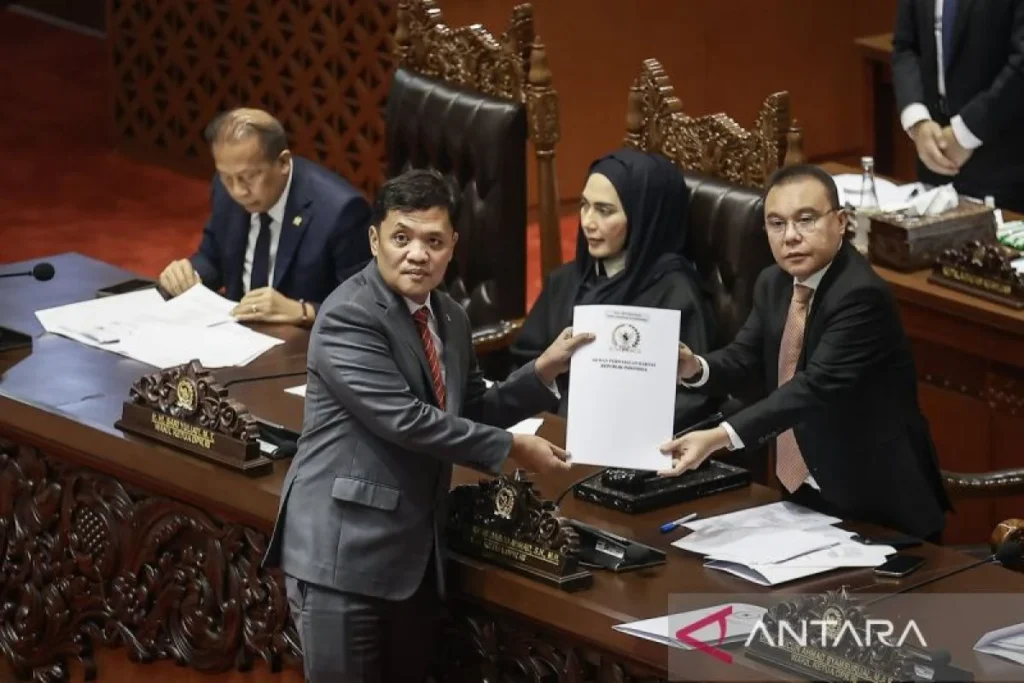
- Early 2026: The DPR plenary session formally approves the Bill on the Third Amendment of the Polri Law, greenlighting its transition into state law. Government representatives, including the Ministry of Law and Human Rights (Kemenkum), robustly defend the legality and procedural compliance of the drafting process against early criticisms.
- June 17, 2026: Law Number 5 of 2026 officially comes into force, immediately shifting the mandatory retirement age thresholds for thousands of active-duty police personnel nationwide.
- October 7, 2026: The Constitutional Court (Mahkamah Konstitusi / MK) convenes its inaugural hearing for Case Number 362/PUU-XXIV/2026. Petitioners formally challenge Article 30, Paragraph (5) and the transitional provisions of the new law, arguing that the differentiated retirement age based on rank is discriminatory and advocating for a unified retirement cap of 58 years. During the session, the judicial panel provides formal guidance on petition revisions and grants the applicants a strict 14-working-day window to perfect their legal documentation.
As the judicial review remains in the preliminary examination phase, UU No. 5 of 2026 remains fully binding and legally enforceable, and no judicial ruling has yet altered its provisions.
3. Supporting Data and Transitional Provisions
Managing the immediate shift in personnel pipelines required the inclusion of meticulous transitional rules within the legislation. When the law took effect on June 17, 2026, hundreds of officers were actively approaching or standing at the doorstep of the traditional retirement age of 58.
To prevent institutional disruption and abrupt career terminations, the law establishes clear baseline rules for those caught in the transition:
- Personnel Aged 56 at Promulgation: Officers who had already attained 56 years of age at the time the law came into effect are integrated directly into the new age structure, allowing them continued service up to their respective rank-based ceilings.
- Personnel Aged 57 at Promulgation: Officers aged 57 at the time of implementation are granted explicit extensions to their service duration, allowing them to continue active duty up to the age of 59.
- Personnel Turning 58 in 2026: Officers scheduled to hit the legacy retirement age of 58 within calendar year 2026 are accommodated via the transitional articles, making them eligible for service extensions up to age 59 depending on their rank and evaluation.
These mechanics are designed to smooth the demographic curve within the internal police hierarchy, preventing sudden blockages in promotion pipelines while retaining seasoned leadership during critical operational windows.
4. Official Responses and Institutional Justifications
The introduction of Law No. 5 of 2026 has drawn rigorous scrutiny from lawmakers, executive branches, and civil society actors.
The Government and DPR Defense
Defending the legislation, representatives from the Ministry of Law and Human Rights (Wamenkum) alongside legislative leaders have consistently maintained that the drafting and ratification of the Polri Law fully complied with statutory legislative procedures. Officials argue that modernizing law enforcement requires a higher accumulation of institutional knowledge, leadership maturity, and technical specialization. By allowing senior officers and specialists to serve until age 60, the state maximizes its investment in professional training, particularly for high-level counter-terrorism, cyber-security, and complex criminal investigation units.
Civil Society and Legal Challenges at the MK
Conversely, critics and legal petitioners contesting the law at the Constitutional Court express concern over potential stagnation in the promotion pathways for junior and mid-level officers. The core argument brought before Case Number 362/PUU-XXIV/2026 centers on the principle of legal equality. Petitioners contend that differentiating retirement ages by rank creates systemic advantages for higher-ranking personnel while compressing career progression opportunities for younger officers. They advocate for a flat retirement cap, arguing that 58 years remains an optimal benchmark to maintain structural mobility and operational dynamism within the force.
5. Strategic Implications for the Indonesian National Police
The long-term repercussions of UU No. 5 of 2026 will reverberate across multiple facets of Indonesia’s internal security architecture:
1. Human Resource Dynamics and Promotion Flow
The extension of service tenure for Bintara, Tamtama, and Officers up to age 60 inherently alters the timeline for upward mobility. While it retains experienced personnel in key positions, it requires the National Police Headquarters (Mabes Polri) to carefully calibrate recruitment quotas and promotion boards to ensure that incoming cohorts of young graduates from the Police Academy (Akpol) and police training schools face reasonable career advancement trajectories.
2. Operational Stability and Specialized Expertise
In an era marked by sophisticated transnational crimes, digital financial fraud, and complex public security demands, retaining specialized talent is paramount. The provisions allowing extensions for technical experts and high-ranking commanders provide Polri with the institutional flexibility needed to safeguard ongoing operations, intelligence networks, and strategic administrative transitions without sudden leadership vacuums.
3. Judicial Oversight and Future Legal Precedent
The ongoing proceedings at the Constitutional Court represent a critical check on legislative power regarding state apparatus management. Regardless of the final verdict, the MK’s eventual ruling on Case Number 362/PUU-XXIV/2026 will establish a major constitutional benchmark concerning the balance between institutional utility and career equality within Indonesian uniformed services. Until such a ruling is handed down, Polri leadership, active personnel, and administrative divisions must strictly navigate their operational planning under the parameters set forth by Law Number 5 of 2026.