Severe Rear-End Collision Sparks Intense Safety Debate as Dongfeng-Huawei Backed Epicland X9 REEV Catches Fire in China
JAKARTA — The rapid global expansion of New Energy Vehicles (NEVs) has continually pushed the boundaries of automotive technology, bringing electrified platforms, advanced driver-assistance systems, and high-capacity battery packs into the consumer mainstream. However, alongside these technological leaps come heightened public scrutiny and rigorous safety evaluations, particularly concerning crash survivability and fire risks.
A recent high-velocity traffic accident in Taizhou, China, involving the newly launched Epicland X9 Range-Extended Electric Vehicle (REEV)—a premium smart SUV born from the high-profile strategic collaboration between automotive giant Dongfeng and tech conglomerate Huawei Qiankun—has thrust the industry back into the spotlight. The catastrophic collision, followed by a dramatic post-crash fire, instantly ignited online debates across global automotive forums regarding the structural integrity and thermal management systems of modern electrified vehicles.
Yet, as investigative reports and official corporate statements subsequently revealed, the incident offers a fascinating case study in modern vehicle safety engineering, challenging preconceived notions about battery-related fires in electrified transport.
1. Main Facts: The Taizhou Incident and the Epicland X9
The incident occurred on a bustling thoroughfare in Taizhou, China, capturing widespread attention due to the severity of the wreckage and the pedigree of the vehicle involved. The Epicland X9 REEV is a six-passenger, full-size luxury SUV that represents a milestone for its makers. Officially launched to the market just weeks prior on September 24, 2026, the vehicle is positioned as a flagship product of intelligent mobility, marrying Dongfeng’s decades of vehicle manufacturing prowess with Huawei Qiankun’s cutting-edge smart cabin and autonomous driving solutions.
As a Range-Extended Electric Vehicle (REEV), the Epicland X9 utilizes a dual-energy architecture. It features an internal combustion engine (ICE) that functions exclusively as an on-board generator to recharge the high-voltage battery pack, which in turn powers the electric motors driving the wheels. For the X9, this energy storage system relies on a Lithium Iron Phosphate (LFP) battery pack supplied by Contemporary Amperex Technology Co. Limited (CATL), a global leader in lithium-ion battery development known for its chemical stability.
The accident sequence began when the Epicland X9 was struck from behind by a heavily loaded dump truck traveling at a remarkably high rate of speed. The sheer momentum and mass differential between a fully laden commercial dump truck and a passenger SUV resulted in severe structural deformation, particularly concentrated at the rear quarter of the X9.
Despite the violence of the impact, which culminated in a post-collision fire, the incident ultimately underscored robust occupant protection protocols. Most importantly, all three passengers inside the vehicle escaped the harrowing ordeal completely uninjured, emerging as a testament to the vehicle’s structural load paths and emergency egress systems.
2. Chronology of Events: From Impact to Emergency Response
To understand how a routine traffic stop transformed into a high-stakes emergency, automotive safety analysts have reconstructed the timeline of the Taizhou collision based on eyewitness accounts, traffic camera footage, and preliminary investigative findings from local authorities and the manufacturer.
Phase One: The Stationary State and High-Speed Impact
Prior to the collision, the Epicland X9 was brought to a complete stop, obeying local traffic conditions. The vehicle was occupied by three individuals. Approaching from behind at a dangerously high velocity was a commercial dump truck, heavily laden with aggregate cargo. Due to a combination of potential factors currently under police investigation—ranging from driver fatigue to possible brake fade or distraction—the heavy truck failed to decelerate adequately.
Phase Two: The Catastrophic Rear-End Collision
The truck impacted the rear of the stationary Epicland X9 with immense force. In automotive engineering, rear-end collisions involving heavy commercial vehicles pose a severe threat to passenger safety due to the risk of underride, where a smaller vehicle slides beneath the higher frame of a truck. In this instance, the impact energy was violently transferred into the rear crumple zones and structural pillars of the X9, crushing the tailgate, rear cargo area, and encroaching upon the engine bay housing the range-extender’s internal combustion components.
Phase Three: Egress and Smoke Development
Remarkably, the immediate aftermath of the crash highlighted the efficacy of the vehicle’s structural engineering. As the dust settled and the three occupants processed the violent jolt, the automated electronic systems and mechanical latch releases functioned precisely as designed. The doors of the Epicland X9 remained fully operational, suffering no power loss or structural jamming that would trap the occupants. The three passengers swiftly unbuckled and evacuated the cabin, moving to a safe distance from the wreckage.
Phase Four: Thermal Event and Emergency Intervention
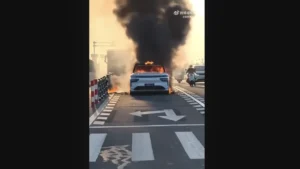
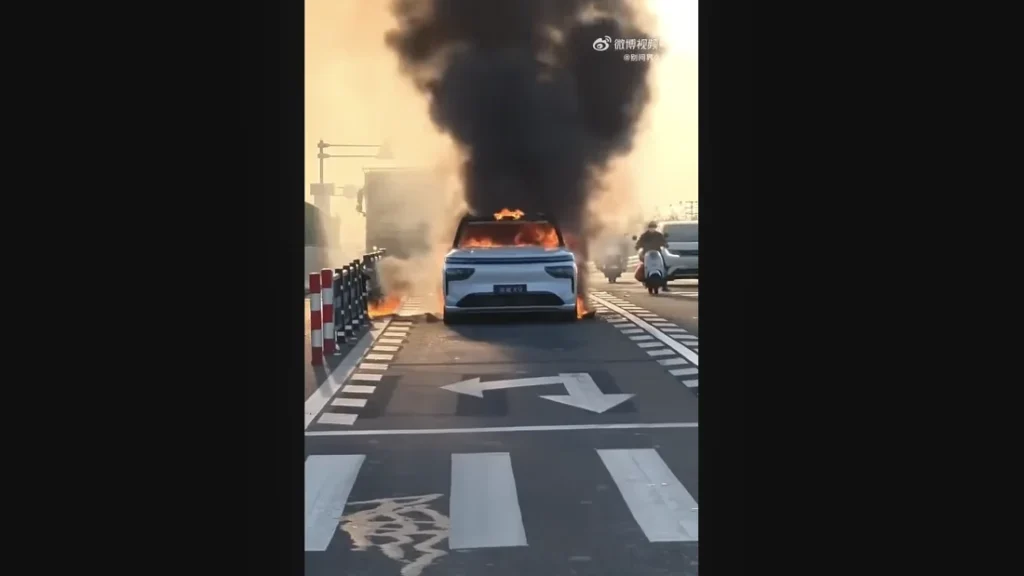
While waiting for local traffic police and emergency responders to arrive at the scene, the rear portion of the damaged SUV began to emit thick smoke. Within minutes, an open fire broke out at the rear of the vehicle. Emergency fire suppression units arrived shortly thereafter and deployed extinguishing agents, successfully containing and fully extinguishing the blaze before it could engulf the entire passenger compartment.
3. Supporting Data and Technical Analysis: The Battery Mystery
In the wake of any NEV fire, public and expert attention immediately zeroes in on the high-voltage energy storage system. Modern consumer bias often links electric vehicle fires inexorably with thermal runaway of lithium-ion batteries. However, the technical realities of the Epicland X9 incident defied these early assumptions.
The LFP Battery Advantage
The Epicland X9 utilizes an LFP (Lithium Iron Phosphate) chemistry battery pack sourced from CATL. LFP chemistry is widely celebrated within the engineering community for its superior thermal stability and resistance to thermal runaway compared to traditional Nickel Manganese Cobalt (NMC) chemistries. LFP cells have a higher decomposition temperature, meaning they require significantly more external heat or physical abuse to reach a state of uncontrolled exothermic reaction.
Post-Fire Inspection Findings
Following the extinguishment of the fire, engineers from Epicland, alongside independent forensic investigators, conducted a comprehensive disassembly and diagnostic scan of the X9’s wreckage. The findings were definitive:
- Structural Integrity of the Pack: The high-voltage LFP battery pack, despite absorbing a portion of the massive kinetic energy from the rear-end collision, remained structurally intact.
- Cell Stability: There was zero evidence of puncture, short-circuiting, or thermal runaway within the individual battery modules.
- Electrical Isolation: The vehicle’s high-voltage safety disconnects functioned instantaneously upon impact, isolating the battery pack from the rest of the electrical architecture and preventing electrical arcing.
Identifying the True Source of the Fire
With the battery officially cleared of fault, investigators turned their attention to the secondary systems housed within the REEV architecture. The root cause of the fire was traced not to the high-voltage electrical grid, but rather to the internal combustion engine (ICE) components—specifically, the vehicle’s high-pressure fuel delivery and management system.
When the heavy dump truck compressed the rear and mid-section of the vehicle, the sheer mechanical displacement ruptured fuel lines and damaged auxiliary engine peripherals near the range-extender generator. Residual heat from the operational cycle of the ICE, combined with pressurized fuel making contact with hot metallic surfaces or sparks from sheared wiring harnesses, ignited the gasoline fuel source. Thus, the fire was classified as a traditional fuel-fed engine bay fire, rather than a traction battery failure.
4. Official Responses and Corporate Transparency
In the fast-paced digital age where viral videos of vehicle fires can devastate a brand’s reputation overnight, corporate response strategy is critical. Epicland acted swiftly to control the narrative through verifiable data and transparent communication.
Statement from General Manager Zeng Qinglin
General Manager Epicland Zeng Qinglin issued a formal, detailed press statement addressing the Taizhou incident, prioritizing customer reassurance and analytical transparency.
"The safety of our passengers is always our absolute priority," Qinglin stated. "We are profoundly relieved and grateful that the three passengers inside the vehicle sustained zero injuries during what was undeniably a terrifying and high-impact collision. Thanks to our rigorous safety engineering, the vehicle’s doors functioned precisely as designed, allowing the occupants to immediately self-evacuate to a safe location before the fire developed."
Furthermore, Qinglin addressed the elephant in the room—the condition of the vehicle’s electrification hardware:
"Following comprehensive post-incident inspections conducted by our engineering teams and independent experts, we can confirm conclusively that the vehicle’s LFP battery pack remained completely intact. The fire originated from the internal combustion engine’s fuel system components due to extreme structural crushing from the rear impact, and was entirely unrelated to the high-voltage battery storage system."
Huawei and Dongfeng Synergy Under Scrutiny
The incident also placed the spotlight on Huawei Qiankun and Dongfeng, the powerhouse partners behind the Epicland brand. Analysts note that while Dongfeng brings decades of heavy manufacturing, crash-structure design, and vehicle assembly expertise, Huawei contributes the sophisticated digital brain—including smart battery management systems (BMS), real-time thermal monitoring, and intelligent crash-response protocols. The rapid isolation of the high-voltage system during the Taizhou crash is being cited by industry observers as proof that Huawei’s software-hardware integration successfully mitigated potential electrical hazards even under extreme distress.
5. Implications for the Future of REEVs and NEV Safety
The Taizhou accident involving the Epicland X9 REEV carries profound implications for the broader automotive industry as it transitions away from traditional fossil-fuel vehicles toward electrified alternatives.
Dispelling NEV Fire Myths
For years, sensationalist media headlines have fostered a generalized public anxiety regarding electric vehicle safety, often painting all NEV fires with the same brush. Every post-crash fire is frequently assumed to be a "battery fire." The Epicland X9 case serves as an essential educational milestone for the public and the media. It demonstrates that Range-Extended Electric Vehicles (REEVs) and Plug-in Hybrid Electric Vehicles (PHEVs) retain traditional internal combustion engine components—including fuel tanks, fuel lines, and exhaust systems—which remain susceptible to conventional fuel-fed fires during severe kinetic trauma, entirely independent of the high-voltage battery.
Advancing Crash Architecture and Fuel Safety
The incident will likely prompt engineers to re-evaluate crash protection zones specifically surrounding auxiliary fuel systems in REEVs. While manufacturers have spent the past decade hardening battery packs against intrusion through reinforced aluminum subframes and advanced shielding, auxiliary fluid lines (fuel, coolant, and brake fluid) must receive equal architectural consideration to prevent secondary fuel-fed fires during heavy rear or side impacts.
The Vindication of LFP and Smart Safety Systems
Finally, the undamaged state of the CATL-supplied LFP battery pack reinforces the industry’s confidence in iron-phosphate chemistry for mass-market electrified transport. LFP’s inherent resistance to thermal runaway, coupled with rapid-response high-voltage disconnect fuses managed by advanced smart systems like Huawei Qiankun, proved effective in safeguarding the vehicle’s primary energy store from becoming a secondary hazard.
Conclusion
As autonomous features, heavy batteries, and complex hybrid powertrains continue to redefine modern mobility, incidents like the one in Taizhou will inevitably occur. However, the story of the Epicland X9 is ultimately a success story of modern automotive safety. It highlights how robust structural design can preserve occupant survival space, how automated egress systems save lives, and how transparent, data-driven post-incident analysis can separate engineering reality from reactionary fear.