Bank Jakarta Strengthens Governance and Expands MSME Access to Bolster Public Trust and Drive Capital City’s Economy
JAKARTA — In the modern financial ecosystem, the banking sector operates not merely on capital transactions and liquidity, but fundamentally on confidence. Recognizing this paramount reality, Bank Jakarta has embarked on a comprehensive institutional overhaul aimed at reinforcing its corporate governance framework while simultaneously broadening its service footprint, with a strategic emphasis on micro, small, and medium-sized enterprises (MSMEs).
This dual-pronged strategy is designed to cement public trust, safeguard the institution against systemic and operational vulnerabilities, and serve as a primary catalyst for sustainable economic growth within the capital city.
The bank’s leadership underscores that trust is the singular currency upon which all banking operations are built. Consequently, the meticulous implementation of Good Corporate Governance (GCG) has transitioned from a regulatory obligation to an absolute corporate ethos, continuously cultivated across all levels of the organization.
Main Facts: The Pillars of Bank Jakarta’s Strategic Blueprint
The operational refocusing of Bank Jakarta rests on two fundamental pillars: the rigorous institutionalization of GCG and the targeted expansion of grassroots financial inclusion.
- The Core Philosophy: Bank Jakarta views banking fundamentally as a "business of trust." To earn and retain this trust, institutional governance must be unyielding, transparent, and continuously adapted to modern regulatory standards.
- Corporate Governance Overhaul: Led by President Director Agus H. Widodo, the bank is systematically upgrading its compliance mechanisms, bolstering risk management protocols, and refining internal control systems to ensure absolute operational health, accountability, and transparency.
- The Five GCG Principles: The bank’s governance framework is strictly anchored in five foundational pillars: Transparency, Accountability, Responsibility, Integrity, and Fairness.
- MSME and Micro-Center Expansion: To stimulate grassroots economic activity, Bank Jakarta is aggressively scaling up its physical and operational presence through dedicated micro and MSME centers. This approach ensures that financial products and funding pathways directly match the unique demands of local entrepreneurs.
- Current Scale and Reach: Bank Jakarta currently manages a substantial customer base of approximately four million individuals, reflecting its extensive penetration within the Jakarta metropolitan area.
Chronology: The Dialogue, Strategy, and Institutional Evolution
The strategic direction currently pursued by Bank Jakarta did not emerge in a vacuum; it is the culmination of deliberate internal reforms paired with active stakeholder engagement.
Phase 1: Continuous Internal Refinement
Over successive fiscal cycles, Bank Jakarta’s executive board recognized that rapid scaling must be matched by structural maturity. The institution initiated a phased overhaul of its compliance and risk divisions. Recognizing that traditional banking models often fail to capture the nuances of modern financial risks—ranging from cybersecurity threats to complex regulatory shifts—the bank restructured its internal control systems. This phase laid the groundwork for integrating the five core GCG principles into daily operational workflows.
Phase 2: Grassroots Alignment and Strategic Consultations
As the bank’s client portfolio expanded toward the four-million mark, leadership identified a critical structural gap: while corporate and consumer segments were well-served, micro-entrepreneurs and traditional market traders often faced friction in accessing institutional financing. This realization spurred the conceptualization of localized micro-centers designed to operate in close proximity to major commercial hubs and traditional markets across Jakarta.
Phase 3: The Cikini Dialogue with LIGA Pro Jakarta
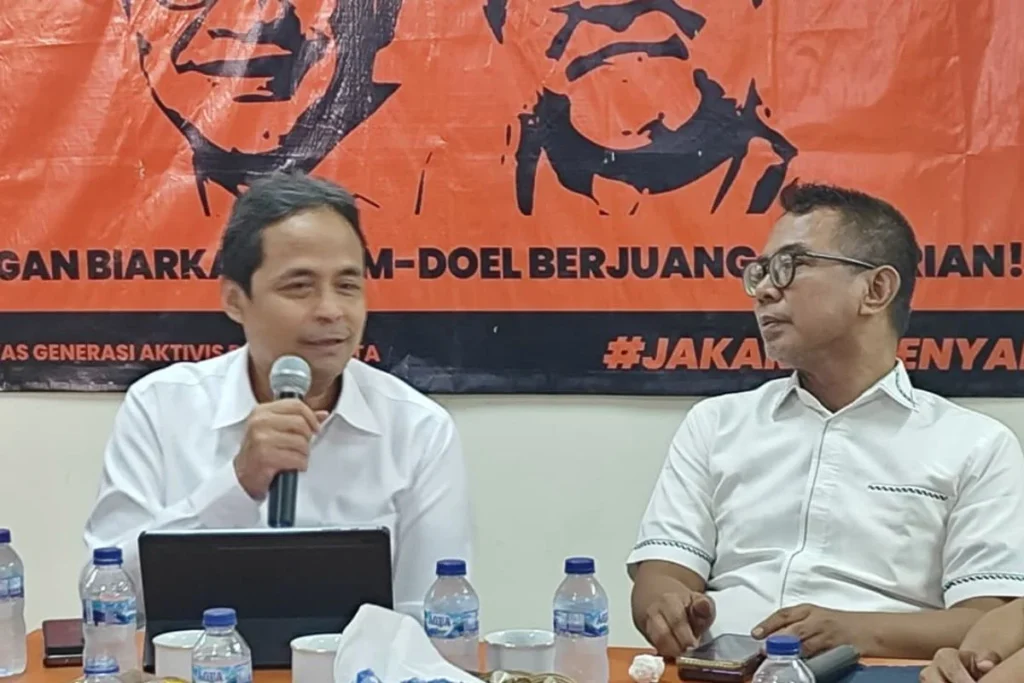
The latest milestone in this ongoing strategic rollout took place on a Thursday in Jakarta. President Director Agus H. Widodo participated in an intensive public policy and economic dialogue hosted by the Lintas Generasi Aktivis (LIGA) Pro Jakarta. Held at the historic Gedung Gondangdia Lama 25 in Cikini, Central Jakarta, the forum served as an intellectual testing ground for the bank’s policies.
During the session, executive leadership presented the bank’s governance roadmap to community activists, youth leaders, and economic observers. The dialogue provided a collaborative platform for external stakeholders to offer constructive critiques and policy suggestions, reinforcing the bank’s commitment to public transparency and community-driven development.
Supporting Data and Institutional Context
To fully understand the weight of Bank Jakarta’s current trajectory, one must examine the quantitative and structural data underpinning its operations.
The Scale of Operations
With a customer base hovering around four million accounts, Bank Jakarta occupies a crucial position in the regional financial architecture. Managing a portfolio of this magnitude requires a resilient technological and administrative backbone. As financial inclusion initiatives drive more citizens into the formal banking system—echoed by recent regional financial milestones such as the OJK’s FinFest 2026, which successfully catalyzed thousands of new account openings—the pressure on institutional infrastructure intensifies. Bank Jakarta’s governance reforms are specifically timed to absorb this influx without compromising service quality or risk thresholds.
The Five Pillars in Action
Bank Jakarta operationalizes GCG through a strict adherence to international and domestic regulatory benchmarks:
- Transparency: Ensuring stakeholders, regulators, and customers have open access to material information regarding financial performance, risk profiles, and corporate policies.
- Accountability: Clearly delineating the roles, responsibilities, and performance metrics of the board of directors, commissioners, and operational staff.
- Responsibility: Aligning bank operations with broader regulatory frameworks, environmental standards, and societal obligations.
- Integrity: Cultivating an ethical corporate culture with zero tolerance for fraud, corruption, or regulatory arbitrage.
- Fairness: Guaranteeing equitable treatment for all stakeholders, including minority shareholders, depositors, and small-scale borrowers.
Synergies with Public and Private Entities
In tandem with internal governance upgrades, Bank Jakarta has actively pursued external synergies. Recent strategic agreements forged with various Regional-Owned Enterprises (BUMDs) and State-Owned Enterprises (BUMNs) have allowed the bank to embed itself deeper into Jakarta’s municipal projects, infrastructural financing, and public payment ecosystems. These partnerships provide a steady, reliable institutional revenue stream that cushions the bank against retail market volatility.
Official Responses and Stakeholder Perspectives
The strategic roadmap laid out by Bank Jakarta has drawn positive evaluations from both internal leadership and external civic organizations.
The Bank’s Perspective: Trust as the Ultimate Asset
Elaborating on the philosophy guiding the institution, President Director Agus H. Widodo emphasized that no amount of capital injection or marketing can substitute for institutional credibility.
"The banking business is a business of trust. For this bank to be trusted, governance has become a mandatory requirement, and that is something we are continuously building," Agus stated firmly during the Cikini forum.
He further elaborated on the mechanics of this trust-building exercise, noting that the overhaul spans multiple administrative layers.
"This effort is necessary to ensure that the bank’s operations run healthily, accountably, and transparently," Agus explained, speaking to the gathering of activists and media representatives.
Addressing the foundational framework, he reiterated, "There are five core principles that form the basis of corporate governance implementation: transparency, accountability, responsibility, integrity, and fairness."
Shifting focus to the real economy, Agus detailed the rationale behind the bank’s physical and operational expansion into community-level commercial zones:
"This strategy is implemented so that financing and banking services can reach business actors more effectively, according to the characteristics and needs of each segment. The development of micro-centers is a major focus because micro-business actors require access to services that are close to their business locations and markets."
Concluding his remarks, Agus extended his gratitude to the civil society representatives in attendance:
"We deeply appreciate and thank LIGA Pro Jakarta for organizing this discussion and providing constructive input for the betterment and progress of Bank Jakarta."
The Civic Perspective: Endorsement from LIGA Pro Jakarta
The leadership of LIGA Pro Jakarta responded enthusiastically to the bank’s briefing. Syafti Hidayat, widely known as Ucok and serving as the Presidium of LIGA Pro Jakarta, praised the proactive leadership style demonstrated by Agus H. Widodo.
"We greatly appreciate the innovations and breakthroughs made by Bank Jakarta under the leadership of Agus H. Widodo," Ucok remarked following the discussion.
Expressing an ambitious vision for the regional institution, he added:
"Hopefully, Bank Jakarta’s services can continue to be enhanced and eventually surpass both Himbara (state-owned banks) and private commercial banks."
Implications for Jakarta’s Financial Ecosystem and Future Outlook
The comprehensive repositioning of Bank Jakarta carries profound implications for the socio-economic fabric of the capital city. As Jakarta transitions through various phases of urban development and economic decentralization, the availability of accessible, reliable, and localized financial services becomes an indispensable public good.
1. Strengthening the MSME Backbone
MSMEs have historically formed the shock absorber of the Indonesian economy, providing localized employment and driving domestic consumption. However, these entities frequently encounter structural barriers when seeking institutional credit—ranging from stringent collateral requirements to a lack of formal financial history.
By decentralizing its operations through micro-centers, Bank Jakarta is effectively bridging this gap. Bringing loan officers, micro-credit facilities, and advisory services directly to traditional markets and commercial districts reduces transaction costs for small business owners. This localized integration not only accelerates loan disbursement but also fosters financial literacy among micro-entrepreneurs, pulling a larger segment of the informal economy into the formal financial grid.
2. Mitigating Systemic Risk Through GCG
In an era marked by heightened macroeconomic uncertainty and tightening regulatory scrutiny from bodies like the Financial Services Authority (OJK), banking institutions cannot afford structural laxity. By rigorously enforcing the five principles of GCG—specifically transparency and accountability—Bank Jakarta is insulating itself against potential liquidity shocks, non-performing loan (NPL) spikes, and operational misconduct. A well-governed bank is inherently more resilient, capable of weathering economic downturns while safeguarding depositors’ capital.
3. Fostering Competitive Pressure in the Regional Banking Space
The endorsement from civic groups like LIGA Pro Jakarta—highlighting a desire for the bank to rival major state-owned institutions (Himbara) and private banking giants—signals shifting public expectations. Regional development banks (Bank Pembangunan Daerah or BPD) are increasingly expected to shed their legacy image of bureaucratic sluggishness and adopt the agility of modern fintech-driven financial institutions. If Bank Jakarta successfully executes its governance and MSME-expansion strategy, it sets a formidable benchmark for other regional lenders across the archipelago.
Conclusion
Bank Jakarta’s current trajectory illustrates a mature understanding of modern banking realities. By fusing unyielding corporate governance with grassroots financial inclusion, the institution is securing its foundational integrity while actively participating in the economic upliftment of the capital city. As it navigates its relationship with its four million customers and broadens its footprint among small business owners, Bank Jakarta is positioning itself not just as a regional financial custodian, but as a proactive engine of equitable urban prosperity.