Indonesia Jadi Pendiri Organisasi AI Dunia, Wamenkomdigi Angga Ungkap Manfaatnya
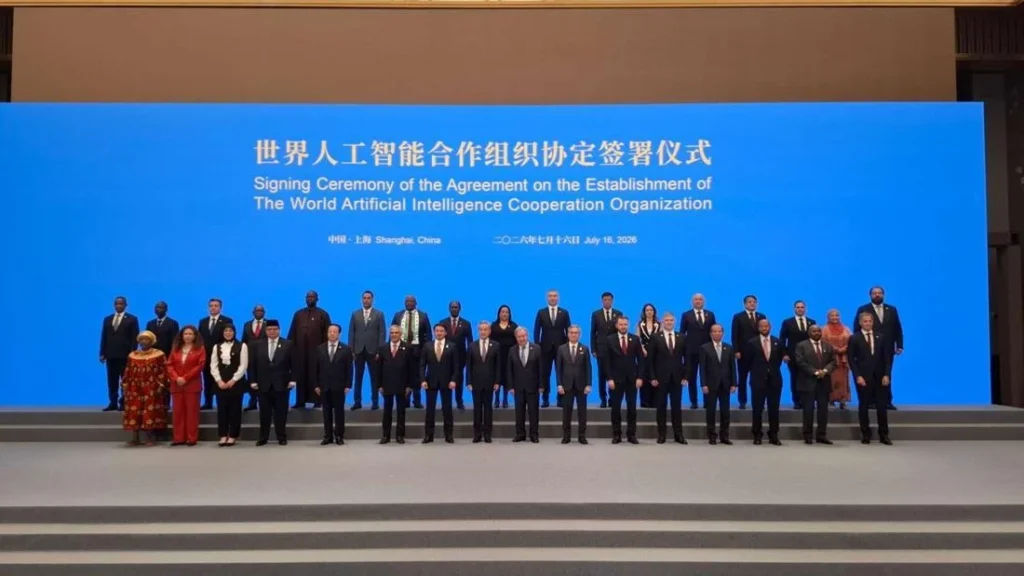
The formalization of Indonesia’s membership took place during a high-profile signing ceremony in Shanghai, China, on July 16, 2026. The Indonesian delegation was led by the Coordinating Minister for Economic Affairs, Airlangga Hartarto, accompanied by the Vice Minister of Communication and Digital, Angga Raka Prabowo. The event was further elevated by the presence of United Nations Secretary-General António Guterres, underscoring the organization’s pivotal role in the future of international diplomacy and technological standards.
I. Main Facts: A New Era for Global AI Governance
The establishment of WAICO marks a departure from fragmented, nation-specific AI regulations toward a more unified, multilateral approach. As one of the 29 founding members, Indonesia has secured a seat at the table where the future rules of the digital age will be written.
The Nature of WAICO
WAICO is structured as an independent, non-profit, intergovernmental organization. While it operates under the UN framework, it maintains the agility necessary to keep pace with the rapid evolution of machine learning and generative technologies. Its primary mandate is to ensure that AI innovation is not a "winner-takes-all" race but an inclusive endeavor that benefits all nations, particularly those in the Global South.
Indonesia’s Strategic Positioning
By becoming a founding member, Indonesia is no longer merely a consumer of foreign technology. The nation is now positioned as a proactive architect of global AI ethics and standards. This move is seen as a fulfillment of Indonesia’s "Golden Indonesia 2045" vision, which emphasizes digital sovereignty and high-value economic growth.
II. Chronology: The Road to Shanghai
The establishment of WAICO was the result of years of diplomatic negotiations aimed at bridging the "AI Divide" between technologically advanced nations and emerging economies.
July 16, 2026: The Signing Ceremony
The official founding ceremony took place in Shanghai, a city that has become a global hub for AI research. Minister Airlangga Hartarto signed the founding documents on behalf of the Republic of Indonesia. The ceremony was attended by representatives from 28 other nations, ranging from industrial powerhouses to rapidly developing African and Latin American states. Secretary-General António Guterres delivered a keynote address, emphasizing that "AI must be a force for good, governed by the people, for the people."
July 17, 2026: The Informal Preparatory Session
Following the signing, the focus shifted to the operationalization of the organization. Vice Minister of Communication and Digital, Angga Raka Prabowo, chaired the Indonesian delegation during the Informal Preparatory Session on the Establishment of WAICO. This session served as the first working meeting to discuss the organizational structure, the location of regional offices, and the immediate priorities for the 2026–2027 term.
July 18, 2026: Public Announcement and Press Release
By Saturday, the Indonesian government released official statements to the domestic and international press, outlining the strategic objectives achieved during the Shanghai summit and the expected timeline for the first General Assembly of WAICO.
III. Supporting Data: Membership and Organizational Mandate
WAICO’s strength lies in its diverse membership, which represents a significant portion of the world’s population and emerging markets.
The 29 Founding Members
The coalition is a diverse mix of nations, primarily representing the Global South and emerging economies, which seek to ensure that AI development is not monopolized by a few private entities or a handful of Western nations. The founding members include:
- Asia: Indonesia, China, Malaysia, Pakistan, Kazakhstan, Uzbekistan.
- Americas: Brazil, Venezuela.
- Eurasia: Russia, Serbia.
- Africa: South Africa, Kenya, Ethiopia, Zambia.
- And 15 other developing nations committed to digital inclusivity.
Core Pillars of Cooperation
The WAICO charter outlines four primary areas of focus:
- Capacity Building: Facilitating the transfer of knowledge and training for human resources to ensure that the workforce in developing nations can compete in an AI-driven economy.
- Technology Access: Expanding access to high-performance computing (HPC) and AI models for research institutions in member states.
- Governance and Ethics: Developing a unified international framework for AI ethics to prevent the misuse of technology in ways that violate human rights or national sovereignty.
- Strategic Coordination: Aligning national AI strategies to prevent market fragmentation and promote cross-border investment.
IV. Official Responses: National Pride and Strategic Intent
The Indonesian government has characterized this membership as a "momentum-defining" event for the nation’s digital future.
Vice Minister Angga Raka Prabowo
Speaking from Shanghai, Vice Minister Angga Raka Prabowo emphasized that the move is about protection as much as it is about progress.
"Indonesia’s participation in WAICO is a strategic momentum to strengthen our national AI governance. We must ensure our domestic policies are aligned with international best practices. Simultaneously, this opens a massive space for cross-border collaboration, ensuring that the development of the AI ecosystem remains inclusive and responsible," said Angga in a statement released on July 18.
Minister Airlangga Hartarto
Minister Airlangga Hartarto noted that the economic implications are the primary driver. He highlighted that AI is expected to be a "new source of economic growth." By joining WAICO, Indonesia gains early access to investment flows and R&D partnerships that would otherwise be difficult to secure through bilateral channels alone.
The Role of the Ministry of Communication and Digital
The rebranding of the ministry (formerly Communication and Information) to include "Digital" reflects the government’s focus. The ministry plans to use the WAICO framework to accelerate the "Digital Transformation Roadmap," focusing on local startups and integrating AI into public services.
V. Implications: What This Means for Indonesia’s Future
The decision to join WAICO is not merely a diplomatic gesture; it has profound implications for Indonesia’s economy, security, and social fabric.
1. Economic Transformation and Investment
Indonesia aims to transition from a commodity-based economy to one driven by technology and high-value services. WAICO will serve as a catalyst for:
- Attracting Foreign Direct Investment (FDI): Global tech firms are more likely to invest in a country that adheres to recognized international AI standards.
- Boosting the Startup Ecosystem: Indonesian AI startups will gain easier access to international markets and collaborative research opportunities with other WAICO member states.
2. Human Capital Development
One of Indonesia’s greatest challenges is the digital talent gap. Through WAICO’s capacity-building programs, Indonesia can leverage global expertise to train thousands of engineers, data scientists, and ethicists. This is crucial for ensuring that the "Demographic Bonus" of the 2030s does not become a liability due to technological unemployment.
3. Strengthening Sovereignty and Ethics
As AI becomes integrated into critical infrastructure—from power grids to financial systems—national security becomes synonymous with algorithmic security. WAICO provides a forum for Indonesia to advocate for "Data Sovereignty," ensuring that the data generated by Indonesian citizens is used ethically and that the benefits of that data remain within the country.
4. Influence in the Global South
By leading within WAICO, Indonesia cements its role as a leader of the Global South. Alongside countries like Brazil and South Africa, Indonesia can push for a "Third Way" in AI governance—one that avoids the extremes of total state control or unregulated corporate dominance.
5. Accelerating Public Service Efficiency
The government intends to utilize AI to streamline bureaucracy. With WAICO’s guidance on "AI for Public Good," Indonesia can implement smarter healthcare diagnostics, precision agriculture for food security, and more efficient urban planning in the new capital, Nusantara (IKN).
Conclusion
Indonesia’s entry into the World Artificial Intelligence Cooperation Organization is a bold statement of intent. It signals that the world’s fourth-most populous nation is ready to lead in the digital age. By collaborating with 28 other founding members under the UN’s watchful eye, Indonesia is ensuring that the AI revolution is not something that simply "happens" to it, but something it helps to shape.
As the delegation returns from Shanghai, the focus now shifts to domestic implementation. The success of this venture will depend on how effectively the government can translate these international agreements into tangible benefits for its 280 million citizens, ensuring that the "Intelligence" in Artificial Intelligence is matched by the "Wisdom" of national policy.