The Weight of Privilege: Ethics, Labor, and Spiritual Tourism at India’s Girnar Mountain
Introduction: A Viral Snapshot of Inequality
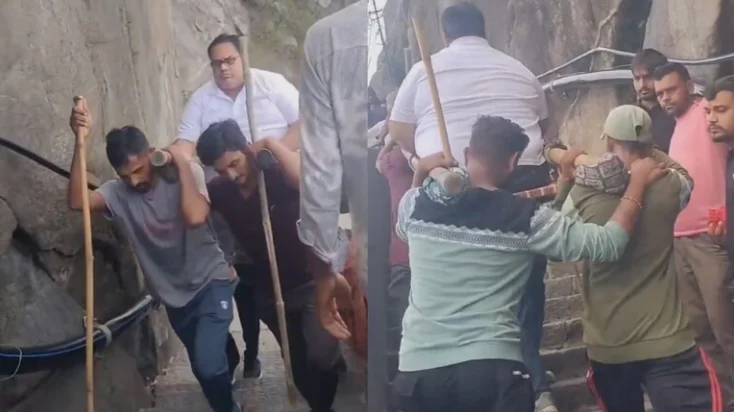
A brief, haunting video clip circulating on the social media platform X (formerly Twitter) has ignited a fierce, international debate regarding the intersection of spiritual pilgrimage, economic privilege, and the ethics of labor. The footage, shared by user Daniel Mayakovski, captures a scene that has become increasingly common yet deeply contentious in the sacred landscapes of India: a wealthy tourist, seemingly fit and able-bodied, being carried up the grueling, jagged steps of Mount Girnar by four local porters.
The video shows the men navigating the steep stone staircase—a route notorious for its vertical incline—using wooden poles for balance while carrying the traveler in a traditional palki (litter). As the footage went viral, it sparked an immediate backlash, with critics labeling the act a grotesque display of late-stage capitalism. The debate centers on a provocative question: Has the sanctity of pilgrimage been eroded by the ability of the wealthy to outsource physical suffering to the marginalized?
The Geography of the Sacred: Mount Girnar
Mount Girnar, located in the Junagadh district of Gujarat, is far more than a hiking destination; it is a spiritual epicenter of immense historical and religious significance. Rising 1,031 meters above sea level, it stands as the highest point in the entire state of Gujarat.
For the Jain community, Girnar is a place of profound holiness, believed to be the site where Neminatha, the 22nd Tirthankara, attained Kevala Jnana (omniscience). Simultaneously, the mountain is revered by Hindus, housing temples dedicated to Amba Mata, Mahakali, and the sacred Dattatreya Peak. The mountain’s base serves as a historical gateway, featuring the rock edicts of Emperor Ashoka dating back to the 3rd century BCE, which preach the moral tenets of ahimsa (non-violence). Furthermore, the surrounding forests form the last natural stronghold for the endangered Asiatic Lion (Panthera leo persica).
Chronology of the Controversy
The incident, which gained traction in late July 2026, serves as a flashpoint for long-standing tensions at Indian pilgrimage sites.
- The Ascent: The journey to Dattatreya Peak involves navigating over 10,000 stone steps. It is widely considered one of the most physically demanding pilgrimages in India.
- The Viral Spark: When Mayakovski uploaded the clip, the juxtaposition of the sedentary passenger and the laboring porters struck a nerve. The caption explicitly framed the act as an exploitation of local labor, where the wealthy purchase convenience at the cost of the physical dignity of others.
- Public Outcry: Within hours, the comment sections of social media platforms were flooded with moral outrage. The debate quickly pivoted from the specific incident to the broader moral implications of using palki services for leisure rather than necessity.
- The Societal Pushback: As the debate grew, defenders of the porters emerged, arguing that the service provides essential income in a region with limited economic opportunities, setting the stage for a complex socio-economic discourse.
Supporting Data: The Palki Industry and Economic Reality
To understand the nuance of this controversy, one must distinguish between the intent of the palki service and its application.
Historically, the use of porters at sites like Girnar, Vaishno Devi, and Kedarnath was intended as an act of accessibility. It was a lifeline for the elderly, the differently-abled, and those with severe health conditions who would otherwise be unable to fulfill their spiritual vows. The service is a lifeline in the local economy, where many families in the Junagadh district rely on the tourist season to sustain themselves throughout the year.
However, recent trends indicate a shift. An increasing number of young, healthy tourists are opting for the palki service simply to avoid the fatigue of the climb. This "commodification of comfort" is what critics find most egregious. When physical exertion—a traditional component of the pilgrimage experience meant to symbolize humility and devotion—is treated as a burden to be offloaded, the spiritual nature of the journey is arguably compromised.
Official and Stakeholder Perspectives
While there has been no formal government ban on the service, the situation at Girnar mirrors the ongoing protests at Kedarnath. In Kedarnath, local porters have staged demonstrations against the proposed construction of a ropeway, fearing that mechanical alternatives will destroy their livelihoods.
These incidents highlight a precarious balance. If authorities restrict the use of porters to only those with medical certificates, they risk alienating a workforce that relies on the "leisure" market to survive. Conversely, allowing the current trend to continue unchecked invites social resentment and moral decay in the eyes of the public.
Ethical Implications: The Moral Divide
The social media discourse surrounding the viral video has been polarized, reflecting a deep divide in how society views labor and merit:
- The "Privilege" Argument: Critics argue that if one needs to be carried to reach a deity, the sincerity of the pilgrimage is questionable. Some users remarked, "If you need four men to carry you to reach God, you might as well pray from the comfort of your own home." This perspective posits that the struggle of the climb is the prayer itself.
- The "Livelihood" Defense: Conversely, many netizens have stepped up to defend the porters. They argue that the porters are skilled professionals who take pride in their strength and the income they generate. For them, the tourist’s laziness is irrelevant; the economic transaction is the priority.
- The "Inequality" Lens: Sociologists point to the incident as a microcosm of the global wealth gap. In this view, the palki is a modern iteration of historical systems where the elite have always sought to minimize their physical labor by leveraging the desperation or the labor-power of the working class.
The Future of Pilgrimage Tourism
The incident at Girnar serves as a mirror held up to contemporary India. As the country’s middle and upper classes grow, the "experience" of traditional rituals is being reshaped by the power of the wallet.
The core conflict is not necessarily the existence of the porters, but the devaluation of their labor. When a service designed for the vulnerable is consumed by the able-bodied, it shifts from being an act of social support to an act of consumer entitlement.
Moving forward, the challenge for tourism boards and spiritual authorities is to establish guidelines that protect the dignity of the porters while maintaining the sanctity of the pilgrimage. Should there be a tiered system? Should "leisure" portering be taxed or regulated? Should the focus return to the physical requirement of the pilgrimage to maintain its spiritual integrity?
Conclusion: A Complex Realism
The viral video of Mount Girnar is more than just a momentary social media sensation; it is a snapshot of a complex socio-economic transition. It highlights the tension between a traditional, labor-intensive economy and a modern, convenience-driven consumer culture.
Ultimately, the debate forces us to confront the "price" of our experiences. Whether one views the porter as a victim of exploitation or a provider of a necessary service, the sight of a human being carrying another up a sacred mountain remains a powerful, uncomfortable symbol. As long as the divide between the wealthy and the working class persists, the steps of Mount Girnar will continue to be a battlefield where spiritual values and economic realities collide.
The legacy of the palki carriers—the men who bear the weight of both the tourist and the socio-economic pressures of the state—remains a testament to the resilience of the local community. However, as society evolves, the question of whether this form of "human-powered transport" belongs in a modern, equitable world remains an unanswered, albeit vital, query.
As the debate continues, the pilgrims of Girnar continue their climb—some with their own feet, some on the shoulders of others—each step a quiet testament to the shifting moral landscape of the 21st century.